BABYMONSTER's 'HOT SAUCE' Brings 80s Hip-Hop to K-Pop's Busiest Summer in Years
 By Jang Hojin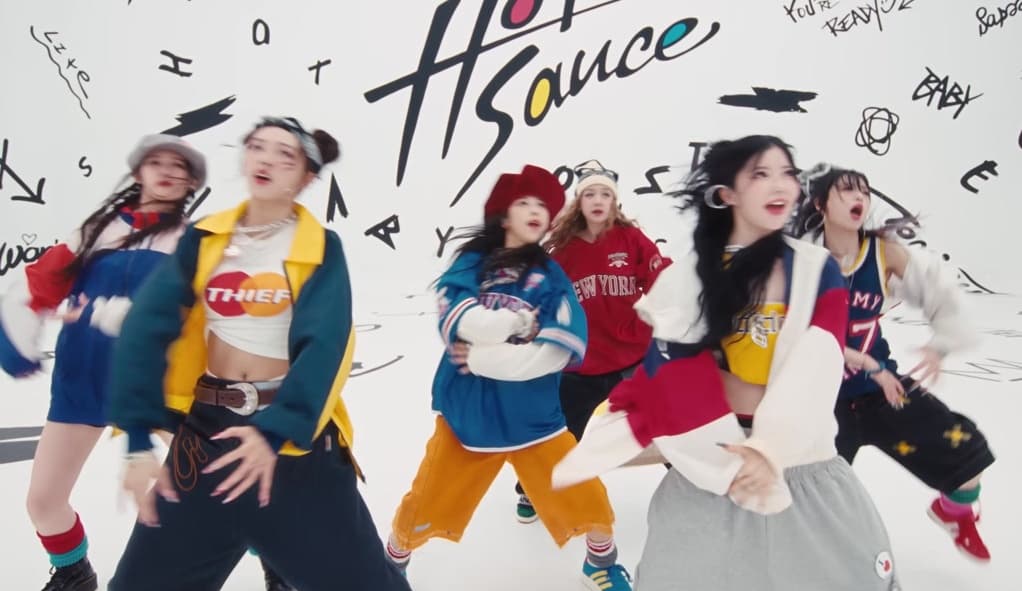
BABYMONSTER released 'HOT SAUCE' on July 1, 2025, their first English-language special summer single, bringing an 80s old-school hip-hop concept to a debut streaming chart position of 521,719 Spotify streams. The release came as the opening move in a July 2025 K-pop calendar that would prove one of the most densely packed comeback months in recent memory, with BABYMONSTER arriving at the gate ten days ahead of a double-header that would reshape the summer's chart conversation.
'HOT SAUCE' was performed by six members — Ruka, Pharita, Asa, Ahyeon, Rora, and Chiquita — with Rami continuing her medical hiatus. The six-member configuration had become the operational norm for the group's promotional activities in 2025, and the single's production was built around the specific sonic and visual identity the group could deliver at that configuration rather than treating the absence as a constraint to work around. The result is a track designed for full-group choreography efficiency rather than the spotlight rotation that a seven-member lineup would typically require.
The Seo Taiji Homage and What It Signals About BABYMONSTER's Concept Evolution
The most discussed element of 'HOT SAUCE' before its release was its logo design: the song's promotional typography lifted directly from Seo Taiji and Boys' 1992 debut album font. The homage was specific enough to require industry knowledge to catch and broad enough to function as a cultural signal to those who recognized it. Seo Taiji and Boys' 1992 debut is one of the most significant release events in Korean popular music history — the moment that is conventionally dated as the origin point of the modern Korean pop industry structure — and their font appearing on a 2025 BABYMONSTER single connected the group's retro concept to a lineage with genuine historical weight rather than a generic vintage aesthetic.
The sound carried the same intent. The track combines synth bass and brass in a configuration designed to evoke late-1980s American hip-hop production without reproducing it wholesale. The key creative decision was the hook structure: the lyrics compare bold, confident self-assertion to various types of spicy food — a lyrical metaphor that translates across language markets without requiring cultural context that non-Korean listeners wouldn't carry. The addictive hook over retro production is a formula that YG has deployed across multiple acts, but 'HOT SAUCE' applied it in a direction — specifically, hip-hop rather than dance-pop — that gave BABYMONSTER a sonic positioning distinct from their recent work.
YG's H2 Master Plan and Where 'HOT SAUCE' Fits
The 'HOT SAUCE' release arrived as the first consumer-facing product of a YG master plan that Yang Hyun-suk had announced publicly in late May 2025. That roadmap committed the label to a densely scheduled H2 activity calendar across BABYMONSTER, BLACKPINK, and TREASURE simultaneously — a structural ambition that was notable given the label's historical preference for spacing major releases to avoid internal competition. The summer single for BABYMONSTER, arriving July 1, was designed to establish the group's momentum before the larger July 11 releases landed.
The positioning logic was straightforward. BABYMONSTER, at their stage of commercial development, benefits most from continuous promotional windows rather than isolated event releases. A summer single that gives the group an active digital footprint through July — feeding streaming algorithms, sustaining social media visibility, maintaining broadcast performance activity — creates a more favorable environment for their subsequent full-album cycle than a gap would. 'HOT SAUCE' is not designed to be their biggest commercial moment of 2025; it is designed to keep BABYMONSTER's name in active conversation during a summer dominated by their YG labelmates' more anticipated returns.
The 80s Revival Logic in K-Pop's Summer Cycle
BABYMONSTER's choice of 80s hip-hop as the 'HOT SAUCE' conceptual anchor fits a broader pattern in K-pop's relationship with American popular music history. The 80s retro wave that had been building across K-pop production since the early 2020s — manifesting in specific artists across multiple generations — had by mid-2025 developed enough critical mass to function as a recognized aesthetic category rather than a novelty gesture. Groups that arrived at the retro concept after the wave had already established itself were navigating a more crowded field than the early adopters had, but they were also entering a market where the aesthetic's vocabulary had been fully decoded by Korean audiences who now understood what the references were and why they worked.
The Seo Taiji connection added a specifically Korean dimension to what might otherwise have been read as a Western throwback exercise. By connecting the 1980s American hip-hop sound to the 1992 Korean pop revolution through a font choice — and by doing so in a way that required Korean pop history knowledge to fully appreciate — 'HOT SAUCE' argued for a genealogy of the retro concept that ran through Korean music history rather than only through its American sources. Whether that argument reached beyond the segment of the audience already equipped with that history is the question the track's streaming trajectory through July will begin to answer. What the debut streams suggested, at least, was that the opening audience had heard the single and found it worth returning to.
The broader significance of the Seo Taiji reference extends beyond the individual track. By invoking that lineage at a moment when YG was publicly positioning BABYMONSTER as the standard-bearers for the next phase of the label's creative identity, the single made an implicit argument about continuity and inheritance: that BABYMONSTER's sonic ambitions are rooted in the same tradition that built the infrastructure they are now operating within.
How do you feel about this article?
저작권자 © KEnterHub 무단전재 및 재배포 금지
Entertainment Journalist · KEnterHub
Entertainment journalist specializing in K-Pop, K-Drama, and Korean celebrity news. Covers artist comebacks, drama premieres, award shows, and fan culture with in-depth reporting and analysis.
Comments
Please log in to comment