DAY6 Just Proved K-Pop's Biggest Myth Wrong — And It Took 10 Years
How K-pop's reluctant rock band became the first Korean group to headline Goyang Stadium — and what their decade means for the industry
 By Park Chulwon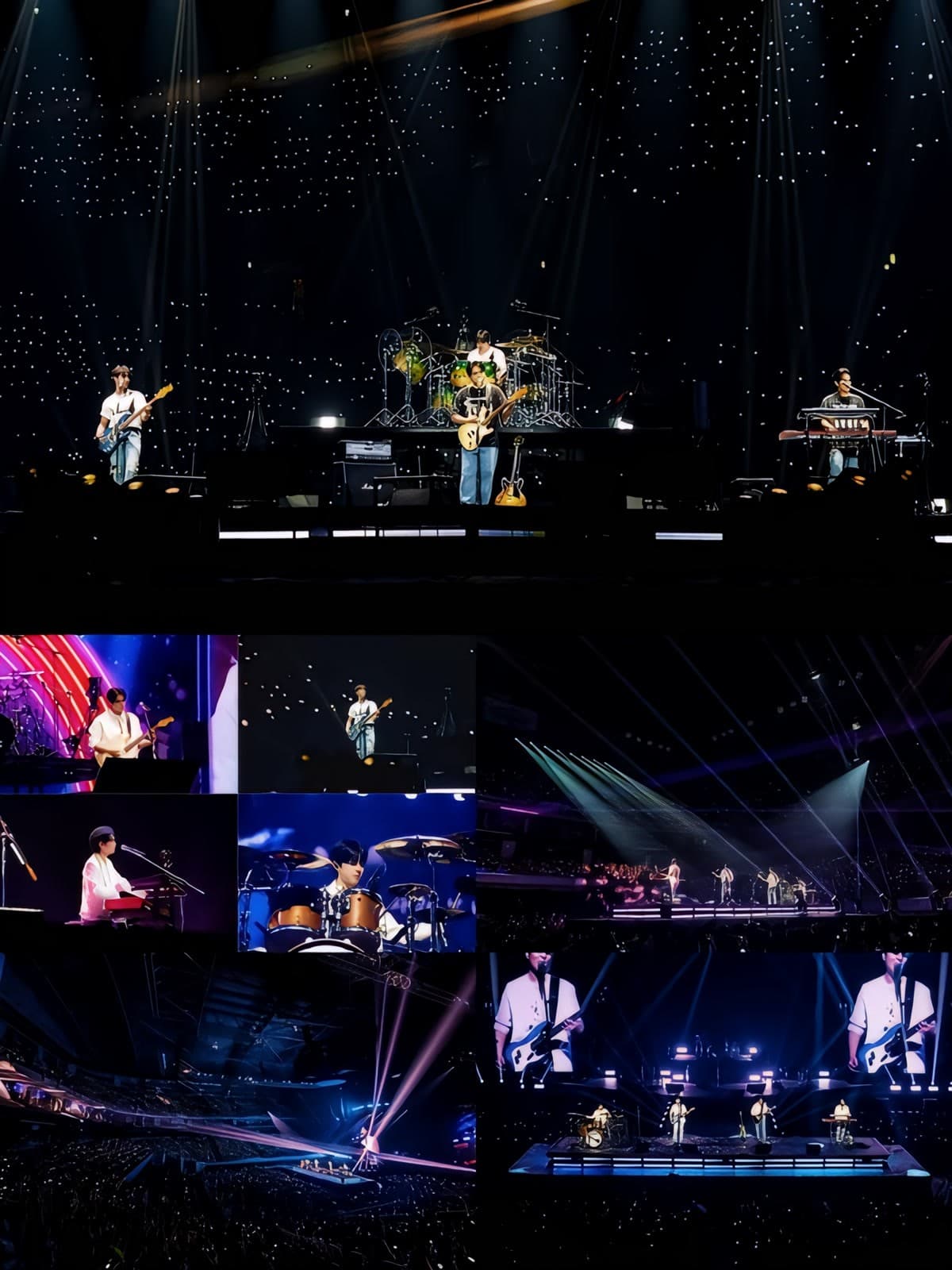
On September 7, 2025, DAY6 celebrated the tenth anniversary of their debut. In K-pop, ten years is an achievement. For a rock band that spent those years fighting the industry's basic assumptions about what Korean popular music is supposed to be, ten years is something closer to a manifesto confirmed.
Two days earlier, they had released The DECADE — their fourth Korean-language studio album, the first in nearly six years, and a title that served as both anniversary marker and statement of purpose. The album contained ten new songs. Two days after the anniversary, they performed two sold-out shows at Goyang Stadium, becoming the first Korean domestic band to headline that venue since it was opened to international acts. The weekend accomplished, in compressed form, what the preceding decade had been building toward: a demonstration that a rock band, operating within the K-pop industrial structure, could reach the same heights of cultural and commercial scale as any idol group.
The story of how they got there is neither simple nor triumphant at every turn. It includes a period of near-dissolution, a membership departure, individual health crises, mandatory military service, and a long stretch in which the group's commercial trajectory was genuinely uncertain. The fact that The DECADE existed at all was not inevitable. That it was celebrated at Goyang Stadium in front of tens of thousands of fans made the improbability retroactively look like destiny.
The Reluctant K-Pop Band
DAY6 debuted under Studio J, an experimental imprint within JYP Entertainment — a company whose primary commercial identity in 2015 was built around polished idol group production. JYP's roster included GOT7, Miss A, 2PM, and TWICE (who debuted the same month as DAY6). Against that context, a six-piece rock band with instruments was an anomaly by design.
The founding lineup included Sungjin (leader, guitarist, vocalist), Young K (bass, vocals, primary songwriter), Wonpil (keyboards, vocals), Dowoon (drums, backing vocals), and two additional members, Brian and Jae, who contributed guitar and vocals. The initial configuration was unwieldy by idol group standards — too many members for conventional visual positioning, too instrument-dependent for standard choreography-centered promotions.
The group's early commercial trajectory reflected this positioning challenge. Their debut single "Congratulations" attracted genuine attention and established their signature sound — anthemic pop-rock with emotional directness in the lyrics — but the group did not immediately achieve the headline performance of JYP's idol productions. The question of how a live-instrumentation band fit into a K-pop commercial structure designed around vocal performance and synchronized dancing remained unresolved for the first two years of their career.
The answer arrived in 2017 in the form of an experiment unprecedented in K-pop: the "Every DAY6" project, in which the group released two new songs every month for a full year. The project generated 25 tracks over twelve months, including "I Wait," "How Can I Say," "I Smile," and the single that became DAY6's first enduring classic: "You Were Beautiful." The sustained creative output demonstrated both the group's songwriting depth — particularly Young K's compositional range — and a commercial approach that prioritized catalog building over single event marketing.
The Catalog That Survived Its Makers' Absence
The most remarkable chapter in DAY6's decade is not the one they lived through consciously, but the one that happened in their absence. Beginning in 2021, as members entered mandatory military service and Jae departed the group in December of that year, DAY6 as a performing and promotional entity essentially ceased to exist. The four-member core — Sungjin, Young K, Wonpil, Dowoon — had staggered service periods that meant no complete group activity was possible.
During this period, something unusual happened. "You Were Beautiful," released in 2017 and already well-established in Korean streaming catalogs, began appearing consistently in recommendation algorithms and playlist placements. "Time of Our Life," released in 2019, followed a similar trajectory. The songs were discovered, or rediscovered, by listeners who had not been active fans during the original promotional periods — younger Korean audiences who encountered the group through streaming discovery, and international listeners for whom the catalog was arriving fresh.
The streaming revival was quantifiable. Both songs re-entered chart positions years after their release. Fan accounts of encountering DAY6 through algorithm recommendations, then consuming the full catalog, became a documented phenomenon in fan community spaces. The group was building new fans while none of its members were actively promoting.
This pattern — the military hiatus as inadvertent discovery engine — illuminated something about DAY6's music that sustained commercial promotion sometimes obscures: the songs worked independently of their promotional context. The emotional directness and melodic clarity of DAY6's best work was the kind that recommended itself across time and discovery contexts without requiring the amplification of active promotional campaigns. They were, by this measure, a genuinely durable act.
The Departure, the Return, and the Reconstitution
Jae's departure in December 2021, after more than six years, was announced without extensive public explanation and received with mixed response. Some fans expressed disappointment; others accepted the departure as a private matter. The structural consequence was that DAY6 became a four-member group — Sungjin, Young K, Wonpil, Dowoon — whose configuration was now entirely Korean in membership (Jae was a Korean-American member who had been the group's primary English-language interface with international media).
The four-member configuration returned to activity beginning in 2023 as military service obligations were completed, and the reunion generated a level of public attention that the group's pre-hiatus commercial trajectory had not predicted. The streaming revival had expanded the audience. The personal narrative of return — four members reuniting after individual service periods, operating now as a leaner and more structurally stable unit — created an emotional context that gave the comeback commercial and cultural significance beyond what pure promotional mechanics could have manufactured.
By 2024, DAY6 had announced their 10th anniversary plans. The KSPO Dome concerts in May 2025 — which ranked second in Korean live ticket sales for the first half of the year, behind only Coldplay — confirmed that their returned commercial scale was substantial. The Goyang Stadium shows in late August and the full anniversary celebration in September were the culmination of a return arc that had been building since the first post-service activity.
The DECADE: Ten Songs for Ten Years
The DECADE was the fourth Korean-language studio album by DAY6 and their first in nearly six years. The gap made the release consequential beyond normal album-cycle logic: this was not simply the next record in a continuous creative stream, but the statement that followed an extended silence and represented where the band stood after everything the preceding years had contained.
The album's dual title tracks — "Dream Bus" and "Inside Out" — balanced the retrospective and prospective modes that the anniversary context demanded. "Dream Bus" was the more openly nostalgic, a song about the journey traveled and the destination still ahead, structured around a central metaphor of collective transport that served the group-reunion emotional register. "Inside Out" operated with more urgency, a track about transformation and authenticity whose production combined the melodic rock clarity of DAY6's earlier work with a contemporary sound awareness that prevented the album from reading as purely retrospective.
The decision to structure The DECADE around exactly ten new tracks was deliberate — a formal choice that mirrored the anniversary it commemorated. Young K, whose songwriting had been the central creative constant of the group's career, contributed to the compositional work on the album in ways that maintained the characteristic emotional directness that had defined DAY6's catalog across its full range. The lyrical preoccupations — time, memory, belonging, the emotional demands of creative work — were continuous with the group's history rather than departures from it.
The supplementary materials that accompanied the release reinforced the retrospective dimension. The DAY6 10th Anniversary Medley Live, released simultaneously, traced the catalog from debut single "Congratulations" through "Letting Go," "I Smile," "Shoot Me," "Days Gone By," and the anniversary releases — a compressed retrospective that gave both longtime fans and new arrivals a navigable overview of what ten years of DAY6 music contained. The documentary DAY6: Time of Our Decade, premiering September 9, extended the retrospective into personal testimony.
Goyang Stadium: The First Korean Band to Headline
The August 30–31 concerts at Goyang Stadium — held two days before the anniversary rather than on it, to align with weekend scheduling — were the single most symbolically loaded events of the celebration. Goyang Stadium had previously hosted international touring acts, most recently Coldplay, who had performed in Korea earlier in 2025 as part of a global stadium tour. For a Korean domestic act to headline the same venue was an achievement without precedent in Korean band history.
The total capacity across two nights represented approximately 80,000 audience positions — a scale that placed the concerts among the largest attended by any K-pop act that year in Korea, and among the largest ever for a Korean band in any configuration. The physical infrastructure — stadium rock production, lighting rigs, stage construction — was on the scale of international arena touring rather than the more contained concert infrastructure typical of Korean idol productions.
The significance was understood by the industry in terms beyond box office. A Korean domestic rock band selling out a stadium was a proof of concept for a category of music that had existed within K-pop's industrial structure but had rarely achieved the commercial scale that the idol format generated. Every previous year, when analysts discussed the ceiling of what a Korean band could achieve commercially, the answer had involved some implicit comparison to idol groups that set the scale. Goyang Stadium suggested the ceiling was higher than any previous reference point had indicated.
What DAY6 Proved About Rock in K-Pop
The K-pop industry's structural economics have historically worked against live-instrumentation bands in ways that do not apply to vocal-and-dance idol groups. Production costs for touring bands exceed those for choreography-based acts. The training infrastructure — years of instrument practice in addition to vocal and performance training — requires longer development periods. The visual positioning dynamics that generate the individual-member following that drives K-pop's characteristic commercial model are harder to execute when members are partially obscured by instruments during live performance.
DAY6 navigated these structural disadvantages not by circumventing them but by building a commercial model that did not depend on them. Their fan relationship was built around the music first — the specific emotional quality of the songs — and around individual member personalities second, in ways that did not require visual positioning mechanics. Young K's basslines were as recognizable to the fandom as any idol member's distinct vocal timbre. Dowoon's drumming had its own devoted following. The instruments were not barriers to parasocial connection; they were, for this fandom, the medium through which that connection operated.
The JYP contract renewal, announced alongside The DECADE's release, formalized what the commercial performance had confirmed: that DAY6 represented ongoing commercial viability within JYP's portfolio, and that the label's investment in maintaining an active rock band alongside its idol group roster had produced returns that justified continuation. The renewal was described as emerging from a foundation of accumulated trust — which, in context, meant that ten years of commercial and creative collaboration had produced the kind of relationship that could sustain continued partnership without requiring renegotiation from a position of uncertainty.
Verdict: A Decade That Proved the Exception Could Become the Rule
When DAY6 debuted in September 2015, they were an exception within K-pop — a rock band in an idol ecosystem, an instrument-based group in a choreography-centered industry, a commercial proposition that the prevailing structures did not obviously support. Ten years later, they were the proof of a different proposition: that exceptions, sustained and developed with sufficient quality and commercial discipline, can eventually redefine the possible rather than simply occupying the margins of it.
The DECADE was not a valedictory album. The title and the content both made clear that the band understood their tenth anniversary as a threshold rather than a conclusion. The streaming revival during the military hiatus had shown them that their catalog could generate new fans without active promotion. The Goyang Stadium shows had demonstrated the live commercial ceiling they could reach. The JYP contract renewal had secured the institutional support for what comes next.
What comes next, for a band that spent a decade proving K-pop's basic assumptions about rock music wrong, is presumably more of the same: music made with the specificity and emotional intelligence that has characterized their best work, delivered at the scale that their decade of audience-building now supports. For the fans who have been there since "Congratulations," and for the ones who found their way in through "You Were Beautiful" on a streaming algorithm recommendation in 2022, the next decade's starting point is a stadium and a contract renewal. Not a bad foundation for an exception that became a rule.
The Numbers That Built the Legacy: Streaming Milestones
The Goyang Stadium concerts did not emerge from nowhere. They were the culmination of a catalog whose commercial longevity had been building in the background — through military hiatuses, lineup changes, and years without coordinated promotional activity — in ways that most K-pop acts never achieve.
The clearest measure of that longevity was "You Were Beautiful." Released in 2017 as part of the Every DAY6 project, the song crossed 100 million Spotify streams on February 22, 2024 — nearly seven years after its release date. No other DAY6 song had reached that threshold before it. The milestone was remarkable not because the number was large by current streaming standards, but because of the timeline: a song from 2017 reaching its first streaming landmark in 2024, after the group had been largely inactive for three years, was evidence of sustained discovery rather than promotional push.
The Melon data told a similar story. DAY6 passed one billion total Melon streams — earning membership in Melon's internal "Billions Club" — and accumulated 340 million Melon streams in 2024 alone, the year before The DECADE's release. On the 2025 Melon Yearly Chart, "You Were Beautiful" ranked at number 25, still charting strongly despite being eight years old. "Time of Our Life" held at number 23. "Welcome to the Show," released in 2024, sat at number 35. By early January 2026, multiple DAY6 songs remained in the Melon Top 100 — a catalog density that almost no K-pop act sustained across multiple years without continuous active promotion.
The DECADE album extended these numbers at a pace that reflected the audience growth during the hiatus. First-day Hanteo sales reached approximately 90,000 copies — more than double DAY6's previous single-day record of around 40,000. All ten tracks entered the Melon Top 100 on release day. The Melon Spotlight event accompanying the release, which included a video call for twelve lucky users, generated additional algorithmic exposure that kept the album in chart positions for over a week after release.
What the Setlist Said: Thirty Songs, Ten Years
The August 30–31 concerts at Goyang Stadium were structured as catalog retrospectives rather than conventional album-cycle performances. The setlist across both nights spanned more than thirty songs drawn from every phase of DAY6's decade — a programming decision that reflected both the anniversary context and the group's unusual relationship with their own catalog.
The opening sequence set the tone: "Time of Our Life," "Melt Down," and "HAPPY" moving rapidly from recent material into the deeper archive. Songs from the Every DAY6 project — "I Smile," "You Were Beautiful," "Letting Go" — appeared mid-set, positioned as catalog centerpieces rather than nostalgic detours. "Congratulations," the 2015 debut single, emerged in the later portion of the evening, turned from origin point into culmination. The two title tracks from The DECADE — "Dream Bus" and "INSIDE OUT" — appeared as the performance's present-tense statement, surrounded by the decade that preceded them.
The second night was live-streamed globally via Beyond LIVE, extending the audience for a concert that had sold its physical seats weeks in advance. Wonpil, reflecting on the experience, said: "I always dreamed of an outdoor concert, and now we're performing at Goyang. I'm so thankful — it's overwhelming." Young K, who had attended Coldplay's Goyang concert as an audience member in April 2025 — reportedly shedding tears from the stands — was on the same stage four months later. The symmetry was not lost on anyone who had tracked both events.
The Critics on The DECADE: What the Reviews Said
Critical response to The DECADE was broadly positive, with particular attention paid to the album's tonal range and the willingness to depart from DAY6's established sound in specific directions. The album's 92/100 user-critic score on aggregate review platforms was accompanied by individual reviews that identified what the collection achieved.
"INSIDE OUT" was the most consistently praised track. KPOPReviewed scored it 9/10, describing it as "tickling the DAY6 nostalgia" while bringing a fresh groovy chorus that worked independently of its anniversary context. Hallyureviews called it "probably my favourite DAY6 title track in recent years — it's just so incredibly charming in its approach." The track's combination of melodic rock clarity with contemporary production sensibility — avoiding both pure nostalgia and jarring modernization — was cited as evidence of a group that had absorbed a decade of musical development without losing their recognizable identity.
"Disco Day" generated particular critical interest as the album's most stylistic departure. Reviewers described it as "legitimate disco — the most pleasant surprise on the album," noting that the genre shift was executed with enough conviction to function as a standalone track rather than an anniversary-themed experiment. "My Way" was identified as channeling classic 2000s pop-rock energy with a directness that recalled DAY6's earlier work. "Before The Stars" and "Our Season" were praised as the album's emotional anchors — ballads that carried the weight of the decade's accumulated material without straining for artificial profundity.
The Honey POP's assessment framed the album's achievement succinctly: it "feels like the intersection between the celebrated early era of DAY6 and the award-winning form of modern DAY6." For a tenth anniversary record, that intersection was the point — not a replication of what the group had been, but a demonstration of what they had become after building on what they were. Music Business Worldwide noted DAY6 as evidence that "the K-band genre has genuine commercial scale," while the Korea Times ran the headline "Rock group DAY6 transforms K-pop band landscape" — a characterization that the Goyang Stadium numbers had made difficult to contest.
How do you feel about this article?
저작권자 © KEnterHub 무단전재 및 재배포 금지
Entertainment Journalist · KEnterHub
Entertainment journalist focused on Korean music, film, and the global K-Wave. Reports on industry trends, celebrity profiles, and the intersection of Korean pop culture and international audiences.
Comments
Please log in to comment