Disney Spent Billions on 'Tempest' — Here's Why It Still Disappointed
Jun Ji-hyun and Kang Dong-won's long-awaited reunion produced K-drama's most instructive cautionary tale of 2025
 By Park Chulwon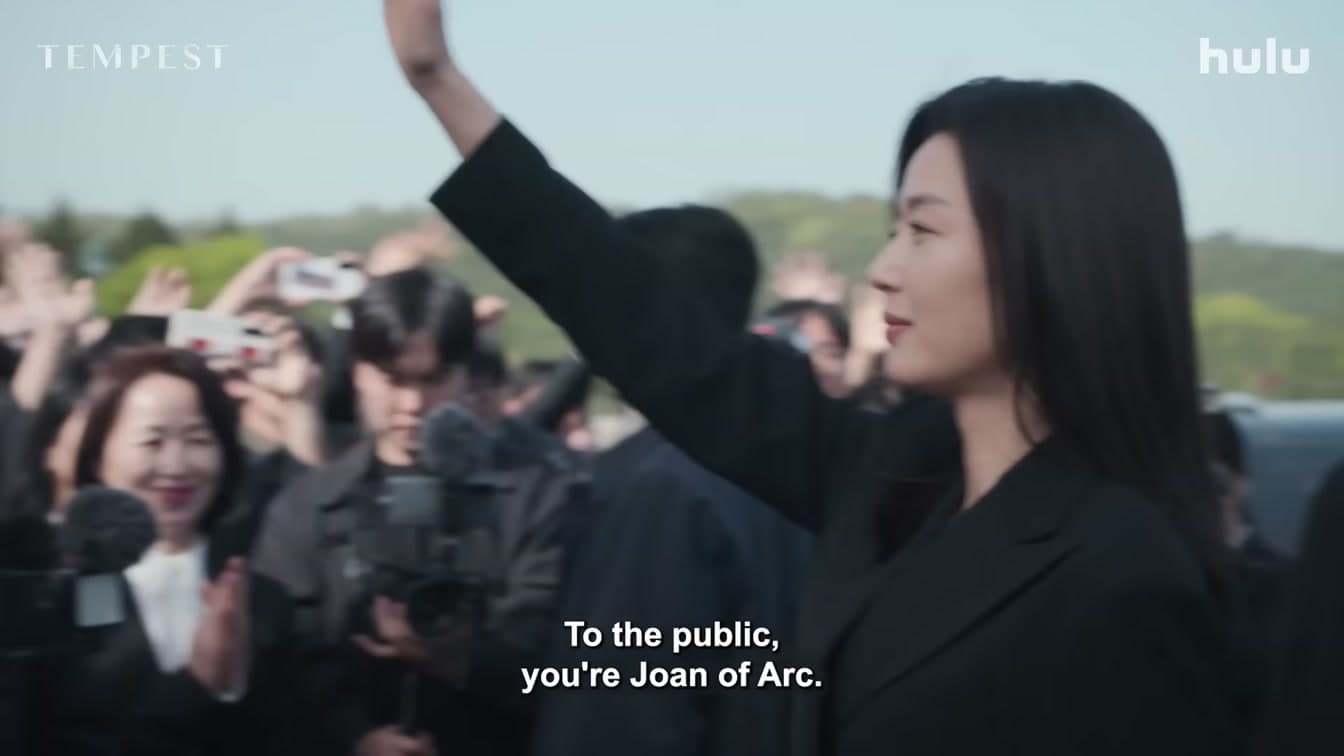
The headline was irresistible. A spy thriller starring two of South Korea's most revered actors — Jun Ji-hyun, who had not appeared in a drama since Legend of the Blue Sea in 2016, and Kang Dong-won, whose last television credit was a 2004 SBS series — arriving together on Disney+ with a production budget reportedly in the tens of billions of won, written by the screenwriter behind Crash Landing on You. By any measure of advance positioning, Tempest was the Korean drama event of 2025.
By any measure of execution, it was one of the year's most instructive disappointments.
The show aired nine episodes from September 10 to October 1, 2025, on Disney+ globally and Hulu in the United States. Its opening weekend placed it fourth globally across Disney+ and Hulu combined. By the time the finale aired, it was being dissected in industry commentary as a case study in how premium resources, elite talent, and institutional support can fail to compensate for a script that loses its nerve in the second half. The critics gave it perfect scores. The audiences gave it 22 percent on Rotten Tomatoes. Both reactions told something true about the drama.
What the Show Was — and What It Promised to Be
Tempest — known in Korean as 북극성 (Polaris) — was written by Jeong Seo-kyeong, whose career included work on Crash Landing on You, and directed by Kim Hee-won, who had worked on Vincenzo and My Mister. The combination of writer and director carried substantial credibility. The cast expanded the promise: alongside Jun Ji-hyun and Kang Dong-won, the ensemble included John Cho, Lee Mi-sook, Park Hae-joon, and Joo Jong-hyuk.
The premise was politically pointed. Jun Ji-hyun played Seo Mun-ju, a former South Korean UN ambassador who left her career under circumstances the drama would gradually reveal. Kang Dong-won played Paik San-ho, an international special agent of deliberately obscured nationality whose loyalties and history were constructed as the drama's central mystery. The two are brought together by a deadly attack that threatens the stability of the Korean Peninsula and find themselves navigating a conspiracy reaching into the highest levels of government, international intelligence, and corporate power.
This was, on paper, the infrastructure of a prestige thriller with the emotional intelligence that Korean television at its best delivers — the kind of work that takes genre mechanics and uses them to explore something about how power and human vulnerability intersect. Jeong Seo-kyeong had done exactly that with Crash Landing on You, which took a geopolitical absurdity as its premise and turned it into one of the most emotionally resonant Korean dramas of the decade. The expectation was not unreasonable.
The Opening Episodes: When the Promise Held
For roughly the first third of its run, Tempest delivered on what it promised. The opening episodes established a visual language — wide shots of international locations, precise interior photography, a color palette that communicated institutional cold and personal warmth in opposition — that felt genuinely cinematic rather than simply expensive. Kim Hee-won's direction in these episodes was composed and confident, with action sequences that avoided the shaky-camera incoherence that afflicts many high-budget Korean action productions.
The performances of the two leads were consistently strong. Jun Ji-hyun brought to Seo Mun-ju the quality that has defined her best work: an intelligence that operates below the surface of every scene, a character who is thinking two moves ahead of everyone around her while appearing to react spontaneously. Her scenes with Kang Dong-won in the early episodes had the electricity of two performers each registering the other as a genuine match, which is rare and was correctly identified by audiences as the drama's primary pleasure.
Kang Dong-won's return to the small screen after more than two decades was widely noted before the show aired. He had remained one of Korea's most commercially successful film actors during that interval, appearing in productions including The Berlin File and Peninsula. His decision to return to television — and specifically to co-produce Tempest, not simply act in it — was understood as a statement of commitment to the material. In the early episodes, that commitment registered visibly. He played Paik San-ho with a physical restraint and watchful ambiguity that served the character's construction as mystery.
Where the Drama Unraveled
Somewhere around the drama's midpoint — with precision of onset that multiple reviewers identified independently — the craft that had characterized the opening episodes began to fragment. The political thriller machinery, which had been generating tension through layered ambiguity, was progressively replaced by a more conventional set of dramatic priorities: family secrets, romantic resolution, and a final confrontation designed primarily for emotional payoff rather than thematic coherence.
The shift was not subtle. Scenes that had been staged for information and inference became scenes staged for reaction. The conspiracy, which had gestured toward systematic critique of how states exercise power through proxies and proxies exercise power through deception, collapsed into a more familiar story about one family's legacy of betrayal. Paik San-ho's mystery, which had been the drama's most compelling sustained puzzle, was resolved in ways that satisfied continuity without satisfying meaning.
Several reviewers described the finale specifically as "very K-drama" in a way intended as criticism — meaning that it defaulted to the emotional templates of Korean melodrama when the structural ambitions of the preceding episodes had established different expectations. The writer who had, in Crash Landing on You, found a way to honor both genre pleasure and genuine originality, appeared in Tempest to have chosen genre pleasure at the expense of what had made the drama interesting.
The audience score on Rotten Tomatoes — 22 percent on the Popcornmeter at initial measurement — was extreme, and partially reflects organized downvoting campaigns launched in response to the show's cultural controversies. But the core critical reaction from viewers who watched the drama without political motivation was consistently similar: a drama that began with exceptional promise and did not complete the journey it started.
The Budget Question: Separating Myth from Reality
Much of the discourse around Tempest as a "flop" referenced a production budget of ₩500 billion — approximately $370 million — a figure that circulated widely online and in international entertainment coverage. At that scale, the drama would have been among the most expensive television productions in history, comparable to the largest American prestige productions. The failure framing was shaped significantly by this number: "Disney spent $370 million and got this."
The number is almost certainly wrong. Following the finale, the drama's director and writer both denied the ₩500 billion figure publicly. Reporting by The Korea Herald put the actual production budget in the range of ₩50–70 billion — approximately $34–51 million at 2025 exchange rates. That figure is still very large for a Korean drama production and substantially exceeds the median budget for domestic premium productions. But it places Tempest in the category of expensive prestige K-drama, not in some unprecedented tier of expenditure.
The misinformation mattered because it structured the failure narrative in ways that obscured the actual story. A drama that cost ₩50–70 billion and underperformed domestically while achieving second place among Disney+ originals globally is a disappointment but not a catastrophe. A drama that cost ₩500 billion and produced the same result would be an industry-shaking event. Most of the commentary treated the drama as the latter when it was the former.
The China Problem: When a Single Line Costs Millions
The most consequential controversy surrounding Tempest was not about the drama's narrative quality. It was about a single line of dialogue, a two-second shot of a city, and a poem recited with a non-native accent.
The drama included a scene in which a character asked: "Why does China have a preference for war?" The question circulated immediately on Chinese social media, generating substantial negative reaction. A separate scene depicting the northeastern Chinese city of Dalian as an area of run-down alleyways — filmed in an old Hong Kong location and processed through dark color grading to create a poverty association — amplified the response. Jun Ji-hyun's recitation of Li Bai's classical poem Bring in the Wine (將進酒) in Mandarin, with a Korean accent, was additionally circulated as an object of mockery.
The reaction was organized and consequential. Louis Vuitton, La Mer, and Piaget — three luxury brands for which Jun Ji-hyun served as a spokesperson — removed her promotional materials from their social media accounts within days. Some brands deleted posts announcing her as an ambassador without explanation. Industry sources cited potential losses in the range of millions of dollars, though Jun Ji-hyun's agency disputed the characterization of the relationship endings as cancellations directly caused by the drama, stating that at least one delayed shoot had been affected by "local issues" rather than controversy response.
The China dimension carried particular strategic weight given the broader context of Korean-Chinese entertainment relations. Since the 2016 THAAD deployment controversy triggered China's unofficial ban on Korean cultural exports — dramas blocked, artists removed from advertising, collaborative productions halted — the relationship had been in a prolonged state of managed distance. In 2025, South Korea's foreign ministry had publicly stated that the two governments were working to restore cultural exchange. A high-profile Korean drama generating anti-China sentiment through what critics described as careless writing and cultural insensitivity set back that diplomatic trajectory in ways that extended beyond the entertainment industry.
Iraq, Vietnam, and the Global Responsibility Problem
The China controversy was the most commercially damaging of Tempest's cultural reception problems, but it was not the only one. The drama also drew organized backlash from Iraqi viewers who objected to its depiction of Iraq as an inherently dangerous, uncivilized environment — using the country as a setting that functioned primarily as a backdrop for danger and disorder. The response took the form of coordinated low-score campaigns on review platforms, driving down the audience score on IMDB specifically.
Vietnamese viewers raised distinct objections to scenes that depicted South Korean military personnel as heroic figures in the context of the Vietnam War — a framing that Korean critics of the drama noted was both historically contested and narratively gratuitous. The Vietnam War retains significant cultural sensitivity in contemporary Vietnam, where the role of South Korean forces as perpetrators of civilian massacres during the conflict has been the subject of ongoing diplomatic tension between Seoul and Hanoi.
Professor Yoon Seok-jin of Chungnam National University's Korean Language and Literature Department, responding to the controversies, offered a formulation that captured what had gone wrong: "Dramas released on global OTT platforms like Disney+ are aimed at viewers around the world, so the description or expression of a specific country needs to be somewhat cautious." The statement was measured but its implication was clear: a production of this budget and platform scale should have anticipated these problems before they reached audiences.
The multi-front controversy illuminated a tension that has been building in the Korean drama industry as it expands its global ambitions. Productions aimed at international audiences must navigate cultural representations that will be received differently by different national audiences. What reads as action-thriller shorthand in South Korea may read as stereotype or insult elsewhere. Tempest, despite its international production scale — including cast member John Cho, whose presence signaled explicit awareness of an English-speaking audience — failed to build the cultural sensitivity review infrastructure into its production process that its global platform demanded.
The A-List Problem: When Star Power Is Not Enough
The most industry-significant analytical question surrounding Tempest is not why it failed domestically while performing reasonably internationally, but what its failure suggests about the relationship between celebrity and commercial success in Korean drama.
For years, the conventional wisdom in Korean entertainment held that certain actors constituted near-bankable assets — names that could move ratings, attract platform investment, and guarantee audience sampling in ways that transcended any individual project. Jun Ji-hyun was, by any assessment, at or near the top of that tier. Her feature film The Berlin File (2013) had been a major commercial success. Her dramas My Love from the Star (2013) and Legend of the Blue Sea (2016) had been global phenomena. Her return to the small screen in 2025 was, by definition, an event.
It drew viewers for the premiere. It did not keep them through the run. Domestic Good Data Corporation rankings placed Tempest below several competing dramas throughout its airing period, including productions from tvN's weekend slot. The sampling that Jun Ji-hyun and Kang Dong-won's names generated did not convert to sustained engagement, and the word-of-mouth trajectory for the drama ran in the wrong direction as the second half of the run arrived.
Industry observers in Korea drew the broader conclusion that a structural shift had occurred: audiences in 2025 were making content decisions based on what they heard from people who had watched a show, not on who was in it. Social media word-of-mouth, fan community discussion, and algorithm-driven discovery had displaced the star-name-as-guaranteed-audience mechanism that had operated in Korean television since at least the 2000s. Tempest was not the first drama to demonstrate this, but its profile made the lesson impossible to avoid.
What Disney+ Learned — and What K-Drama Needs to Remember
Disney+ arrived in South Korea in 2021 with stated ambitions to become a major player in original Korean content production. By 2025, the platform had produced and co-produced multiple high-profile Korean dramas and films, with mixed results. Tempest was its most prominent Korean investment to date, and its performance — strong enough globally to rank second among the platform's originals, disappointing enough domestically to generate extensive "flop" coverage — produced an ambiguous lesson.
The global performance was real. Second place among Disney+ originals is a commercially meaningful outcome. Jun Ji-hyun and Kang Dong-won's combined international recognition drove sampling across multiple markets, particularly in Southeast Asia and among K-drama-adjacent audience communities. As a platform investment, Tempest achieved its international metrics even when it failed its domestic ones.
The domestic failure, however, carries disproportionate cultural weight in an industry where Korean audiences function as the primary arbiters of K-drama quality. When Korean viewers and critics call a drama a disappointment, that judgment influences how the show is received internationally and how the platform's subsequent productions are perceived. Disney+ Korea's credibility as a home for premium creative work was, at minimum, not enhanced by Tempest's script problems and cultural controversies.
Jun Ji-hyun Beyond the Controversy
Assessments of Jun Ji-hyun's personal performance in Tempest separated consistently from assessments of the drama itself. Her work was described by critics who found the surrounding production disappointing as the element that made watching worthwhile — a performance of controlled authority and emotional precision that the material around it did not always deserve.
The brand controversy, while commercially significant, was partially resolved by her agency's clarifications about the nature of the relationship delays. Louis Vuitton and La Mer resumed their associations with her following the conclusion of the drama's run, suggesting that the luxury brands had made short-term reactive decisions rather than permanent relationship terminations. The multi-million-dollar figure cited by some coverage was real as an estimate of potential exposure but not confirmed as actual realized loss.
What Tempest cost Jun Ji-hyun more tangibly was the narrative momentum of a long-awaited return. Nine years between drama appearances had built anticipation that demanded a worthy vehicle. The show's script failures meant that her comeback, rather than being defined by a performance that matched or exceeded her previous landmark work, was defined instead by controversy, divided audience reaction, and the industrial question of what went wrong. Her performance merited better. The discussion she received was shaped by everything around it.
Verdict: A Warning Label for an Industry
Tempest will be studied by the Korean entertainment industry for years, not as a comprehensive failure — it was not that — but as a document of the specific conditions under which premium resources and elite talent can produce a result that disappoints the expectations they generate. The script lost its structural nerve. The cultural representations created controversies that were both predictable and avoidable. The budget misinformation inflated the failure narrative beyond its actual proportions.
What remains after the noise settles is a drama with two exceptional lead performances, genuinely strong opening episodes, and a second half that did not honor the first. That is a specific creative failure, one that in a more modestly positioned production would attract limited notice. In the most anticipated Korean drama of its release window, it became a case study.
The K-drama industry's expansion onto global platforms has brought global budgets, global audiences, and global accountability. Tempest discovered that global accountability includes responsibility for how every country depicted in a production will receive those depictions. The next Korean prestige thriller with international production ambitions will benefit from studying this experience. The lesson is not that ambition is dangerous. The lesson is that ambition requires the infrastructure to support it all the way to the finish.
The Bigger Picture: K-Drama on Global Platforms in 2025
The parallel between Tempest and 2025's dominant Korean television story is instructive. While Bon Appétit, Your Majesty — a tvN cable production with a fraction of the platform investment — accumulated 588.3 million Netflix hours and redefined what a K-drama could achieve commercially, the flagship Disney+ original with two of Korean cinema's most celebrated actors struggled to sustain domestic momentum past its second week of release.
The contrast illustrates something that the streaming era had perhaps obscured: that the mechanism by which Korean television earns international audiences still runs primarily through domestic quality. When Korean viewers respond to a drama with sustained enthusiasm — talking about it, recommending it, generating the kind of organic word-of-mouth that translates directly into streaming engagement — international platforms follow. When they don't, even massive international distribution cannot fully substitute for the absence of that cultural endorsement.
This is not an argument against international co-production or platform investment in Korean content. Disney+, Netflix, Amazon, and their competitors have collectively expanded the resource base available to Korean productions in ways that have enabled genuine creative achievements. But Tempest demonstrated that investment without Korean audience endorsement produces a specific kind of result: a show that travels globally on the strength of its cast's international recognition while being quietly discounted by the audience best positioned to judge its creative merit.
For the Korean production industry, the lesson reinforces what every drama-maker already understands but sometimes forgets under the pressure of international ambition: the audience that matters most, the one that creates the cultural authority every subsequent audience responds to, is the one watching on Saturday night on tvN or the following morning on TVING. Serve that audience, and the global numbers follow. Fail it, and no budget compensates for the gap.
How do you feel about this article?
저작권자 © KEnterHub 무단전재 및 재배포 금지
Entertainment Journalist · KEnterHub
Entertainment journalist focused on Korean music, film, and the global K-Wave. Reports on industry trends, celebrity profiles, and the intersection of Korean pop culture and international audiences.
Comments
Please log in to comment