ENHYPEN Just Made K-Pop History at Coachella — And DJ Kaskade Noticed
The fastest K-pop group ever to reach Coachella delivered a set that left a 30-year festival veteran speechless
 By Park Chulwon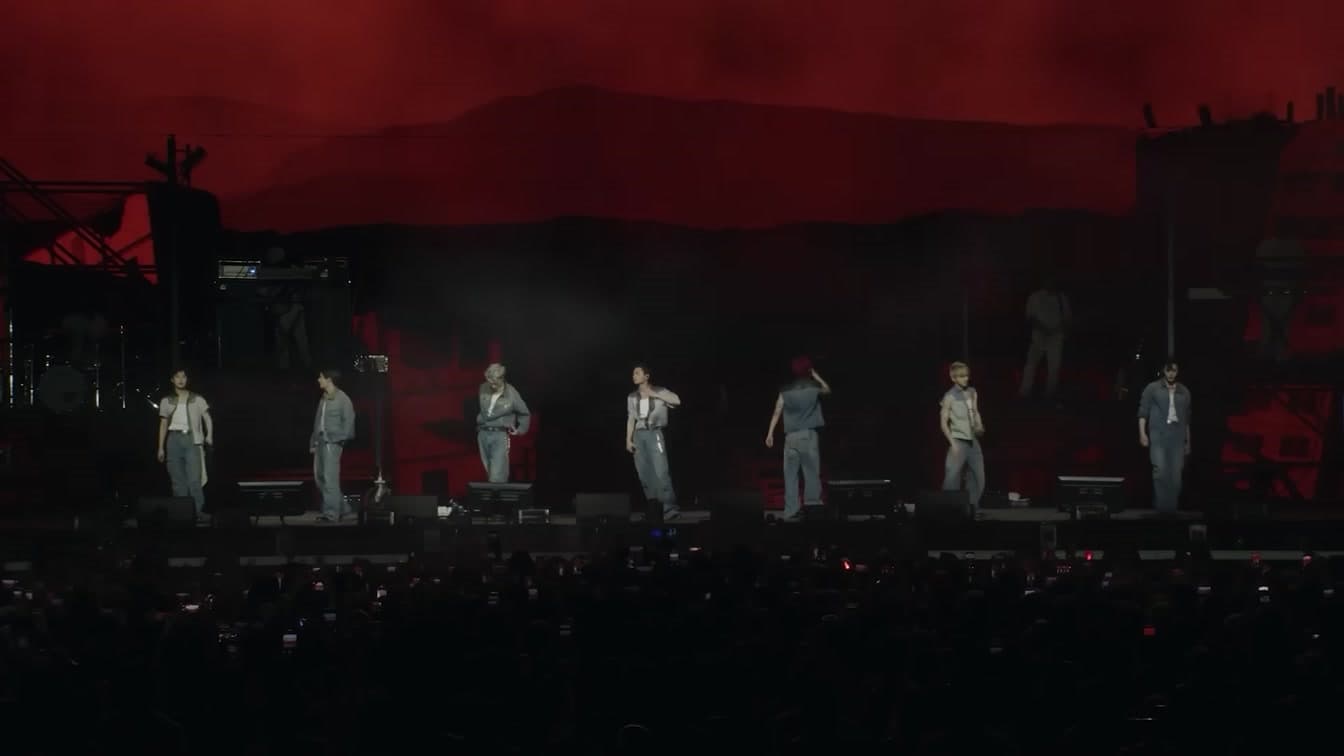
ENHYPEN performed at Coachella Valley Music and Arts Festival on April 12 and 19, 2025, from the Sahara Stage. The set was thirteen tracks, forty-five minutes, performed in custom Prada denim. The visual concept — "Vampires in the Desert" — took the group's established gothic aesthetic and transplanted it into the sun-bleached California landscape, generating enough ironic friction that the look became one of the weekend's most circulated images. DJ Kaskade, a festival veteran who had seen thousands of acts across his career, offered the most quoted response: "I'm going to be straight here and say what all of us are thinking: ENHYPEN is probably not from planet Earth. These guys are to boy-bands up to now what a tin can and string are to iPhones."
ENHYPEN had debuted in November 2020 through HYBE's reality competition series *I-Land*. Their Coachella appearance, four and a half years after that debut, made them the fastest K-pop group to perform at the festival since their debut — a record that had been set in the specific context of K-pop's accelerating Western integration, but that was still notable as a measure of how quickly their commercial and cultural profile had developed. The two Coachella weekends were the centerpiece of a week-long American market activation that also included ENHYPEN's first US television appearance — on *Jimmy Kimmel Live!* on April 10, two days before the first Coachella set — and the announcement, from the Coachella stage itself, of a ten-city world tour and a forthcoming mini-album.
From I-Land to Indio: The Four-Year Trajectory
*I-Land*, the competition series through which ENHYPEN was formed, debuted on Mnet and ran from June to September 2020. Twenty-three contestants competed across a structured elimination format; seven members were selected through a combination of producer votes and global viewer voting. The lineup — Jungwon, Heeseung, Jay, Jake, Sunghoon, Sunoo, and Ni-ki — reflected HYBE's intentional international composition: Jay and Jake were Korean-Americans, Ni-ki was Japanese, and the remaining members were South Korean. The configuration was designed for both domestic Korean commercial performance and international accessibility, following the template that BTS had established for HYBE's global market approach.
In their first four years of commercial activity, ENHYPEN had built a commercial profile characterized by strong album sales, an escalating international touring footprint, and a fandom — ENGENE — whose organized support generated consistent chart performance across both Korean and Japanese markets. By April 2025, the group had released multiple mini-albums, two studio albums, and several Japanese releases, accumulating total album sales that placed them firmly in the second tier of active fourth-generation K-pop boy groups by commercial volume. They had not yet achieved the level of Western chart penetration that distinguished the top tier — ATEEZ, Stray Kids — from their generational peers. The Coachella activation in April 2025 was designed, in part, to address that gap.
The commercial sequencing around Coachella Week One was deliberate. The April 4 release of "Loose," a digital single in English, provided the American market with accessible entry-point content before the festival. The April 10 *Jimmy Kimmel Live!* appearance — their first US television performance — placed them in front of a mainstream American broadcast audience two days before the first Coachella set. By the time the Sahara Stage performance began on April 12, ENHYPEN had introduced themselves to the American market through three distinct channels in the same week. The Coachella performance was the culmination of a coordinated activation strategy rather than a standalone event.
The Sahara Stage: What the Performance Demonstrated
The thirteen-track Coachella setlist drew from across ENHYPEN's discography: "Blockbuster" opened, followed by "Blessed-Cursed," "Future Perfect (Pass the MIC)," "ParadoXXX Invasion," "Paranormal," "XO (Only If You Say Yes)," "No Doubt," "Sweet Venom," "Daydream," "Moonstruck," "Bite Me," "Drunk-Dazed," and "Brought the Heat Back" as the closing track. The selection prioritized high-energy performance tracks over the group's slower or more introspective material — a deliberate calibration for a festival context where audience attention spans are shorter and competition for engagement more intense than in a dedicated K-pop concert environment.
The "Vampires in the Desert" aesthetic — ENHYPEN's gothic visual identity transposed into the sun-drenched desert setting — generated coverage that extended beyond music press. The custom Prada denim outfits, worn by the group as brand global ambassadors, created fashion industry content hooks that amplified the performance's media coverage into channels that did not overlap with K-pop fan press. Forbes described the set as defining "a new level of global stage presence." The BuzzFeed review stated simply that ENHYPEN's performance was "otherworldly." DJ Kaskade's quote was shared across platforms by both fans and mainstream music media, generating discovery sampling that extended the performance's audience beyond those who had seen it live.
One dimension of the performance that generated significant social media discussion was the contrast between pre-show expectations and actual execution. Some online discourse before Coachella Week One had suggested the Sahara Stage crowd might be thin for a K-pop group without top-tier Western name recognition. The actual turnout contradicted that expectation, and Week Two — which ENHYPEN members noted was visibly larger than Week One — suggested that the first performance had generated word-of-mouth that drove additional attendance. Jungwon addressed the response directly: "We didn't expect so many ENGENEs in the US to come out to the desert for two weekends, so it really surprised and touched us." The comment captured both the genuine surprise and the commercial implication: ENGENE's American presence was larger, and more willing to physically mobilize for live events, than the pre-show discourse had implied.
The World Tour Announcement: Ten Cities, One Stage
At the conclusion of the Coachella set, ENHYPEN announced their upcoming world tour — *Walk the Line* — and their forthcoming mini-album *DESIRE: UNLEASH*. The dual announcement from the Coachella stage was a deliberate commercial execution: using the festival's largest audience available to them as the reveal platform for their next career chapter. The tour's ten announced cities covered North America (New York, Chicago, Houston, Los Angeles), the United Kingdom (London, Manchester), and continental Europe (Amsterdam, Brussels, Berlin, Paris).
The tour announcement reflected a structural reality about K-pop's Western market development in 2025. Groups at ENHYPEN's commercial tier — strong album sales, organized international fandom, but not yet the Western streaming numbers that generate mainstream media coverage independent of the K-pop ecosystem — had found that European touring was often commercially easier to execute than North American touring, because European K-pop fandom was concentrated in major cities with lower logistics overhead and less competition from the American market's more crowded concert calendar. The four European cities in the announcement provided a European commercial anchor for the tour while the four American cities extended the Coachella momentum into markets where ENHYPEN's fandom had been building for years without major live event access.
The *DESIRE: UNLEASH* mini-album announcement provided additional commercial structure. The Coachella performance had introduced ENHYPEN to a festival audience; the tour announcement gave that audience a future live event to anticipate; the album announcement gave the fandom a purchasing event to plan for. The three elements together — performance, tour, album — represented a coordinated Western market launch campaign using the Coachella platform as its announcement infrastructure. It was, in commercial terms, one of the more sophisticated single-event activations any K-pop group had executed at a Western music festival.
HYBE's Strategic Deployment of ENHYPEN at Coachella
ENHYPEN's Coachella appearance was not simply a reflection of their own commercial development. It was also a reflection of HYBE's strategic approach to Western market cultivation across multiple acts simultaneously. Lisa, performing in Week One, was a YG-era artist operating under RCA's institutional support for her solo career. Jennie, performing later in the same weekends, was under her own OA label. ENHYPEN represented HYBE's direct institutional stake in the festival's K-pop presence.
HYBE's Coachella strategy in 2025 reflected the company's Multi-home framework at a domestic festival level. Rather than concentrating its Western promotional resources on a single act, HYBE had supported individual members of different HYBE acts — ENHYPEN directly, with the institutional infrastructure of BELIFT LAB and HYBE's global operations behind them — while operating in the same festival context as non-HYBE acts whose Coachella presence generated collective narrative benefit for K-pop as a category. The $9.3 million Earned Media Value that ENHYPEN generated at the festival, ranking third among all Coachella 2025 performers, reflected both their own commercial presence and the broader K-pop narrative context in which their performance was received.
The Prada brand ambassador relationship — announced in 2024 — had positioned ENHYPEN's visual identity at the intersection of K-pop and luxury fashion that had become one of the genre's most commercially significant Western market access points. Luxury fashion brand partnerships had, by 2025, become a standard mechanism through which K-pop groups extended their Western visibility into media channels that reached fashion, culture, and lifestyle audiences who did not necessarily follow Korean music. ENHYPEN's Prada outfits at Coachella generated coverage in fashion press that ran alongside — and sometimes instead of — the music coverage, doubling the effective media reach of the performance itself.
Verdict: The Fastest K-Pop Group to Coachella Earned Its Place
The pre-show social media skepticism about ENHYPEN's Coachella crowd was itself a data point about how Western music media thought about K-pop acts outside the very top tier of global commercial recognition. The assumption — that a group without Western radio airplay or mainstream streaming presence could not fill a major festival stage — reflected a model of concert attendance that K-pop's fandom structure had already disrupted at multiple levels. ENGENE showed up in the desert, in numbers that surprised the group themselves, because K-pop fandoms travel for their artists in ways that streaming-oriented Western audiences do not necessarily do for theirs.
What the performance demonstrated went beyond fandom loyalty, however. The set quality — the vocal execution, the choreographic precision, the stage production values — held up against the general Coachella audience's expectations in ways that generated coverage from media outlets with no K-pop focus or K-pop audience. DJ Kaskade's quote was not a K-pop media publication's assessment. It was a festival industry veteran's response to a live performance that exceeded his expectations on its own terms. That kind of response — from observers with no prior investment in the outcome — is the Western validation that K-pop's global expansion has been working toward for years.
ENHYPEN arrived at Coachella 2025 as the fastest K-pop group to reach the festival since their 2020 debut. They left having announced a ten-city world tour, a forthcoming mini-album, and a performance record that had generated $9.3 million in earned media value. For a group four and a half years into a career built on the HYBE institutional infrastructure and their own formidable performance capacity, April 2025 was the beginning of a Western market presence, not the culmination of one. The fastest path to Coachella had brought them to a starting line that their performance confirmed they were ready for.
The ENGENE Fandom and the American Market's K-Pop Infrastructure Gap
One of the structural tensions that Coachella 2025 made visible was the gap between K-pop's organized fandom infrastructure and the American music industry's standard mechanisms for measuring audience scale. American radio, streaming algorithm recommendations, and mainstream music media coverage all operate primarily through channels that K-pop fandoms have not historically been able to penetrate at the same scale as they penetrate the platforms built around organized fan participation — chart streaming campaigns, physical purchasing coordination, voting aggregations. ENHYPEN's Coachella crowd was large enough to make the pre-show skeptics look foolish, but the skepticism itself reflected a real infrastructure gap that the performance alone could not close.
The April 4 "Loose" single — an English-language track designed specifically for American radio and streaming platform recommendation algorithms — represented ENHYPEN's explicit acknowledgment of this gap and a direct attempt to address it. English-language content from K-pop acts had produced mixed results across the genre's Western expansion history. BTS's English releases had been the most commercially successful, generating genuine Hot 100 performance independent of fandom streaming coordination. Other groups' English-language tracks had been well-received within the fandom but had not broken through to the organic discovery audience that the singles were designed to reach. "Loose" was too new at the time of Coachella to have produced clear results; its *Jimmy Kimmel Live!* performance gave it a broadcast platform that extended its potential reach.
The Jimmy Kimmel appearance itself was significant as infrastructure rather than as a single commercial event. American late-night television has been one of the primary mechanisms through which music acts introduce themselves to the mainstream American audience — not because the viewing numbers are enormous, but because the clips circulate and because the booking itself is a signal of credibility that other American media outlets recognize and respond to. ENHYPEN's first Kimmel appearance was the first step in a mainstream American media relationship that would need to be sustained over multiple appearances and multiple years before it translated into the organic discovery that Western mainstream commercial success requires.
The world tour — *Walk the Line* — provided the live event infrastructure for the next phase of that relationship. North American arena-level touring generates the local media coverage, fan community activity, and physical market presence that streaming numbers alone cannot provide. Groups at ENHYPEN's commercial tier had found, across K-pop's Western expansion, that the live touring relationship with local audiences was often the mechanism that converted casual streaming interest into dedicated fandom — and that dedicated fandom, once developed, generated the album sales and streaming coordination that sustained commercial performance between tour cycles. For ENHYPEN in April 2025, the Coachella performance and the tour announcement together represented a commitment to building that relationship at scale, with the institutional resources to execute it properly.
What Kaskade's Quote Actually Meant
DJ Kaskade's response to ENHYPEN's Coachella performance — comparing them to "what a tin can and string are to iPhones" relative to previous boy bands — was widely shared because it was quotable. But the substantive content of the comparison pointed to something specific about what the performance had demonstrated. The "tin can and string" versus "iPhone" comparison was not primarily about talent or charisma. It was about system sophistication.
K-pop idol training produces performers whose live execution reliability, choreographic precision, and performance consistency are the products of training regimens measured in years rather than months. The consistency that makes a ENHYPEN Coachella performance land the same way across Week One and Week Two — same energy, same precision, same stage presence in a physically demanding outdoor festival environment where the variables are less controlled than in a dedicated concert venue — is the product of institutional investment in performer development that Western pop's production model does not replicate at the same scale. Kaskade recognized this. The "iPhone" was not a metaphor for charisma. It was a metaphor for engineered reliability — for the product of a system that understood what it was building and built it with precision.
That recognition, from a music industry professional with decades of festival experience, was the most commercially meaningful response to ENHYPEN's Coachella set — more meaningful than streaming numbers, more meaningful than earned media value, more meaningful than social media trends. It was evidence that the K-pop training system, applied to ENHYPEN's specific members across their four and a half years of preparation, had produced live performers who impressed people whose careers depended on accurately evaluating live performance quality. In April 2025, that impression was the most durable thing ENHYPEN took home from the desert.
Lisa in the Crowd and K-Pop's Coachella Solidarity
One of the less-discussed details of ENHYPEN's Coachella weekend was the report that Lisa was spotted in the crowd for their Sahara Stage performance — extending the K-pop solidarity narrative that had run through both weekends, with Rosé attending Lisa's and Jennie's sets and Lisa attending Jennie's. The detail is small in commercial terms but significant in what it communicates about the structural moment K-pop was navigating in April 2025. Multiple Korean artists at the same Western festival, attending each other's performances, visible to the same audience, generating coverage that framed K-pop as a collective presence rather than a series of individual acts — this was not a coincidental outcome. It reflected the reality that the K-pop industry's global expansion had, by 2025, produced a cohort of acts with sufficient Western commercial credibility that their simultaneous Coachella presence was logistically feasible and commercially sensible.
The Earned Media Value figure that ranked ENHYPEN third behind Jennie and Lisa was, in this context, not merely a competitive measure. It was a measure of collective category presence. When $30 million in aggregate EMV is generated by Korean acts at a single American music festival, the story is not just about which individual artist performed best. It is about K-pop as a category of musical performance that Western audiences, Western media, and Western industry professionals have integrated into their understanding of what Coachella is. ENHYPEN's $9.3 million contribution to that aggregate was the result of their own performance quality and their own fandom's mobilization — but it also benefited from the context that Lisa and Jennie's presence had created, just as their presence benefited from ENHYPEN's. The K-pop acts at Coachella 2025 were competitors in the sense that they occupied the same festival slots and competed for the same audience attention. They were also collaborators in the larger project of demonstrating that K-pop belonged on Coachella's stages — a project whose success depended on all of them performing at the level that each of them did.
ENHYPEN's performance confirmed that HYBE's investment in a group capable of Coachella-level execution had produced what it was designed to produce. The trajectory from *I-Land* auditionees in 2020 to Coachella performers in 2025 — through album cycles, world tours, Japanese market development, Prada brand partnership, and a *Jimmy Kimmel Live!* debut — was not a straight line from debut to Western validation. It was a deliberate institutional construction of the commercial and cultural prerequisites for exactly this kind of Western festival presence. In April 2025, the construction was visible in its completed form, performing for 45 minutes in custom Prada in the California desert, to a crowd that kept growing larger every day it was there.
How do you feel about this article?
저작권자 © KEnterHub 무단전재 및 재배포 금지
Entertainment Journalist · KEnterHub
Entertainment journalist focused on Korean music, film, and the global K-Wave. Reports on industry trends, celebrity profiles, and the intersection of Korean pop culture and international audiences.
Comments
Please log in to comment