From g.o.d to TXT: The K-pop Parenting Show Formula That Never Fails
Wavve's strategic revival of idol variety television's founding format is breaking records and bridging generations.
 By Jang Hojin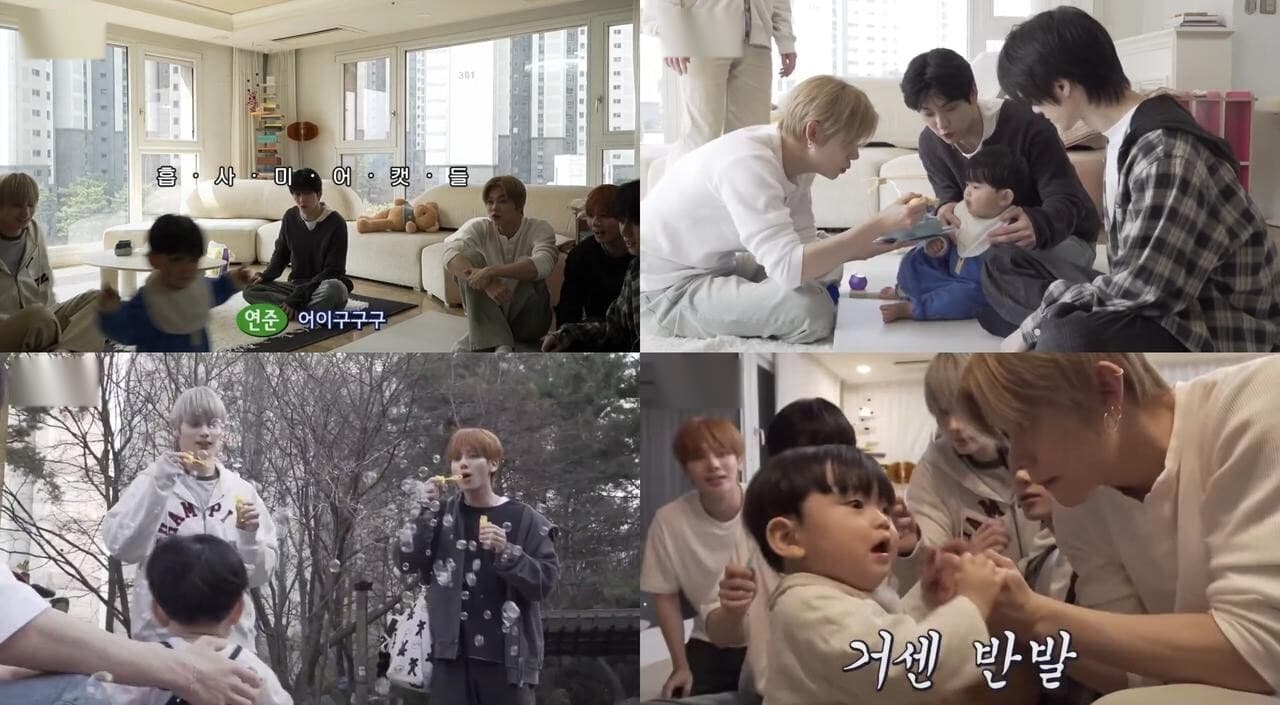
In January 2000, five young men sat awkwardly in a studio apartment, holding an 11-month-old baby for the first time, completely unsure what they were doing. The group was g.o.d — a relatively new idol act — and the baby was Han Jae-min. What happened next nobody could have predicted: their observational variety show became so explosively popular that it forced rival network KBS's flagship comedy institution, Gag Concert, to switch time slots to avoid competing during the same broadcast hour.
Twenty-six years later, on May 1, 2026, history repeated itself. Five members of Tomorrow X Together (TXT) stepped into a nursery on Wavve, South Korea's major streaming platform, with a 14-month-old child in their care. TXT's Parenting Diary became Wavve's number one paid subscriber acquisition content on its very first day. And today — May 21, 2026 — Wavve simultaneously released g.o.d's original Parenting Diary remastered in 4K, completing a generational loop 24 years in the making.
The same format. The same emotional premise. The same result. Just 24 years apart. Understanding why requires going back to where it all began.
The Show That Built a National Group
Before g.o.d's Parenting Diary, Korean idol groups appeared on music programs and variety panel shows — but always as guests, never protagonists. No one had handed an idol group an unscripted, longitudinal reality format and asked them to simply be responsible for another human being. The concept was so unconventional that member Park Joon-hyung revealed in May 2026 that the group had turned the idea down twice before finally agreeing.
When they did agree, the format was deceptively simple: five young men in their early twenties, caring for a baby who was not their own. Every feeding, every diaper struggle, every moment of confused helplessness or unexpected tenderness was broadcast. Audiences did not see a polished idol group performing — they saw real people navigating something none of them had trained for. That distinction was everything.
The cultural impact was swift. With the Parenting Diary capturing family-hour attention on MBC, Gag Concert — one of KBS's most established comedy franchises — reportedly had to shift its broadcast time to avoid direct competition. For g.o.d, the crossover effect was transformative: their second album sold over 500,000 copies. Variety legend Yoo Jae-suk has since described the moment as what it would have been like if "BTS did a parenting variety show" — an analogy that captures just how seismic the cultural crossover was for the time.
The show ran for 16 months, from January 2000 to May 2001. Baby Jaemin became a national figure recognized by millions. In 2018, g.o.d reunited with a grown-up Jaemin for the first time in 17 years — a reunion that reminded an entire generation exactly how deep that emotional investment had run.
Why the Formula Works — And Why Wavve Knew It
The psychology behind idol parenting shows is remarkably consistent across decades. Observational formats that place idols in genuinely uncontrolled situations — stripped of choreography, visual production, and image management — create a specific and powerful parasocial dynamic. Audiences witness real helplessness, real humor, and real warmth from people who otherwise appear carefully constructed. In an industry where every public appearance is meticulously managed, a messy moment of genuine confusion carries more authenticity than a hundred magazine interviews.
What made g.o.d's version revolutionary was duration. This was not a one-episode novelty. It ran for 16 months, and fans watched the members develop genuine affection for Jaemin across that time. The show created a narrative arc — something idol reality formats before it had never attempted — and audiences followed it the way they followed serialized drama.
TXT's version carries similar structural advantages and adds international ambition. As a five-member HYBE group with a devoted global fanbase known as MOA, TXT brings cross-border viewership to a format previously limited to domestic broadcast. The show streams not only on Wavve but also on Amazon Prime Video and Kocowa+ internationally — a distribution footprint g.o.d's MBC broadcast could never have reached in 2000.
The streaming business context matters here. Wavve, currently ranked fifth in South Korea's streaming market with 3.76 million monthly active users as of February 2026, is navigating a period of structural change: a merger with Tving received conditional regulatory approval in June 2025, and the platform appointed a new CEO in April 2026 with a mandate for growth and integration. In that environment, content that converts passive viewers into paid subscribers on day one is precisely the kind of strategic asset a transitioning platform needs most.
When g.o.d Meets TXT: A Bridge 24 Years in the Making
Perhaps the most emotionally resonant element of the 2026 revival is what happens when both generations appear on screen together. Upcoming episodes of TXT's Parenting Diary are confirmed to feature g.o.d members Son Ho-young and Kim Tae-woo — original caregivers of baby Jaemin, now stepping in as experienced guides to TXT. For fans of both groups, this is not nostalgia for its own sake. It is living institutional memory, transmitted across a 24-year gap in K-entertainment history.
The generational dynamic creates a content loop that benefits the platform on both ends. Younger MOA fans discovering g.o.d through TXT's show — many of whom were not yet born when the original aired — now have a direct bridge into K-pop's foundational variety era. Meanwhile, longtime g.o.d fans who grew up watching baby Jaemin have renewed reason to return to Wavve and explore its catalog. That double pull — nostalgia and discovery, operating simultaneously — is exactly what a streaming strategist designs for.
Early audience response reflects this dynamic. International viewers on MyDramaList have given TXT's series an 8.2 score, with reviewers praising the members' natural, makeup-free authenticity and their distinct personalities under pressure — the same qualities that made the 2000 original so compelling across 16 unscripted months of television. Wavve's simultaneous 4K release of g.o.d's original today creates a complete ecosystem: new fans can trace where the format began, while existing fans track how it has evolved.
The Nostalgia Playbook and What Comes Next
The parenting diary format's second act raises a broader question: how many other classic K-entertainment frameworks are viable for streaming-era revival? The g.o.d-TXT arc is not the only nostalgia signal in K-pop's 2026 calendar. Groups from the early 2000s are returning with new material; retro sonic aesthetics are influencing current idol production; and streaming platforms across Korea are increasingly mining legacy catalogs — not just commissioning original productions — as subscriber retention tools.
For Wavve, the near-term calculus depends on how smoothly the Tving integration unfolds. But the success of TXT's Parenting Diary demonstrates that nostalgia-backed K-pop content can drive subscription conversion more efficiently than many premium drama productions, at a fraction of the budget. For TXT, the show expands their public narrative well beyond music: MOA now has ten weeks of intimate, unguarded content to discuss, share, and revisit together.
The show that rewrote the rules of Korean idol entertainment in 2000 is doing it again in 2026. Baby Jaemin grew up. G.o.d's members became veterans of an industry they helped shape. K-pop's global empire expanded beyond anything the MBC broadcast era could have imagined. What remained constant across all of it was the formula: give an idol group a child to care for, step back, and let the audience fall completely in love.
How do you feel about this article?
저작권자 © KEnterHub 무단전재 및 재배포 금지
Entertainment Journalist · KEnterHub
Entertainment journalist specializing in K-Pop, K-Drama, and Korean celebrity news. Covers artist comebacks, drama premieres, award shows, and fan culture with in-depth reporting and analysis.
Comments
Please log in to comment