How Seoul Became K-Drama's Most Powerful Character
Korean television and film have transformed a real city into the world's most emotionally legible urban landscape
 By Park Chulwon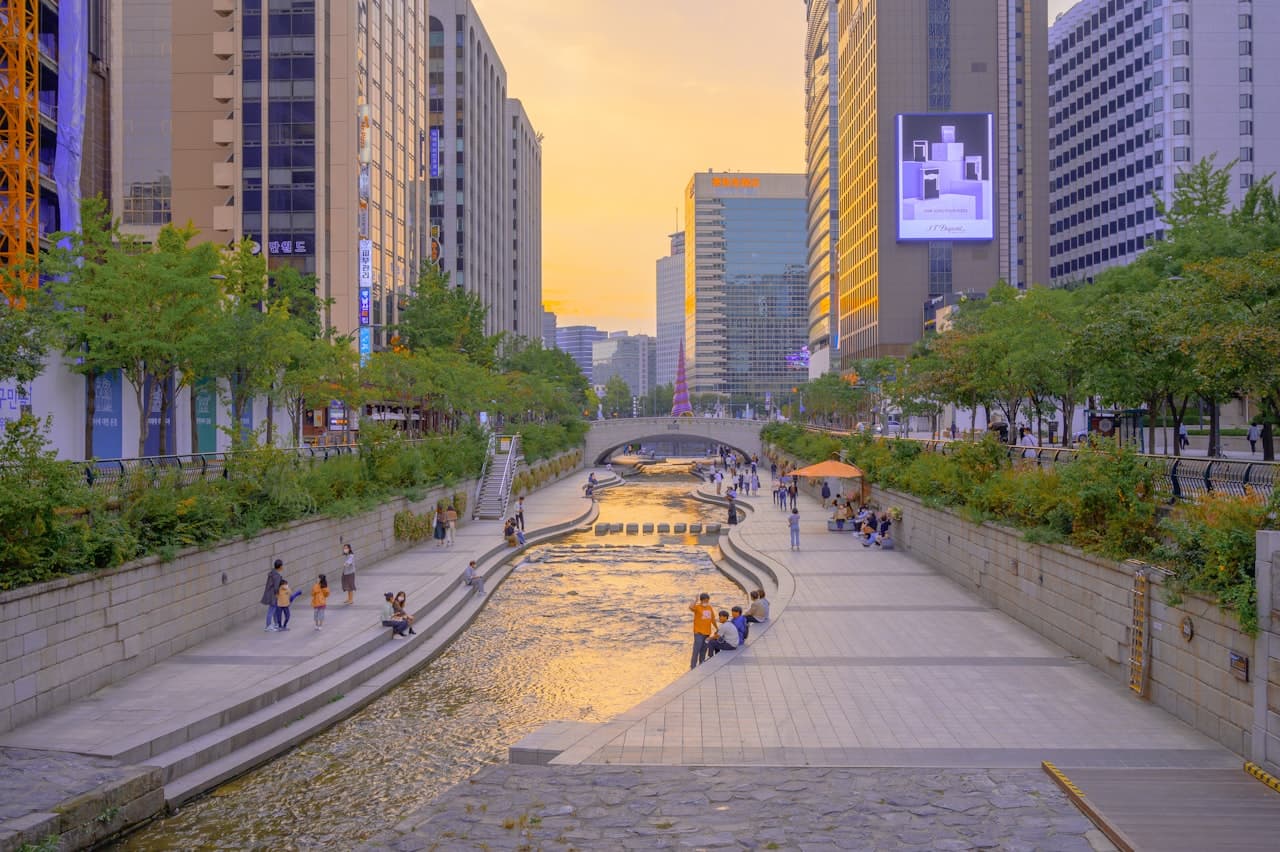
When international audiences first streamed Squid Game in 2021, they encountered something unexpected — not the neon-lit K-pop Seoul of tourism campaigns, but a city of crumbling stairwells, semi-basement apartments, and desperate tent cities on its margins. Netflix later confirmed that the series reached number one in all 93 countries where it tracked viewership, a milestone the platform had never hit with a single title before. The violence was extreme. The premise was surreal. But what made the show impossible to turn away from was the world it inhabited — a recognizable urban system where ambition and despair occupy the same building.
That world was Seoul. And Korean storytelling has been building it, layer by layer, for decades.
A new analysis from HanCinema traces how K-dramas and Korean films have elevated the capital from backdrop to co-protagonist — embedding its spatial logic so deeply into the narrative grammar of Korean content that international viewers are now fluent in a visual language they never formally studied. Architecture means class. Address means identity. Vertical movement — upward or downward — means everything.
Reading the Building: How Korean Storytelling Codes Space
The relationship between Korean narrative and urban space has deep roots. Directors of the 1980s minjung era used cramped markets and back alleys to express political displacement. What evolved over the following decades was something more precise: the elevation of specific addresses into moral shorthand. Jjok-bang (tiny rented rooms), goshiwon (study accommodations), mountain hillside neighborhoods, and Gangnam high-rises became visual vocabulary for entire life trajectories, readable at a glance.
Bong Joon-ho made this architectural subtext explicit in Parasite (2019). The semi-underground dwelling of the Kim family wasn't simply a striking set — it was a thesis. Rain enters from the street. Shoes at pavement level appear in their window frame like a taunt. Every scene filmed below ground is, compositionally, a scene of condescension. When the family ascends into the Park villa's modern glass architecture, the air itself seems to change register. The film won four Academy Awards, including Best Picture, becoming the first non-English language film to claim that honor. International critics praised its storytelling. Korean audiences recognized something older: a visual code they had been reading their entire lives.
Squid Game extended this architectural argument into something systemic. The brutalist Game Island — gray concrete corridors, dormitory bunks, staircase geometry that descends always further down — wasn't arbitrary production design. It mirrored the logic of the social machine that drove its players there. Players fall into debt. They fall into the game. They fall down stairs. The camera rarely lets them rise.
Alone in a City of Millions: The Isolation Aesthetic
Alongside the class-coding of space, Korean urban storytelling has developed a parallel visual tradition: the aesthetics of isolation within density. Seoul is a metropolis of nearly ten million people, yet K-dramas consistently find their emotional center in solitary figures swallowed by crowds that cannot see them. The Han River appears again and again — not as a romantic setting but as a site of withdrawal, a threshold where characters come to think because the city will not stop moving long enough for them to do so elsewhere.
This isn't coincidence. The pressures embedded in contemporary Korean urban life — competitive education pipelines, high housing costs, long working hours, and the social weight of family expectation — create a specific emotional texture that Korean writers have learned to use as narrative material. The character who disappears into a faceless apartment complex after a public failure, who eats convenience-store food alone on a rooftop at 11 p.m., who watches the city at night from a window too high to be seen from below: these images resonate globally because they describe something that cities everywhere produce but rarely acknowledge on screen.
Travel content platforms have reported that K-drama filming locations — Cheonggyecheon Stream, specific café alleys in Hongdae and Insadong, the Mapo Bridge — now attract visitors who describe coming specifically to "see the real Seoul." The city they seek isn't just a geographic location. It's the emotional landscape these dramas mapped for them.
The Escape Narrative: Why Characters Always Want to Leave
Perhaps the most counterintuitive element of Korean urban storytelling is the persistent escape narrative — the recurring dream of leaving Seoul entirely. Characters regularly fantasize about rural provinces, quiet harbor towns, and slow-paced coastal villages where the pressure simply stops. The city is where they must be. It is almost never where they want to be.
This tension has become a distinctive structural feature of Korean drama. The city generates the plot — the job, the rival, the ambition, the debt. The imagined exit generates the longing that shapes character. What makes this tension commercially successful internationally is that it maps onto something nearly universal: the feeling of being held inside an efficient, demanding system that offers no obvious exit while simultaneously containing everything you have worked for.
Productions with the highest international viewership have increasingly leaned into this duality. Seoul's scale — its population density, its architectural contrasts, its visible extremes of wealth and precarity — makes it uniquely capable of holding both sides of that tension within a single frame. The character who gazes at a high-rise tower isn't just looking at a building. They're looking at the gap between where they are and where they're supposed to arrive.
What International Viewers Learn Without Knowing
The cumulative effect of Korean drama's urban grammar is a kind of invisible education. International audiences who have never set foot in South Korea arrive with instinctive knowledge of its social geography. They understand, from the shorthand of location shots, that a character returning to their hometown has failed or retreated. They recognize the specific anxiety of a résumé scene set in a Seoul café because they have watched it dozens of times with different faces. They know, without being told, that Gangnam and Mapo carry different social weight, even if they cannot locate either on a map.
Squid Game Season 3 reportedly drew 60.1 million views in its first three days — another Netflix record, confirming that Korean content's global audience is not contracting between seasons but compounding. The more significant milestone, however, may be invisible: the size of the global viewership that now holds Seoul in imagination as a place they feel they understand, without having physically arrived. Korean storytellers didn't just export entertainment. They exported a city — and the emotional logic of living inside it.
That is a different kind of influence than what Hollywood has historically projected. American cities in global cinema are backdrops for individual transformation. Seoul in K-drama is a system — one that shapes its inhabitants, rewards some and discards others, and never stops demanding. Audiences worldwide have absorbed that lesson not as sociology, but as story. That distinction matters more than any single viewership record.
What Comes Next: Seoul at the Edge of Its Own Frame
The creative challenge facing Korean drama now is what comes after fluency. As global audiences grow more sophisticated in their reading of Korean urban space, the visual shorthand that once carried the weight of an entire social critique requires new elaboration. Newer productions are moving beyond central Seoul — into industrial zones, satellite cities, and the geography of those who couldn't survive the capital's pressure and relocated to its outskirts. The story of the city is expanding to include its edges.
That expansion is itself a map of where Korean storytelling is heading: past the single vertical metaphor of floor-and-basement, toward a more horizontal and complicated picture of what urban life in Korea actually looks like in 2025 and beyond. Seoul will remain the primary character. But it may be, finally, a character complex enough to surprise even the audiences who thought they already knew it.
How do you feel about this article?
저작권자 © KEnterHub 무단전재 및 재배포 금지
Entertainment Journalist · KEnterHub
Entertainment journalist focused on Korean music, film, and the global K-Wave. Reports on industry trends, celebrity profiles, and the intersection of Korean pop culture and international audiences.
Comments
Please log in to comment