JENNIE's 'ZEN' Is Not a Music Video — It's a Mythology
 By Jang Hojin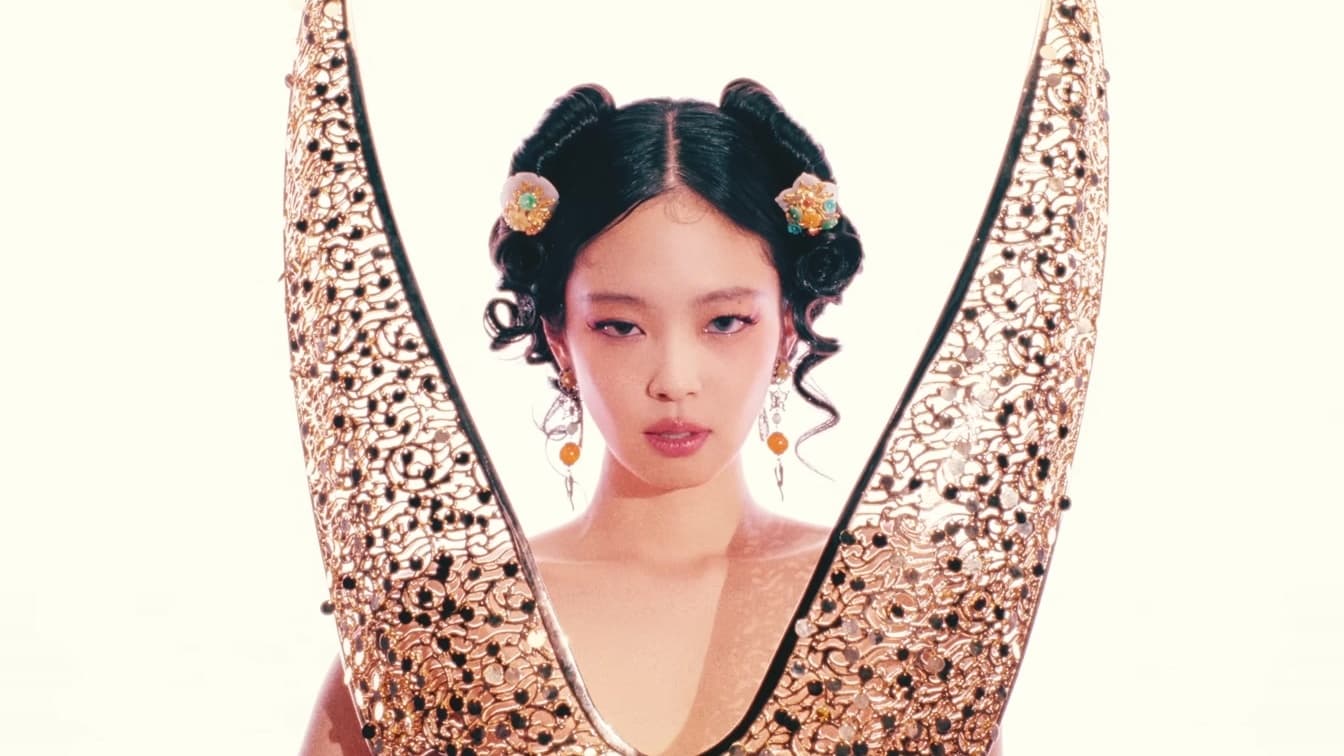
JENNIE drops "ZEN" without warning on January 25, and within hours the music video is trending across five continents. The surprise release lands on her official YouTube channel with no prior teaser, no promotional countdown — just the video itself, fully realized and visually commanding. By the following day, it accumulates 9.1 million views and claims the number-one trending spot on YouTube in 45 countries, including Brazil, Indonesia, the United States, and Mexico. For a solo artist operating between labels and building toward a debut album, that kind of immediate, borderless resonance is not incidental. It is the point.
"ZEN" functions as the first real audio-visual statement of JENNIE's Ruby era, arriving roughly six weeks before the album's March 7 release date. Where earlier coverage of Ruby centered on the announcement itself — its commercial architecture, the OA label context, the global ambitions of her solo project — "ZEN" demands a different kind of attention. This is not a promotional asset. It is an argument: that JENNIE's solo identity is constructed from cultural depth, not commercial calculation. The video makes that argument with unusual authority.
The Director's Vision
The choice of director is itself a statement. Cho Gi-seok is not a typical K-pop music video director. He is a Korean photographer and the founder of the streetwear label KUSIKOHC, whose visual sensibility leans toward surrealism, negative space, and an almost painterly stillness that contrasts sharply with the kinetic maximalism of most idol-adjacent production. His previous music video work includes Red Velvet's "Chill Kill" and LE SSERAFIM's "Unforgivable" — both pieces that prioritized atmosphere over spectacle, concept over choreography showcase.
In "ZEN," Cho's aesthetic translates into something ceremonial. The camera lingers. Frames are composed like museum exhibits — JENNIE positioned within cosmic landscapes, flanked by ancient symbols, lit in tones that oscillate between candlelight warmth and cold celestial blue. There is no hurry in the editing. Sequences breathe. For an artist returning to the solo spotlight after years shared with BLACKPINK's collective identity, the deliberate pacing itself communicates something: she is not trying to catch your attention; she is demanding it on her own terms.
Cho's background in fashion photography also informs how JENNIE's body and face are framed — less as a performer executing moves, more as a figure embedded in myth. The result sits closer to art installation than conventional music video, and it earns that ambition without pretension.
Silla Dynasty as Framework
The conceptual spine of "ZEN" is the Silla dynasty, the ancient Korean kingdom that existed from 57 BC to 935 AD. That span — nearly a thousand years — encompasses one of the most culturally sophisticated civilizations on the Korean peninsula, and crucially for this video, a kingdom with a documented tradition of female authority. The Wonhwa were a prestigious class of female leaders in Silla society, functioning as moral exemplars and cultural arbiters at a time when female civic power was institutionally recognized in ways that remained exceptional in the broader ancient world.
JENNIE is cast, visually and conceptually, as a modern Wonhwa. This is not a superficial costume choice. The gold crown ornaments she wears are directly inspired by excavated Silla artifacts — archaeological objects now housed in Korean national museums, recognizable to Korean audiences as icons of national cultural heritage. When those ornaments appear on screen, they carry the weight of that recognition. Domestic audiences responding virally to "ZEN" are not simply reacting to aesthetic beauty; they are seeing their own history refracted through a contemporary artist's self-presentation.
The video's symbolic vocabulary deepens this framework through three recurring motifs. The Jujak, or Vermilion Bird, appears as an emblem of ethereal beauty and martial strength in Korean mythological tradition — one of the four directional guardians, associated with the south and with fire, power, and protection. The Eurasian eagle owl, native to South Korea, introduces a quality of watchful intelligence, of vision that sees beyond the immediate. And the lotus, loaded with Buddhist resonance in Korean cultural context, is traditionally a symbol of purity emerging from mud — here reimagined as artistic rebirth, the self reconstituted through creative act rather than suppressed by expectation.
Together, these symbols construct a coherent mythological world. JENNIE is not borrowing aesthetic ornament from history; she is positioning herself within a lineage of Korean female figures who exercised power through cultural authority. The conceptual ambition is real, and the execution honors it.
The Song Itself
"ZEN" as a track carries the weight of its visual companion without being overwhelmed by it. The sonic character is measured — unhurried in its opening, then sharpening as the lyrics develop their central argument. JENNIE's vocal delivery stays close to a speaking register in passages, which gives the language room to land with the weight of statement rather than performance.
The line that has circulated most widely since the release — "thick skin layer like chains on chains" — encapsulates the song's thematic core. Confidence here is not presented as effortlessness or innate grace; it is presented as something constructed, accumulated, armored. The chains are not bondage but protection, layered deliberately against exposure. This is a more complex reading of self-assurance than most pop tracks allow, and it connects meaningfully to the energy of "Mantra," the 2024 single that introduced her solo register to international audiences. Where "Mantra" announced arrival, "ZEN" maps the interior architecture of that arrival.
The shooting metaphor woven through the lyrics frames agency as precision — the self as both the one who aims and the one who decides what is worth aiming at. It is language built for someone who has spent years being aimed at by others.
What ZEN Signals
"ZEN" arrives as the first concrete audio-visual evidence of what Ruby will be. Not a trailer, not a promotional clip — a fully realized work that establishes the aesthetic and philosophical register of the album it precedes. The Silla framework, the Cho Gi-seok collaboration, the lyrical focus on self-construction over self-presentation: each of these signals an artist who has used the time between BLACKPINK activities to build a solo identity with genuine specificity.
What March 7 will bring remains to be heard in full. But "ZEN" makes a persuasive case that Ruby will not arrive as a commercial exercise in maximizing existing goodwill. If this pre-release is representative, JENNIE's solo debut album will be an act of cultural positioning — grounded in Korean heritage, shaped by singular creative collaborators, and oriented toward an idea of artistic identity that outlasts any single release cycle. The surprise was not just the timing of the drop. The surprise is how fully formed the vision already is.
How do you feel about this article?
저작권자 © KEnterHub 무단전재 및 재배포 금지
Entertainment Journalist · KEnterHub
Entertainment journalist specializing in K-Pop, K-Drama, and Korean celebrity news. Covers artist comebacks, drama premieres, award shows, and fan culture with in-depth reporting and analysis.
Comments
Please log in to comment