K-Beauty’s Vietnam Shift: Why Trust Now Matters More Than Hallyu
Vietnamese consumers still recognize the Korean beauty halo, but ingredients, compliance and channel discipline now decide which brands keep the sale.
 By Park Chulwon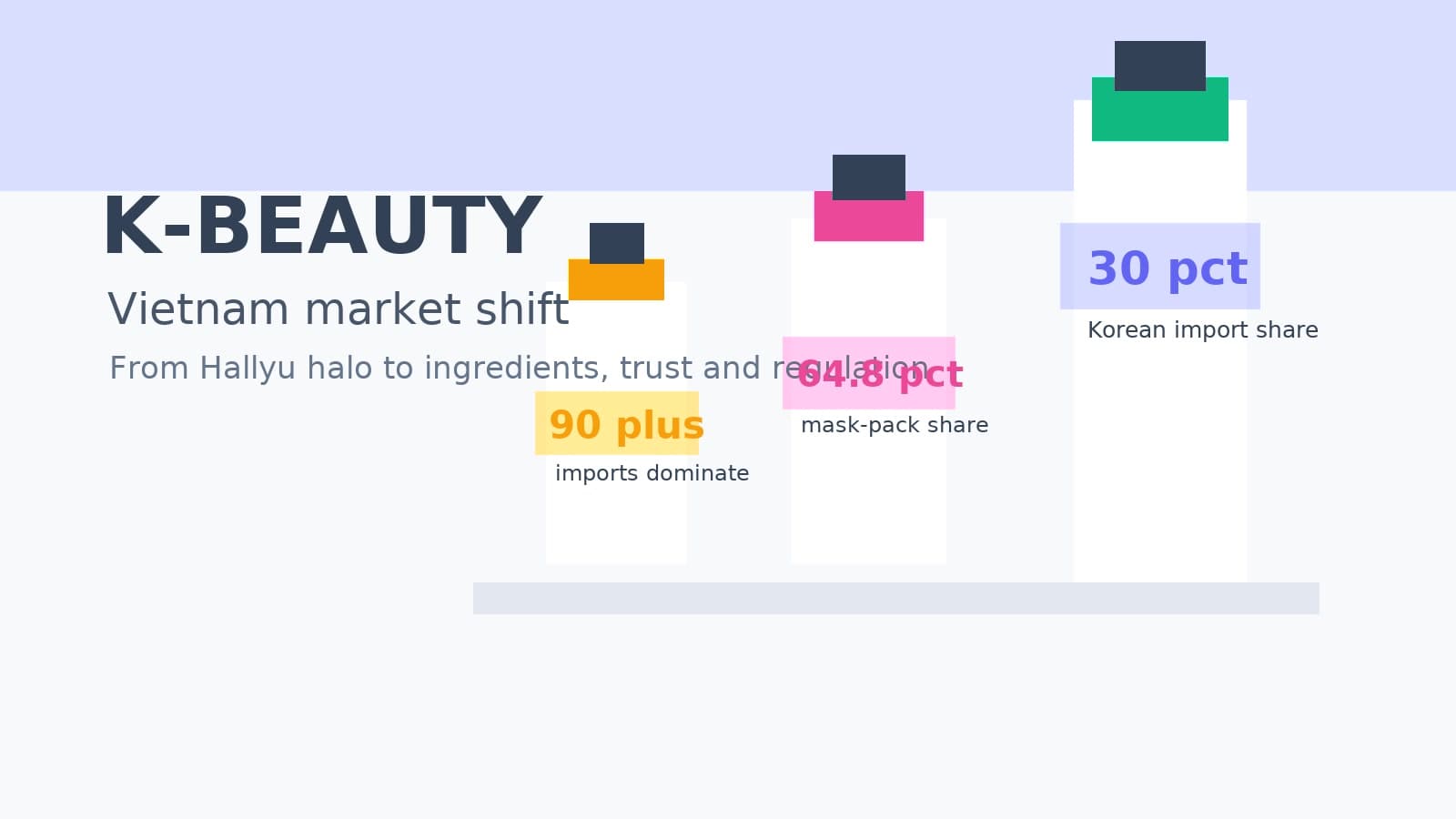
K-beauty's next test in Vietnam is no longer awareness; it is trust. A new local report on Vietnamese consumers suggests that Korean cosmetics still benefit from cultural familiarity, but the purchase decision is moving toward ingredient transparency, real user proof and regulatory confidence.
That shift matters because Vietnam has been one of the more attractive Southeast Asian routes for Korean consumer brands seeking growth beyond China. The old playbook was simple: drama visibility, idol imagery, a polished product story and wide distribution. The new playbook is less forgiving. It asks whether a serum, mask or cream can prove its claims after the Hallyu halo has done its first job.
The angle is clear: this article analyzes how K-beauty’s Vietnam opportunity is shifting from celebrity-led awareness to a trust economy built on ingredients, compliance and channel discipline. That is not a rejection of Korean pop culture. It is a sign that K-beauty has matured enough in Vietnam to be judged like a serious consumer category rather than a souvenir of fandom.
But to understand why this change is important, the market has to be seen in context.
Why Vietnam Became a K-Beauty Test Market
Vietnam has long offered a favorable mix for Korean beauty companies: young consumers, high social-media usage, rising urban incomes and a strong familiarity with Korean entertainment. Market researchers estimate Vietnam’s cosmetics market at about $2.5 billion in 2024, with projections around $3.2 billion by 2030. Vietnam Briefing, citing Statista, separately places the broader beauty and personal care market near $2.74 billion in 2025.
Those figures are not huge compared with the United States or China, but they point to a market where habits are still being formed. That is why Vietnam is strategically useful. A brand can learn how younger Southeast Asian consumers compare Korean, Chinese, Japanese, European and local products in real time. The answer increasingly appears to be pragmatic: shoppers may like Korea, but they still want proof.
The latest Vietnamese consumer feedback reported by Beauty Economy fits that broader pattern. Respondents described Korean pop culture and celebrities as useful for first awareness, not as a final reason to buy. Instead, they emphasized visible effects, safe ingredients, actual reviews and products that fit local skin concerns. The implication is sharp. Hallyu can open the door, but it cannot carry a weak formulation across the checkout page.
That distinction becomes even more important when the competitive field is getting tougher.
The Numbers Show a Market Moving Beyond Image
Vietnam’s beauty sector remains heavily import-driven. Industry summaries from Reach24H and B&Company both describe imported products as accounting for more than 90% of cosmetics sales, while Korean cosmetics represent about 30% of imported sales or market share in their respective summaries. In other words, Korea is not a fringe player. It is one of the standards against which other products are compared.
At the category level, the advantage can be even clearer. Pharmnews, citing Euromonitor, reported that Korean mask packs held 64.8% of Vietnam’s mask-pack market in 2024, far ahead of the United Kingdom at 9.21%, France at 5.22%, Italy at 4.55% and Germany at 4.34%. The same report said Vietnam’s mask-pack market grew from about $12.3 million in 2021 to $15.84 million in 2024, with a projection of roughly $24.43 million by 2029.
The chart tells a useful story. Korea has scale, but scale alone creates exposure. When a category becomes that visible, every recall, mislabeled ingredient or weak claim carries more reputational cost. A smaller challenger can make mistakes quietly. A market leader cannot.
That is where the current debate turns from marketing to operating discipline.
Trust Is Becoming the Real Competitive Moat
The most important phrase in the Beauty Economy report is not “Hallyu decoupling.” It is “ingredients and trust.” Vietnamese consumers are not necessarily abandoning Korean beauty; they are asking Korean brands to justify the premium that cultural affection helped create. That is a healthier but harder stage of growth.
There is a practical reason for the caution. Ajunews reported in February 2026 that Vietnam’s health authorities ordered the suspension and recall of six Korean cosmetics, after eight Korean products had faced registration cancellation or recall six months earlier. The reported issues involved incomplete product information files and ingredient discrepancies. Even if those cases involve specific distributors and products, the broader lesson is category-wide. Trust is easier to lose when the market already expects Korean brands to be safe, advanced and carefully documented.
Chinese beauty brands add pressure from the other side. They can move quickly on price, packaging and social-commerce trends. K-beauty’s best response is not simply to look more Korean or recruit a bigger face. It is to make the Korean proposition harder to copy: clinically credible ingredients, transparent labels, consistent local registration, localized routines and after-purchase reassurance.
The strategic question is no longer whether Vietnamese consumers know K-beauty. It is whether they trust it enough to keep choosing it when cheaper and faster alternatives appear.
This is why ingredient-led trends such as PDRN, retinal, barrier care and derma-style positioning matter. They give brands a vocabulary beyond celebrity association. They also raise the burden of proof. Once a product sells science, consumers and regulators will expect science-grade discipline.
The same shift is visible in how Korean consumer brands are being presented offline.
From Hallyu Event to Channel Strategy
The 2026 Hanoi Hallyu Expo showed that cultural branding still has commercial force. Financial News reported that 107 Korean companies and 277 overseas buyers participated, producing 1,512 consultations and more than $33.26 million in contracts and memoranda of understanding. That is not a soft-power sideshow. It is an export platform.
Yet the details of the expo point to the same transition. Buyers were not only looking for celebrity appeal. They were tracking product trends, ingredients and distribution fit. One Vietnamese importer said Korean trends now travel to Vietnam with little delay, citing PDRN and retinal as examples. That speed is an opportunity, but it also compresses the time brands have to localize claims and prepare compliance documents.
Distribution is another pressure point. Pharmnews reported that health and beauty specialty stores still lead Vietnam’s skincare distribution at 37.7%, while e-commerce has expanded to 27.7%. That split rewards brands that can operate in two modes at once: credible shelf presence for trust and fast digital storytelling for discovery. A brand built only for social virality may struggle in regulated retail. A brand built only for offline counters may miss the consumer conversation.
The winners, then, will not be the brands with the loudest Korean identity. They will be the ones that translate Korean identity into proof at every touchpoint: formula, label, review, store, marketplace and customer service.
That brings the outlook back to the central point.
The stronger reading is that Vietnam is becoming a stress test for the entire post-China K-beauty strategy. For much of the 2010s, Korean beauty companies could treat China as the central growth engine and Southeast Asia as an attractive extension. That hierarchy has changed. As Chinese platforms became more competitive and local Chinese brands improved their speed, price and digital marketing, Korean companies began placing more weight on the United States, Japan, Southeast Asia and the broader Global South.
Vietnam fits that diversification logic, but it is not a simple replacement market. Its consumers are younger and digitally fluent, yet they are also exposed to many beauty systems at once. A Vietnamese buyer can compare a Korean soothing ampoule, a Chinese budget serum, a Japanese sunscreen, a French pharmacy cream and a local natural skincare product in the same shopping session. That level of choice weakens any one country’s automatic advantage.
This is where K-beauty’s entertainment connection becomes both asset and limitation. Korean dramas, idols and lifestyle content still make Korean routines familiar. They help explain why a cushion compact, sheet mask or multi-step routine can feel culturally legible before a consumer has used it. But familiarity is not the same as loyalty. Once the category is understood, consumers begin asking harder questions: Which active ingredient is doing the work? Is the label in Vietnamese? Are the reviews real? Can the product be returned? Was it registered correctly?
That progression is common in maturing consumer markets. The first phase rewards discovery. The second rewards differentiation. The third rewards reliability. Vietnam appears to be moving from the first phase into the second and third at the same time, accelerated by e-commerce and cross-border social media. K-beauty brands that still behave as if they are only introducing Korea may find themselves overtaken by competitors that speak more directly to efficacy and trust.
Regulation also changes the marketing equation. A recall story does not need to involve a top brand to influence the category’s reputation, because consumers often process country-of-origin signals broadly. If a Korean product is recalled for documentation or ingredient inconsistency, shoppers may not distinguish between manufacturer, importer and distributor. They remember that a Korean cosmetic failed a trust test. That is why compliance should be treated as brand work, not back-office work.
The same applies to claims. Words such as derma, clinical, clean, vegan, natural and functional can lift conversion, but they also invite scrutiny. In a market where consumers are learning to read ingredient lists and compare TikTok reviews with marketplace comments, vague language ages quickly. The brands that win will likely pair simple front-end storytelling with deeper proof behind it: certificates, localized FAQs, dermatologist-style education, transparent before-and-after boundaries and clear instructions for humid climates.
There is also a portfolio lesson. Vietnam is not one beauty consumer. Urban Gen Z shoppers may chase fast trends through Shopee or TikTok-style content, while older consumers may prefer pharmacy-like reassurance or family-safe products. Premium shoppers may respond to biotech ingredients and clinic-adjacent language; value shoppers may compare price per milliliter and visible results. A single Hallyu campaign cannot cover those segments. A serious Vietnam strategy needs product tiers, channel-specific hero items and local feedback loops.
For Korean entertainment companies and celebrity marketers, the shift also has implications. Celebrity endorsement will not disappear, but its job is changing. The most effective ambassador may be less useful as a face on a poster and more useful as a bridge into a credible routine: what the product does, when it is used, what skin concern it addresses and why the brand can be trusted. The more mature the consumer, the more endorsement has to serve explanation rather than decoration.
That makes Vietnam a useful warning against lazy global K-wave assumptions. Cultural affection creates an opening, but it does not suspend competition. The market is effectively asking Korean beauty to prove that its innovation is not just aesthetic but operational: better formulas, better documents, better education and better after-sale accountability. In that sense, the decline of pure Hallyu-driven buying is not bad news. It is the price of becoming a normal, trusted category.
For that reason, Vietnam should be read less as a side market and more as a live audit of K-beauty’s next global operating model.
What Comes Next for K-Beauty in Vietnam
K-beauty is not losing Vietnam because Hallyu is less decisive at the point of purchase. It is entering a more demanding phase. The market already knows Korea can set beauty trends. Now it wants to know which Korean brands can keep promises after the trend arrives.
For established companies, this favors stronger local compliance teams, clearer ingredient education and channel-specific product portfolios. For smaller brands, it raises the cost of casual expansion. Vietnam may still reward novelty, but it will punish weak paperwork, vague claims and one-size-fits-all marketing more quickly than before.
The opportunity remains large because Korean beauty still has cultural warmth, category leadership and a reputation for innovation. The risk is assuming those advantages are permanent. In Vietnam’s next K-beauty chapter, the halo gets attention. Trust gets the sale.
How do you feel about this article?
저작권자 © KEnterHub 무단전재 및 재배포 금지
Entertainment Journalist · KEnterHub
Entertainment journalist focused on Korean music, film, and the global K-Wave. Reports on industry trends, celebrity profiles, and the intersection of Korean pop culture and international audiences.
Comments
Please log in to comment