K-Drama Power Map Redrawn: What the 62nd Baeksang Awards Really Mean
Ryu Seung-ryong makes history, OTT platforms score their biggest wins, and a debut musical category signals where Korean entertainment is headed
 By Park Chulwon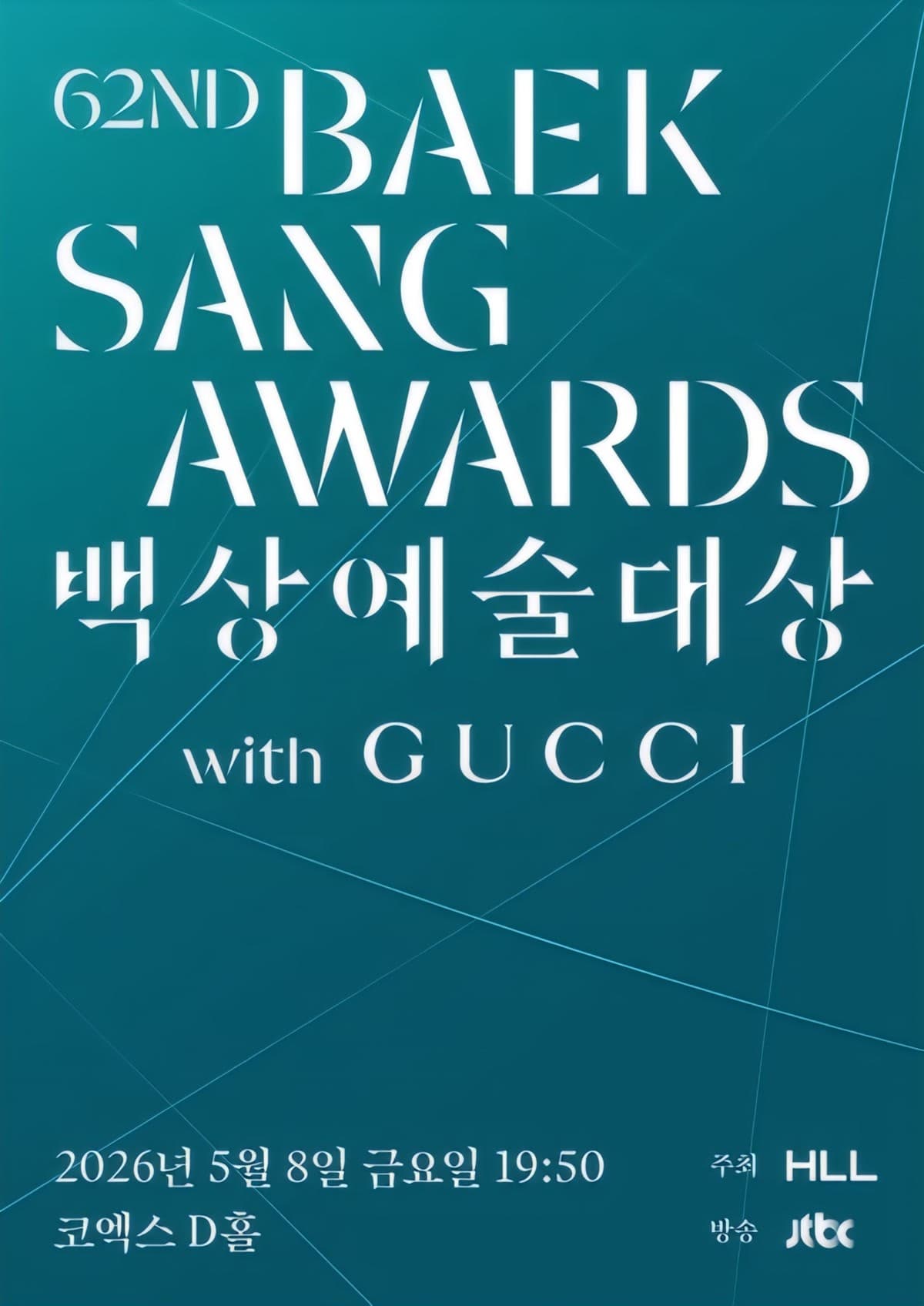
The 62nd Baeksang Arts Awards, held May 8 at Seoul COEX D Hall, were always going to tell us something about where Korean entertainment is headed. They told us more than expected.
Actor Ryu Seung-ryong claimed the broadcast grand prize for his lead role in JTBC "Seoul House, Big Company Employee Kim Manager Story" — a sharp corporate satire that struck a nerve with audiences navigating the real-world anxieties of middle-management life. Yoo Hae-jin took the film grand prize for the historical comedy "A Man Living with the King," a production that reportedly drew approximately 17 million viewers during its theatrical run, making it one of the highest-attended Korean films in recent memory. Both wins were celebrated on their own terms. But the broader story of the night ran deeper than any individual trophy. The 2026 Baeksang quietly rewrote several rules — about where prestige drama lives, who its stars are, and what Korean entertainment wants to be recognized for.
62 Years of Measuring Excellence — and a Changed Landscape
The Baeksang Arts Awards have operated for more than six decades as one of Korea most respected entertainment honors. The ceremony relies on a combination of professional jury assessment and viewership performance, covering film, television drama, variety programming, documentary, and — as of 2026 — musical theatre. This year evaluation period ran from April 1, 2025 through March 31, 2026, capturing twelve months of Korean content production across every platform and format.
Those twelve months coincided with a period of substantial structural change in the Korean entertainment industry. Global streaming platforms now fund, produce, and distribute content that competes directly with traditional broadcasters for talent, production budgets, and audience loyalty. The 62nd Baeksang made that competition official in a way previous ceremonies had only hinted at.
Streaming Platforms Step Into the Winner Circle
The most significant trend from this year ceremony was not any single winner. It was where the winners came from.
Netflix "Silver and Sangyeon" won the broadcast category Best Drama award — among the most prominent Baeksang recognitions for a streaming platform to date. Hyun Bin won Best Actor in the broadcast category for Disney+ "Made in Korea," giving a second consecutive major win to OTT-exclusive content in a single ceremony. Together, those two wins account for exactly half of the four major broadcast drama awards of the night. The other half went to traditional platforms: Park Bo-young took Best Actress for tvN "Unknown Seoul," while the grand prize went to JTBC through Ryu Seung-ryong.
The 50-50 split is not coincidence — it reflects a content landscape that has genuinely divided into two competing models. Netflix and Disney+ have invested heavily in Korean original productions, attracting established stars, ambitious production budgets, and creative mandates that often allow for bolder storytelling than what traditional broadcast schedules permit. The results are now strong enough, consistently enough, to compete for the awards that broadcast networks and cable channels once dominated almost by default. The message to traditional broadcasters is clear: the competition has changed fundamentally.
History Made, Records Broken
Ryu Seung-ryong broadcast grand prize carried historical weight beyond his individual performance. By adding the Baeksang broadcast daesang to his previous film category recognition, he reportedly became the first performer to hold both the film and broadcast grand prizes at Baeksang — an achievement that spans two of the most distinct performance disciplines in Korean entertainment. His character in "Kim Manager Story" — a quietly desperate middle manager trying to survive a conglomerate pressure system — resonated precisely because it felt true. That kind of grounded, unglamorous performance winning the night top broadcast honor says something meaningful about what Korean audiences wanted from their drama this year.
On the film side, "A Man Living with the King" emerged as the ceremony dominant story. Yoo Hae-jin grand prize win was accompanied by Park Ji-hoon sweeping both the Newcomer Award and Naver Popularity Award — jury recognition and popular acclaim arriving simultaneously. The film also claimed the Gucci Impact Award, making it a four-award night. That level of recognition across different measures of success — critical, popular, and commercial — marks "A Man Living with the King" as a genuine crossover achievement by any standard.
Park Ji-hoon dual win warrants attention on its own terms. A jury-voted newcomer award and a popular-vote popularity award won in the same ceremony suggests something relatively rare: a performer whose work connected with both industry professionals and general audiences on first significant exposure. That kind of dual validation tends to launch careers rather than simply mark them. And beyond Park Ji-hoon, the film winning the Gucci Impact Award signals recognition not just from the entertainment industry but from the luxury and cultural sectors that have become important partners in Korean content global positioning.
The inaugural Musical Theatre category adds another dimension to the night reading. Korean musical theatre has long been a significant sector — Seoul is one of the world major musical theatre markets — but had received limited recognition at the country mainstream entertainment awards. The introduction of a dedicated Baeksang musical category, won by "Dream of the Peach Blossom Garden" for Best Work and Kim Joon-su for his performance in "Beetlejuice," signals a broader acknowledgment that Korean entertainment formats are converging in ways the awards structure had not yet reflected.
What the 2026 Baeksang Signals for Korean Entertainment
The 62nd Baeksang results sketch an entertainment landscape that is simultaneously more distributed and more competitive than at any previous point in the ceremony six-decade history. Streaming platforms have the resources and the track record to challenge traditional broadcasters at the industry most credentialed ceremony. Musical theatre is now formally part of the conversation. The definition of what counts as prestige performance — and prestige storytelling — is expanding in real time.
If the night had a thematic throughline, it was this: the categories that matter in Korean entertainment have multiplied, and the quality standard that wins recognition has risen across all of them. Ryu Seung-ryong and Yoo Hae-jin celebrating together on stage — close friends since the beginning of their careers, winning the same ceremony on the same night — was a reminder that behind all the platform strategy and streaming economics, the awards still ultimately go to performances that make an audience feel something. The 62nd Baeksang rewrote some rules. The most important one held.
How do you feel about this article?
저작권자 © KEnterHub 무단전재 및 재배포 금지
Entertainment Journalist · KEnterHub
Entertainment journalist focused on Korean music, film, and the global K-Wave. Reports on industry trends, celebrity profiles, and the intersection of Korean pop culture and international audiences.
Comments
Please log in to comment