Korean At Avignon: Why The K-Wave Is Entering A New Stage
The 80th Festival d Avignon is treating Korean as a language of theater, memory and long-term cultural exchange.
 By Noh Yechan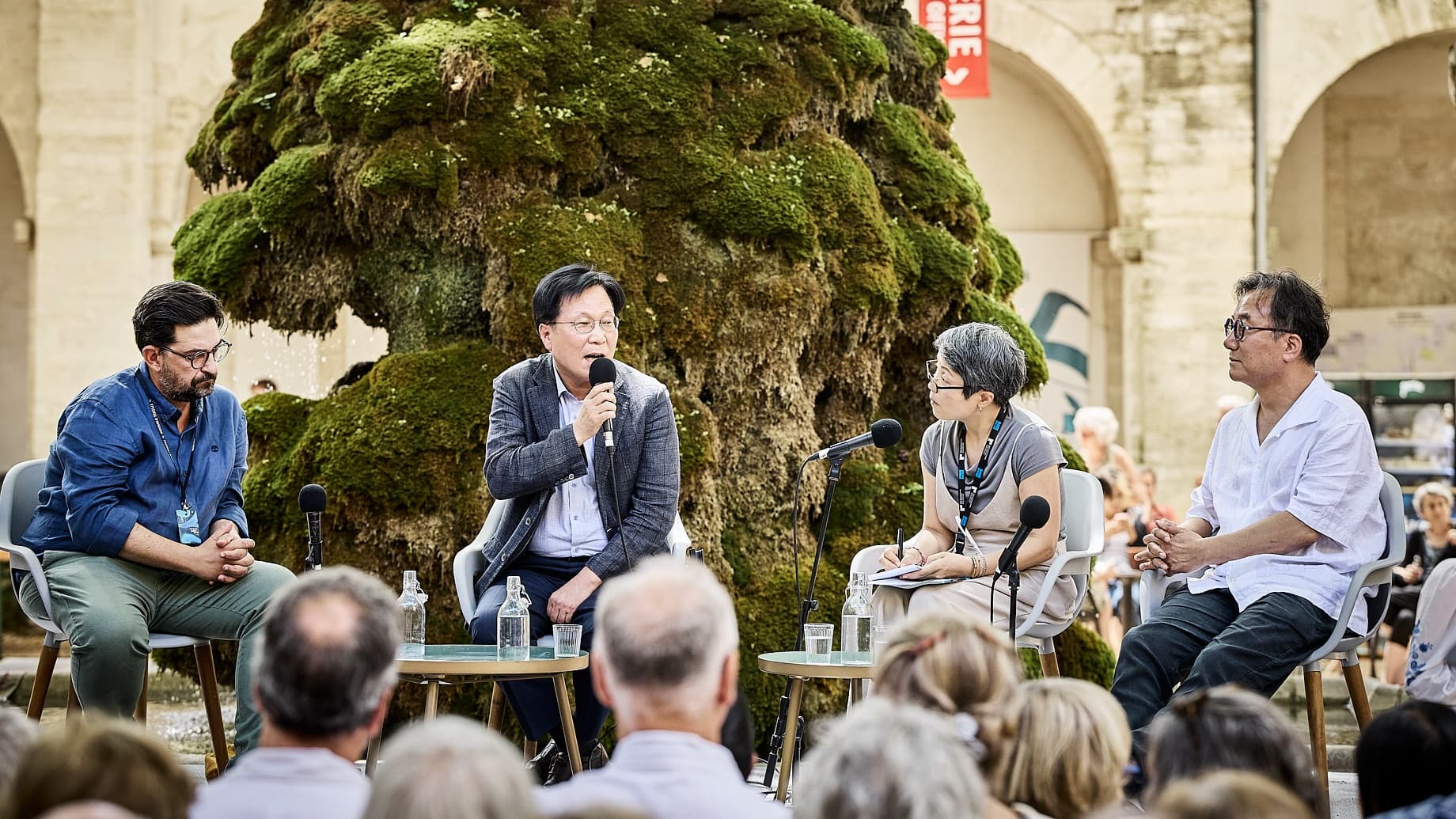
Korean is not appearing at the 80th Festival d'Avignon as a decorative cultural label. It is functioning as a programming principle.
From July 4 to 25, 2026, the French festival is presenting Korean as its guest language, placing Korean performing arts, literature and public-facing language design at the center of one of Europe's most influential theater gatherings. The choice matters because it shows the K-wave moving beyond hit songs, streaming dramas and film awards into the slower, more institutional world of repertory, translation, festival curation and cultural diplomacy. In other words, this is not only a celebration of visibility. It is a test of whether Korean culture can be read as a serious artistic system, not just consumed as a global trend.
The strongest angle is simple: this article analyzes how Korean's guest-language status at Avignon turns the global K-wave from export success into institution-level cultural programming. That distinction is important. Export success depends on attention; institutional programming depends on trust, context and repeatable exchange.
A Festival Slot With Historical Weight
The background gives the moment its force. The Festival d'Avignon's official materials identify Korean as the guest language of its 80th edition, following English, Spanish and Arabic in the program's recent language focus. That sequence puts Korean in a different frame from the usual pop-culture conversation. It is being treated not as a niche Asian-language theme, but as a cultural gateway broad enough to carry theater, dance, literature, cinema, food and public discussion.
Korean reports add the scale. The 2026 festival runs from July 4 to 25, and multiple Korean outlets reported that 9 of the 47 official invited works are Korean productions or Korean-linked works. They also noted that Korean works are returning to Avignon's official program after a 28-year gap. Those numbers matter because they turn soft-power language into measurable programming space. A guest-language label would be thin if it produced only panels and signage. Here, it has changed the shape of the main program.
But the story is larger than one festival cycle. The selection arrives during the 140th anniversary year of Korea-France diplomatic relations, a year already filled with museum, literature and performing-arts exchanges. That timing gives Avignon a double function. It is both a prestigious European stage and a symbolic checkpoint in how Korean culture is being translated for audiences who may know BTS, Bong Joon Ho or Squid Game before they know pansori, Jeju 4.3, contemporary Korean theater or the politics of Korean-language performance.
From Visibility To Curatorial Power
Visibility alone does not explain why Avignon matters. K-pop and K-drama made Korean culture globally familiar, but festival curation asks a harder question: what happens when the audience is not only looking for fandom pleasure, but for artistic language, historical memory and form?
The Korean selection answers with breadth. The official guest-language list includes works such as Island Story, MULJIL, Cuckoo, 1 Degree Celsius, The History of Korean Western Theatre, Haribo Kimchi, KIN: Yeonhee Project, Oiseau and Snow, Snow, Snow. That range is not accidental. It moves from Jeju history and haenyeo labor to migration, food, climate, Western theater history, pansori and contemporary reinterpretations of traditional performance. The curatorial message is clear: Korea is being presented not as a single genre, but as a layered artistic field.
That is where the strategic shift begins. For years, global discussion of the K-wave has often started with commercial reach: chart rankings, streaming scale, box-office records and fandom mobilization. Avignon starts somewhere else. It asks how Korean artists handle memory, embodiment, humor, grief, language and audience participation. The result is less immediately viral, but potentially more durable. It builds interpretive pathways for programmers, critics, translators and theater audiences who decide which works tour, which artists receive commissions and which subjects enter the European cultural conversation.
The chart is deliberately simple because the strategic reading is straightforward: Korean content is not merely present; it occupies nearly one-fifth of the official invited program, while the 28-year return gap gives that presence historical weight. So what? It means Korean performing arts are entering Avignon with enough density to be interpreted as a season-defining theme rather than a guest appearance.
Why The Works Chosen Matter
Still, the numbers are only the entry point. The deeper signal lies in the kind of Korea being introduced. This is not a clean tourism brochure. Several works foreground difficult histories, unstable identities and the politics of memory.
Han Kang's presence is central to that reading. Avignon is presenting Oiseau, connected to her novel We Do Not Part, with Isabelle Huppert and Lee Hye-young reading on the festival's symbolic stage. Another adaptation, Daria Deflorian's Che dolore terribile è l'amore, draws from the same novel's French edition and places Jeju 4.3 in a European theatrical frame. That matters because Han's global literary profile is being used not to soften Korean history, but to make traumatic memory legible across languages.
Jaha Koo's works push the same logic through another doorway. Haribo Kimchi turns food, migration and humor into a participatory performance, while The History of Korean Western Theatre questions what it means for Korean theater to carry Western forms. These are not simple identity displays. They ask audiences to think about translation as pressure: what changes when a culture performs itself abroad, and what remains stubbornly local?
Traditional forms are also being reframed rather than preserved under glass. Lee Jaram's Snow, Snow, Snow and Liquid Sound's KIN: Yeonhee Project point to pansori and nongak as living vocabularies that can be rebuilt for contemporary stages. That distinction is crucial. A heritage showcase says, look at what Korea has. A contemporary performance program says, watch how Korea thinks with what it has inherited.
The Market Impact Beyond The Stage
Avignon's influence is not limited to the audience in the seats. A successful festival run can affect touring prospects, institutional partnerships, translation demand and the way Korean artists are discussed by European critics. That is why the reaction reported on the ground matters. Korean outlets described sold-out or hard-to-book performances, long lines at Korean literature events and strong local interest in Han Kang's books and related programming.
This response also exposes a useful difference between fandom and cultural adoption. Fandom can be fast, loud and concentrated around specific artists. Cultural adoption is slower. It happens when bookstores reorder translated novels, theatergoers ask about Korean playwrights, programmers track touring-ready works and local media treat Korean language as an artistic structure. Avignon appears to be creating that slower layer.
The important shift is not that Europe has discovered Korea. It is that Korean artists are being invited to define the terms of discovery.
There is an industry lesson here for K-entertainment. Global platforms have already proved that Korean stories can travel when distribution is strong. Avignon suggests a different route: prestige circulation through festivals, cultural institutes, co-productions and translators. That route may not deliver the same immediate numbers as a Netflix chart or a music-video launch, but it can create long-term authority. For artists working outside commercial television and idol music, that authority is often the difference between one-off curiosity and sustained international careers.
What Comes Next
The future question is whether Avignon becomes a milestone or a model. If the 2026 program leads to touring invitations, stronger Korea-France festival exchange and more translation infrastructure for Korean performance texts, the guest-language year will have done more than mark a diplomatic anniversary. It will have expanded the map of the K-wave.
The risk is that institutions treat the moment as a one-year spotlight and move on. The opportunity is better. Korean culture has already proved it can dominate popular platforms; Avignon shows it can also occupy difficult, prestigious and multilingual spaces. That is a quieter kind of power, but for the next phase of global Korean entertainment, it may be the more important one.
How do you feel about this article?
저작권자 © KEnterHub 무단전재 및 재배포 금지
Film & Global Culture Reporter · KEnterHub
Film and culture reporter following Korean cinema from Chungmuro to Cannes. Noh Yechan covers theatrical releases, festival circuits and award season, and writes about how Korean entertainment reshapes global pop culture.
Comments
Please log in to comment