Korea's 240.6 Billion Won K-Culture Tech Bet, Explained
The 2027 proposal links immersive concerts, AI copyright and exportable fan experiences.
 By Park Chulwon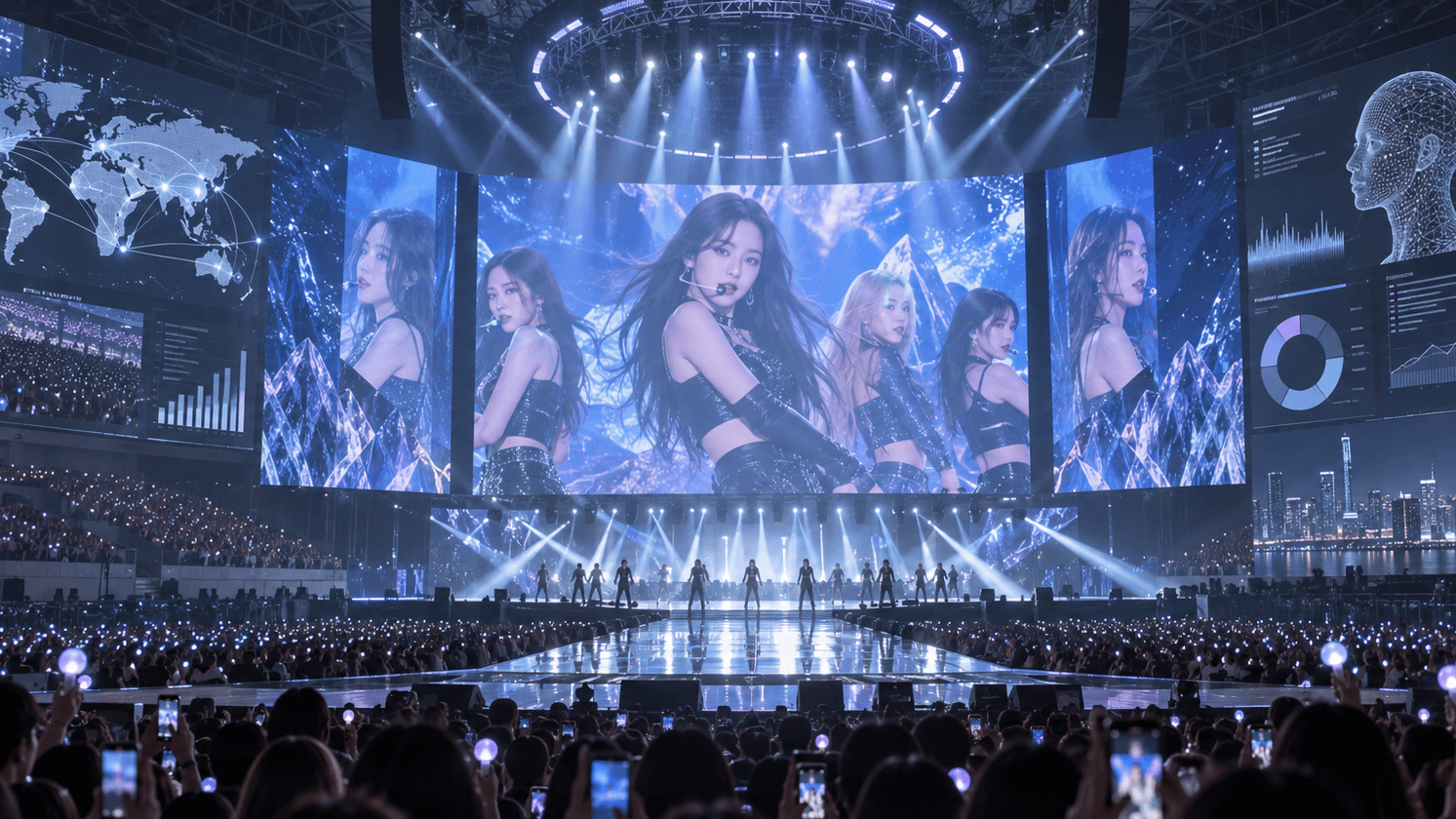
Korea is turning K-culture infrastructure into a budget line. On September 8, 2026, the Ministry of Culture, Sports and Tourism outlined a 240.6 billion won culture-technology ecosystem proposal for 2027, placing immersive live performance, AI copyright systems, museum data, and commercialization support inside one industrial frame. The number is not only larger than before. It signals that the government increasingly sees concerts, fandom experiences, and content IP as technology markets, not just cultural exports.
The headline figure gives the policy its force. The 2027 proposal is up 13.7 percent from the 2026 main budget of 211.5 billion won, according to the ministry figures reported by Kyunghyang Shinmun on September 8, 2026. Within that total, R&D receives 177.4 billion won, private-investment-linked culture technology funds receive 60 billion won, and commercialization support receives 3.2 billion won. That split matters because it shows the state is not funding only research labs. It is trying to connect prototypes, financing, and exportable entertainment formats.
Why This Budget Is Really About The Stage
But the most revealing line item is not the largest one. It is the new 25 billion won K-culture live performance experience R&D project, the first large-scale R&D program of its kind since the ministry began culture R&D work in 2003. Its stated goal is commercialization by 2030, with technologies that let audiences experience concerts and sports as if they were physically present in theaters or specialized venues.
That is a direct response to how K-pop value is changing. Album sales and streaming remain crucial, but the premium layer of the business is increasingly built around live access, fan-event scarcity, and multimedia participation. A concert is no longer only a room with a stage. It is a data-heavy production pipeline involving cameras, spatial audio, LED environments, ticketing, membership platforms, translation, rights clearance, and secondary content.
For K-entertainment companies, that means the government is funding a problem they already face. Global fans want proximity without always being able to travel to Seoul, Tokyo, Los Angeles, or Bangkok. If immersive venues can reproduce some of the value of attendance, the market expands beyond tour routing. That is why this budget belongs in the K-entertainment conversation: it targets the infrastructure underneath fandom monetization.
The Numbers Show A Shift From Support To Scale
The year-on-year comparison is the core signal. Culture technology funding moves from 211.5 billion won in the 2026 main budget to 240.6 billion won in the 2027 proposal, a rise of 29.1 billion won, or 13.7 percent. R&D grows faster inside that frame: the ministry set 177.4 billion won for 2027 R&D, up 17.1 percent from the previous year. So the policy is not merely maintaining existing programs. It is pushing the technical layer of K-culture faster than the overall culture-technology total.
Bar chart comparing Korea's culture technology ecosystem budget from 211.5 billion won in 2026 to 240.6 billion won in the 2027 proposal, a 13.7 percent increase. 0 60bn 120bn 180bn 240bn 211.5bn won 240.6bn won 2026 main budget 2027 proposal Culture Technology Funding Rises 13.7% Source: MCST figures reported September 8, 2026
The supporting allocations clarify the strategy. The 2027 plan assigns 60 billion won in public money to a culture technology fund that is designed to match 40 billion won from private investors, creating a 100 billion won fund. It also earmarks 6.2 billion won for K-museum technology, 5 billion won for K-culture field-solution technology, 3.1 billion won for AI copyright trust governance, and 3.2 billion won for global commercialization and market creation. These are small compared with flagship content budgets, but they define where friction is appearing: rights, data conversion, venue technology, and overseas market entry.
The broader fiscal context is also important. Korea Herald reported on September 4, 2026 that the culture ministry's total 2027 budget proposal reached 9.634 trillion won, up 22.6 percent from 7.855 trillion won this year. Seoul Economic Daily noted that the culture R&D budget of 177.4 billion won is still only about 0.45 percent of the government's total 39.5 trillion won R&D budget for next year. That contrast keeps the story grounded. Culture technology is growing, but it remains a targeted bet rather than a dominant national R&D pillar.
AI Copyright Is Not A Side Issue
The 3.1 billion won AI copyright trust governance project may look modest next to the 25 billion won live-performance program. It could prove just as consequential. K-pop and K-drama production increasingly depend on tools that generate drafts, voices, translations, subtitles, choreography references, visual concepts, and marketing materials. Without trusted rights infrastructure, every efficiency gain creates a new clearance problem.
That is why copyright technology belongs beside immersive concert R&D. A virtual concert, fan translation product, AI-localized video, or archive-based museum experience cannot scale globally if rights ownership is opaque. The technical challenge is not simply detecting infringement. It is building systems that let agencies, creators, platforms, and overseas partners verify what can be used, licensed, monetized, or blocked.
For entertainment companies, this is where policy can reduce operational risk. A label may experiment with AI-assisted subtitles or interactive fan content, but it needs defensible rules before those experiments become products. Public funding does not solve the creative question. It can, however, standardize the trust layer that lets companies move faster without creating avoidable legal exposure.
Impact For K-Entertainment Companies
The immediate winners are unlikely to be only idols or drama studios. The budget points toward production-tech vendors, venue operators, rights-management companies, archive digitization teams, and IP commercialization firms. That ecosystem matters because the next phase of K-culture exports will not be carried by hit songs alone. It will be carried by repeatable systems that turn hits into scalable experiences.
The 2030 deadline attached to immersive live performance is especially useful. It gives companies and investors a planning horizon that matches the government's wider K-culture ambition. Yonhap reported on May 28, 2026 that Culture Minister Chae Hwi-young set a goal of expanding the K-culture market to 400 trillion won by 2030, up from the previous 300 trillion won target. Seoul Economic Daily separately described the 2025 K-culture market scale as 274 trillion won. Moving from 274 trillion won in 2025 to 400 trillion won by 2030 requires more than export promotion. It requires new monetization surfaces.
That is the deeper meaning of this proposal. A 240.6 billion won budget will not transform K-entertainment by itself. But it tells the industry where the state expects the next bottlenecks to appear: immersive access, AI-era rights, commercialization, and globally portable technology. If those pieces mature, Korean entertainment companies will have more than successful content. They will have infrastructure that makes success travel farther.
The Commercialization Gap
The policy's strongest feature is also its most difficult promise: it tries to move culture technology from demonstration to repeatable business. Korea has already shown that digital performance can create attention, but attention is not the same as a market. A one-off immersive concert may impress fans for a weekend. A scalable platform needs standardized production workflows, predictable venue economics, reliable rights handling, and enough high-demand artists to keep utilization high across the year.
That is where the 100 billion won fund becomes more than a financing footnote. Because 60 billion won is public capital and 40 billion won is expected from private investors, the fund is designed to test whether culture technology can attract market discipline rather than survive only as a subsidy category. The ratio matters. A government-only fund can keep prototypes alive; a matched fund asks whether companies can build revenue models that convince outside capital.
For entertainment agencies, this could change how experimental projects are evaluated. A label considering an immersive fan exhibition, AI-localized concert film, or virtual venue partnership usually has to decide whether the project is marketing, technology, or new IP. The budget structure encourages companies to treat those categories together. That may make projects easier to finance, but it also raises expectations: pilots will need measurable attendance, licensing, repeat usage, or export demand.
The smaller line items point to the same commercialization problem from different directions. The 3.2 billion won global commercialization program is not large, but it directly acknowledges that culture technology needs overseas buyers and partners. The 5 billion won field-solution project suggests that the ministry is also listening to practical production pain points, not only futuristic stage concepts. If those programs are selected well, they can help small and mid-sized vendors attach themselves to the larger K-content export machine.
Why The 2030 Target Raises The Bar
The 2030 commercialization target for immersive live-performance technology gives the policy urgency. It is close enough to force near-term decisions, but far enough to require infrastructure rather than publicity. Between 2027 and 2030, the ministry and its partners will need to move through research selection, prototype development, venue testing, artist participation, audience feedback, rights clearance, and export packaging. Each step can weaken the project if it is treated as a separate administrative task.
The timeline also overlaps with the broader K-culture market ambition. The government's stated goal is to reach a 400 trillion won K-culture market by 2030, after a 2025 scale described at 274 trillion won in Seoul Economic Daily's reporting. That implies an increase of 126 trillion won over roughly five years. Hit dramas, idol albums, and tourism campaigns can contribute, but the size of that gap explains why policymakers are now looking at technology layers that can multiply existing IP.
Immersive concerts are a clear example. A successful world tour is constrained by dates, artist stamina, venue availability, freight costs, and local ticket prices. A well-built immersive format could extend the economic life of the same performance into theaters, museums, pop-up venues, fan conventions, and education-linked cultural showcases. It would not replace live touring. The more realistic business case is additive: more markets, more formats, and more price points around the same creative asset.
That additive model is particularly relevant for acts below the stadium tier. Top groups can already justify global tours and premium concert films. Mid-tier artists, legacy acts, musical productions, and drama-related IP may benefit more from shared immersive infrastructure because they cannot always carry the full cost of international staging alone. If public R&D lowers the fixed cost of the technology, the export opportunity becomes less concentrated among the largest agencies.
The Risk Of Measuring The Wrong Outcome
The main risk is that policymakers measure inputs instead of adoption. A bigger budget, a new fund, and several named programs are easy to announce. The harder question is whether the technology reaches real production schedules. By 2028, the meaningful indicators should include signed agency partnerships, venue pilots, export contracts, licensing standards, and repeat audiences. Without those, the 13.7 percent increase from 211.5 billion won to 240.6 billion won will look like administrative growth rather than industrial leverage.
There is also a creative risk. K-entertainment succeeds globally because audiences care about artists, stories, choreography, humor, and emotional access. Technology can intensify those qualities, but it cannot substitute for them. A virtual stage that makes fans feel farther from the performer will fail even if the engineering is impressive. That is why artist-side participation should be built into the R&D process early, not added after prototypes are finished.
AI copyright governance faces a similar adoption test. A rights system that is too vague will not help labels move faster. A system that is too restrictive may discourage legitimate experimentation with subtitles, localization, archival restoration, synthetic guide tracks, or fan-platform features. The useful middle ground is practical: clear metadata, trackable permissions, faster licensing decisions, and audit trails that overseas partners can understand.
If the ministry can align those incentives, the budget could have an effect beyond its nominal size. The 177.4 billion won R&D allocation is only 0.45 percent of the government's total 39.5 trillion won R&D plan, according to Seoul Economic Daily. That small share means culture technology cannot win by spending like semiconductors or defense. It has to win by choosing projects where Korean entertainment already has demand, talent, and global distribution waiting for better tools.
What To Watch Next
The proposal still needs to move through the budget process, so the final figures may change. The key test is whether the new programs survive as executable projects rather than attractive labels. Culture technology often sounds persuasive in policy language; the harder measure is whether artists, labels, venues, and fans actually feel the upgrade.
Three indicators will matter in 2027. First, whether the live-performance R&D program selects partners with real entertainment deployment experience. Second, whether the AI copyright project creates usable standards rather than only research reports. Third, whether the 100 billion won culture technology fund brings private investors into companies that can export products, not only prototypes. If those conditions are met, this budget could become one of the quieter foundations under K-culture's next global phase.
How do you feel about this article?
저작권자 © KEnterHub 무단전재 및 재배포 금지
Entertainment Journalist · KEnterHub
Entertainment journalist focused on Korean music, film, and the global K-Wave. Reports on industry trends, celebrity profiles, and the intersection of Korean pop culture and international audiences.
Comments
Please log in to comment