Ladies' Code Sojung Returns With 'You Ruined Me' — And It's Her Most Honest Work Yet
The singer's latest single strips away the polish and delivers a breakup ballad that hits where it should
 By Jang Hojin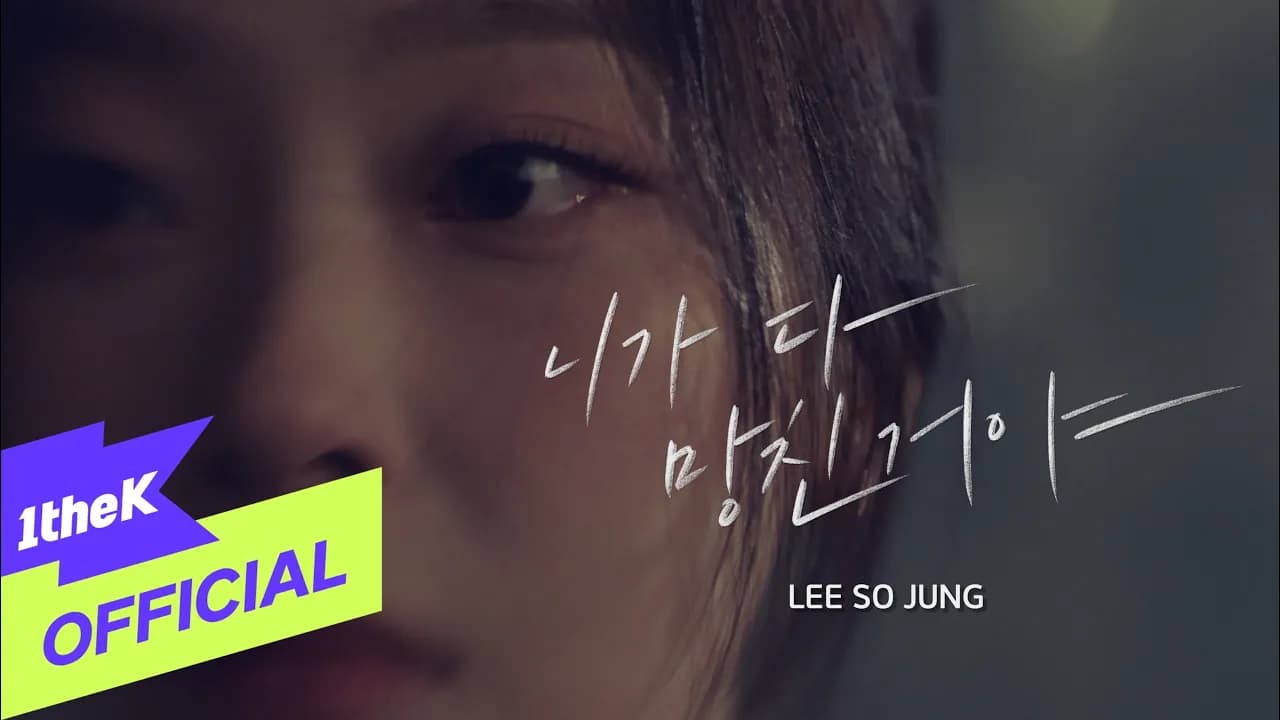
There's a particular kind of Korean ballad that doesn't ask permission to wreck you — it just does it, cleanly and thoroughly, and leaves you sitting with whatever feelings it excavated. Ladies' Code vocalist Sojung arrived with exactly that kind of song on April 5, 2026, when she released her new single 'You Ruined Me' (니가 다 망친거야), along with a music video that matches the song's emotional intensity scene for scene.
The single, uploaded to the 1theK (원더케이) YouTube channel and distributed through streaming platforms, marks a significant new entry in Sojung's solo catalog — one that confirms her position as one of the most emotionally direct vocalists working in Korean pop today.
What the Song Is Actually Saying
The title carries its own weight before a single note plays: 'You Ruined Me.' Not 'You Hurt Me,' not 'I Miss You,' but something blunter, more accusatory, and paradoxically more intimate. The lyrics take that premise and do something unexpected with it — rather than building toward anger or resolution, they spiral deeper into the contradictions of not being able to let go of someone who has already caused damage.
The central lyric — "니가 날 다 망친거야, 이렇게 만든 건 너야" ("You're the one who ruined me, you're the one who made me this way") — sits alongside its own counterargument: "결국엔 난 너여야 해, 너 아니면 나는 안 돼" ("In the end, it has to be you, I can't exist without you"). The song doesn't resolve this tension because it isn't interested in resolving it. It wants to sit inside it, and Sojung's vocal performance is the reason that works.
Her approach here reflects something that makes the best Korean ballads effective across language barriers: the emotional information in her phrasing is legible before the literal meaning is. The buildup, the crack in the voice at key moments, the places where she chooses restraint before the eventual full-volume release — these function as their own language, and Sojung is fluent in it.
The Music Video: Choi Heejin Brings It to Life
The visual component of 'You Ruined Me' adds a significant layer to the single's emotional weight. The music video stars actress Choi Heejin, who takes on the role of someone navigating the immediate aftermath of a breakup — not the dramatic, cinematic version, but the unglamorous internal one that happens when the other person has already left and the feelings are still arriving in waves.
Korean entertainment media praised Choi Heejin's performance for its specificity and restraint. Rather than broad, easily-readable emotional signals, the actress layers the character's state in increments: an initial composed grief that slowly gives way to the kind of emotional explosion that the song's second half demands. The progression mirrors the lyrical arc so precisely that the visual and audio elements reinforce rather than duplicate each other.
Directors who work with music videos face a particular challenge when the song is this direct — the instinct is often to find metaphors and visual indirection to add 'depth.' The 'You Ruined Me' video largely resists that approach, trusting the song and the performance to carry the weight, and that restraint turns out to be the right call.
Sojung in Context: Ladies' Code and Beyond
Sojung has been a fixture in the Korean music industry as the lead vocalist of Ladies' Code, the group she debuted with in 2013 under Polaris Entertainment (now SARAMS Entertainment). Over the years, she has developed a parallel solo career built around exactly the kind of emotionally demanding material that 'You Ruined Me' represents.
Her voice has always been the group's most defining instrument — a combination of technical control and emotional transparency that doesn't hide behind polish. That quality is even more pronounced in a solo context, where there is no ensemble to frame or balance the sound. A vocalist either fills that space or doesn't, and Sojung consistently does.
The 1theK release places the single in the company of a catalog that spans major K-pop acts from across the industry — a context that frames 'You Ruined Me' not as an outlier but as a continuation of what Korean ballad artistry has been building toward for years.
Why This Song Lands the Way It Does
The specific emotional register of 'You Ruined Me' — post-breakup stasis, the inability to assign clean blame or achieve clean release — is one that Korean pop songwriters have returned to repeatedly, and for good reason: it's one of the few emotional states that everyone experiences but that is genuinely difficult to articulate in language that doesn't sound either clichéd or overwrought.
Sojung and her collaborators found a lyrical approach that avoids both traps. The directness is earned, not cheap. The contradiction at the song's core — 'you ruined me and I still need you' — is the kind of emotional logic that takes courage to put into a song because it refuses to make the narrator sympathetic in an uncomplicated way. The listener is asked to understand a feeling that doesn't make rational sense, and the best breakup songs have always asked exactly that.
With 'You Ruined Me' now out and already generating discussion among Korean music listeners, the question is what Sojung does next with this momentum. If this single is any indication, she is working at a level of artistic clarity that would make whatever comes next worth waiting for.
The Ladies Code Legacy and What It Means for Solo Work
Understanding where Sojung comes from as an artist adds texture to what "You Ruined Me" represents. Ladies Code debuted in 2013 and quickly developed a fanbase drawn to the group's combination of sharp choreography and vocal depth — a combination that set them apart in a group landscape that often prioritized one quality over the other. Sojung, as the lead vocalist, was the anchor of that vocal identity.
The group went through a period of significant difficulty that reshaped both their personal lives and their public trajectory in ways that are still part of how long-term fans understand the group's story. What followed has been a gradual, consistent rebuilding — music that has grown quieter and more inward, resulting in solo material that operates in a more intimate register than the group's earlier work.
"You Ruined Me" is a product of that trajectory. It is a song that could only have been made by someone who has been through enough to understand that the most honest emotional statements are often the most complicated ones — those that do not resolve cleanly, that hold contradictory truths simultaneously, that resist the pressure to deliver a hopeful ending because life does not always provide one. That maturity is audible throughout the single, in the writing, the arrangement, and most of all in Sojung's voice. For listeners who have followed her career from its beginning, the song feels not like a departure but like an arrival.
How do you feel about this article?
저작권자 © KEnterHub 무단전재 및 재배포 금지
Entertainment Journalist · KEnterHub
Entertainment journalist specializing in K-Pop, K-Drama, and Korean celebrity news. Covers artist comebacks, drama premieres, award shows, and fan culture with in-depth reporting and analysis.
Comments
Please log in to comment