Lee Sang-min Cleared His Debt — Now He's Back to Making K-Pop Stars
The producer behind Diva and Chakra returns to idol development with 232 Project, and his standards are exactly what you'd expect
 By Jang Hojin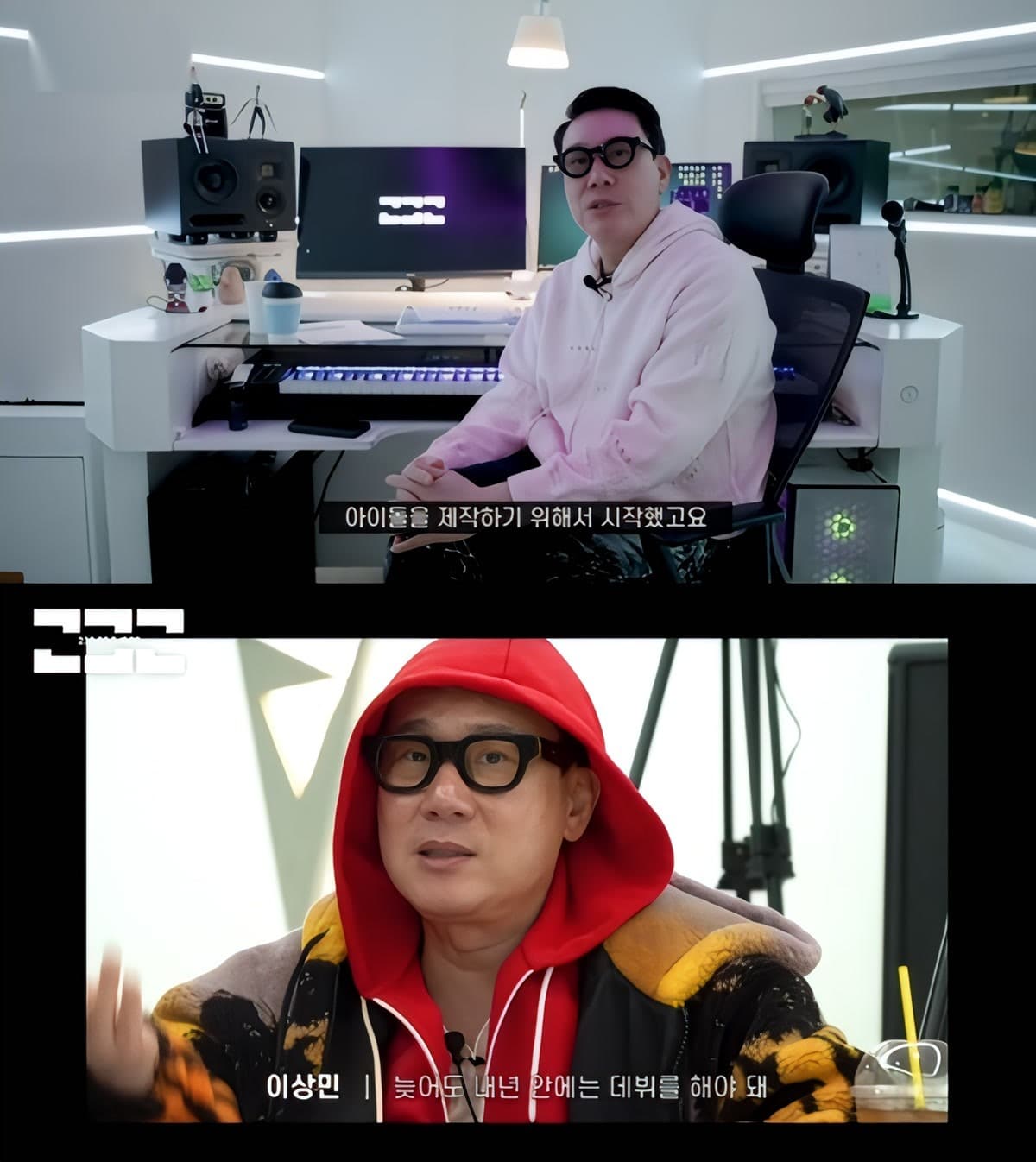
Seventeen years of debt. Over 6.9 billion won in obligations, growing as creditors added interest and penalties. And now, on the other side of all of it, Lee Sang-min is back in a recording studio — not as a performer, but as the person who built some of the most distinctive K-pop acts of the early 2000s. He is making idols again.
The latest episode of his YouTube channel, 232 Project (232 프로젝트), documents Lee Sang-min's visit to 1MILLION Dance Studio in Seoul to evaluate the trainees he has been developing. With dance mentor Lia Kim — one of Korea's most respected choreographers — at his side, Lee Sang-min watched his trainees and made his assessments with the bluntness that has become his television signature. When one trainee, Yun Su-min, failed to meet his standards, his feedback was direct: "You're doing very badly today."
How He Got Here
Lee Sang-min debuted in 1994 as a member of the group Rula (룰라), which became one of the defining acts of the early Korean pop era. His appeal was not just as a performer but as a personality — a natural entertainer with a gift for generating audience reaction. After Rula, he moved into production and management, building girl groups that deliberately positioned themselves against the genre's prevailing aesthetic.
In the late 1990s and early 2000s, when the clean, fresh-faced girl-group image ruled Korean pop — with groups like S.E.S. and Fin.K.L dominating charts — Lee Sang-min produced Diva (디바) and Chakra (샤크라), both built around a harder, more sophisticated concept. They were commercially successful precisely because they went in a different direction. His instinct for finding a gap in the market and building something to fill it was the clearest indicator of where his talents actually lay.
Then things collapsed. In the mid-2000s, a series of failed business ventures left him with debts that dwarfed what most people earn in a lifetime. The initial figure reported publicly was 6.9 billion won — but Lee Sang-min himself has acknowledged that the real amount was higher from the start. "The 6.9 billion was just the starting amount," he explained in a recent variety appearance. "Once I started making money again, the creditors decided they should be receiving more." For seventeen years, servicing and eventually eliminating that debt was the central fact of his life.
He completed repayment in 2023. The following years brought a high-profile variety show comeback, an entertainment award, and now — most significantly — a return to the work that first defined him as someone with a specific vision of what K-pop could be.
What the 232 Project Is
The 232 Project is Lee Sang-min's attempt to apply everything he knows about idol production to a new generation of performers, documented in real time on YouTube. The name references the configuration of the group he intends to build. He has already released two tracks to establish a musical direction: "GENIUS" and "I AIN'T THE ONE" — both showing a sound that leans toward the more international, production-forward end of contemporary K-pop rather than the softer idol mainstream.
The project is explicitly structured as a development reality: viewers follow the trainees through evaluation, feedback, and progress in a format that recalls the survival-show tradition without the elimination-driven drama. Lee Sang-min is not trying to manufacture a moment — he is trying to make a group, on his own timeline and on his own terms.
The 1MILLION Dance Studio visit brought in Lia Kim to provide an independent dance assessment. Lee Sang-min wanted a professional opinion on where his trainees actually stood — not measured against studio expectations, but against the honest standard of someone whose only stake in the outcome was the quality of the evaluation itself.
The Feedback Session
What emerged from the session was a portrait of Lee Sang-min's production philosophy in action. When Lia Kim assessed trainee Park Hye-na, she highlighted natural energy and innate confidence as the girl's defining assets. Lee Sang-min agreed and visibly filed the assessment away — the kind of information that shapes casting decisions. Park Hye-na's particular combination of confidence and adaptability, he noted, created a natural complementarity with the qualities Yun Su-min lacked.
Yun Su-min is the other side of that equation. Lee Sang-min has consistently described her as a blank canvas — someone with exceptional potential who has not yet discovered how to express it physically. His feedback to her during this session was unambiguous: she had not shown up at the level he expected. "You're doing very badly today," he said, in the direct register that fans of his variety television persona will recognize immediately.
But the context matters. Lee Sang-min added, with equal directness, that Yun Su-min should be the No. 1 dancer by the time the group debuts — that is the standard he has set for her, and the blunt feedback is not dismissal but calibration. He wants her to understand the gap between where she is and where he believes she can get to. "If it doesn't work, it doesn't work" is his operating principle — but his continued investment in her development signals clearly that he thinks it can work.
What He Values in an Idol
Lee Sang-min has been explicit about his production priorities. He told media covering the project that he values style and character above visual appeal — a position that cuts against the instinct of much of the Korean idol industry, which tends to lead with looks and build everything else on top of them.
His reference points are the acts he made in a different era: Diva and Chakra were built around sonic and visual concepts, not around the faces of their members. What he is looking for in the 232 Project trainees is the quality he named when he described Yun Su-min as a blank canvas — the capacity to become something distinctive, not just attractive.
His Rula bandmate and longtime entertainment industry figure Hwang Chi-yeol appeared as a guest DJ on a recent variety program alongside Lee Sang-min, and the contrast between their paths in the years since Rula broke up serves as a kind of measure of how much Lee Sang-min has lost, rebuilt, and recalibrated. He enters the 232 Project not as someone working from a position of industry comfort, but as someone who has spent nearly two decades proving something to himself.
The next phase of the project involves the debut timeline Lee Sang-min has publicly committed to: no later than the end of 2027. Whether the group he assembles turns out to carry the same counterprogramming energy that made Diva and Chakra memorable — or whether it finds a different form for the same fundamental instinct — is a story that the 232 Project is now in the middle of telling.
How do you feel about this article?
저작권자 © KEnterHub 무단전재 및 재배포 금지
Entertainment Journalist · KEnterHub
Entertainment journalist specializing in K-Pop, K-Drama, and Korean celebrity news. Covers artist comebacks, drama premieres, award shows, and fan culture with in-depth reporting and analysis.
Comments
Please log in to comment