Lee Sang-woong Lifts New Drama OST
Stone Music releases a lyric video for Too Far Away, the fourth OST from The Legend of Kitchen Soldier.
 By Park Chulwon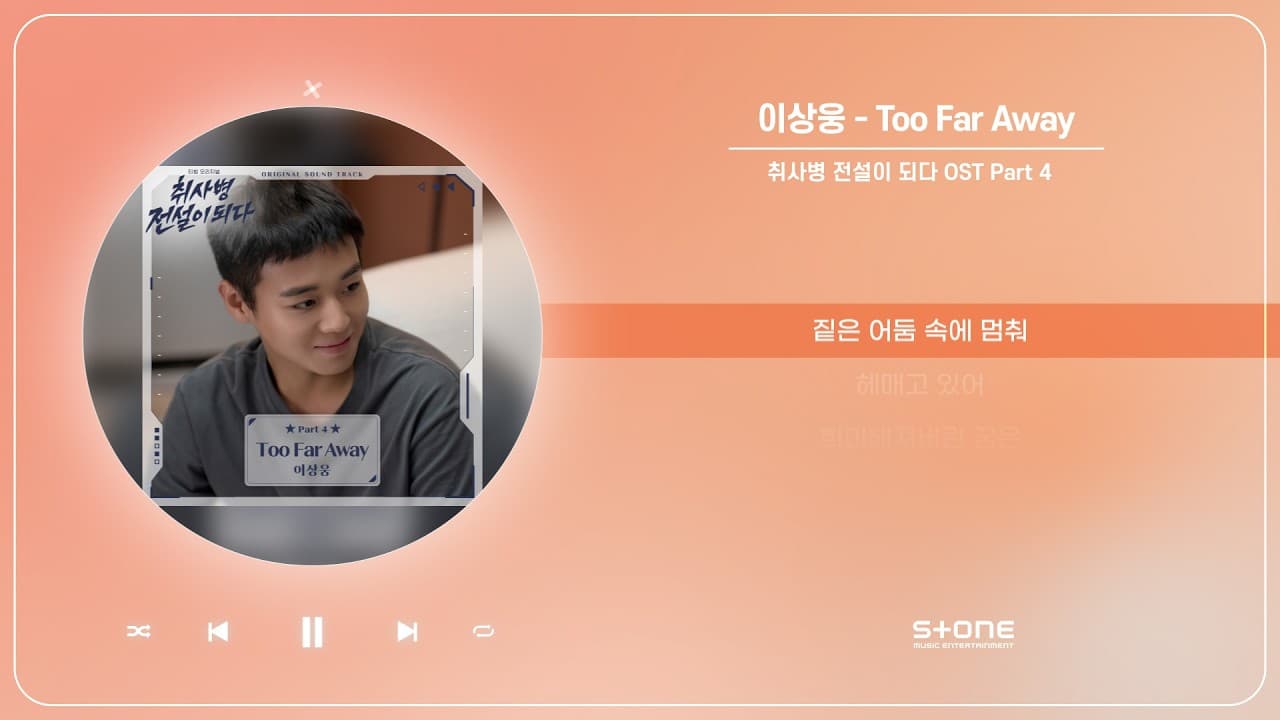
Lee Sang-woong has added a new emotional layer to the drama music conversation with "Too Far Away," the fourth official soundtrack release for The Legend of Kitchen Soldier. Featured on Stone Music Entertainment's official YouTube channel, the one-hour lyric video gives the song an extended showcase at the same time that the OST is being introduced across music platforms and drama fandom spaces.
The release arrives as the TVING original series continues to build attention around its unusual military kitchen premise, a story adapted from a popular Naver Webtoon about growth, discipline and ambition inside the world of army food service. For an artist who recently drew notice through Sing Again 4, Lee's participation gives the soundtrack line-up another singer-songwriter voice with a clear narrative function: his restrained tone and the track's widening arrangement turn a reflective ballad into a companion piece for the drama's coming-of-age themes.
A Soundtrack Release Built Around Mood, Not Noise
"Too Far Away" is being positioned less as a conventional promotional single and more as a mood-setting OST entry. The official description attached to the Stone Music upload highlights Lee Sang-woong as a singer-songwriter who left a strong impression through Sing Again 4, and that background matters. The track does not depend on idol-era spectacle or a chorus engineered for a short-form challenge. Instead, it leans into a lyrical video format, a slow-burn structure and a vocal performance designed to live with the drama's emotional turns.
Supplementary release notices in Korean entertainment media describe the song as opening with a lyrical, dreamlike guitar riff before expanding into a more dramatic sound in its later section. That arc fits the kind of drama music that does its work between scenes: it can sit quietly under moments of hesitation, then rise when a character's private decision becomes visible. In the context of The Legend of Kitchen Soldier, where the premise transforms an everyday military support role into a stage for growth, that sonic movement is especially useful.
The song's English title also supports the drama-facing reading. "Too Far Away" suggests distance, longing and the feeling of pursuing something that may be just beyond reach. For a story centered on a young figure navigating a strict environment and trying to become more than his circumstances, the phrase is broad enough to serve several emotional functions. It can describe a dream, a relationship, a future self or the sense of being separated from ordinary civilian life. OST tracks often succeed when they can carry more than one scene meaning, and this release appears built for that flexibility.
Stone Music's one-hour loop format adds another layer to the rollout. A standard lyric video introduces a track; an extended loop invites listeners to keep it on while studying, working or revisiting the drama's atmosphere. That format has become increasingly common for OST promotion because it converts a single song into a longer listening environment. For viewers who discover a drama through music, the loop can act as an entry point before they move to the series itself. For existing viewers, it gives the emotional color of the show a repeatable form outside the episode runtime.
Why Lee Sang-woong Fits The Drama's OST Line-Up
Lee Sang-woong's name carries a useful balance for this project. He is not being introduced as a brand-new anonymous vocalist, but he is also not so overexposed that the artist identity overwhelms the drama. His Sing Again 4 momentum gives listeners a reason to click, while his singer-songwriter profile lets the song remain anchored in storytelling rather than celebrity spectacle. That balance is exactly what many mid-tempo drama OSTs need: enough recognition to travel, enough restraint to leave room for the characters.
The release also speaks to the wider role of OSTs in Korean drama marketing. A drama soundtrack is no longer only a post-episode add-on. It can become a discovery funnel, a search keyword, a playlist asset and a fan discussion point. A song released through a channel such as Stone Music Entertainment benefits from a music-focused subscriber base that may not overlap completely with the drama's core viewers. That means the upload can introduce The Legend of Kitchen Soldier to listeners who arrive first for Lee's voice or for new soundtrack releases rather than for the series title.
Reports around the release note that OST Part 4 became available on major online music services at noon on June 9, 2026. The drama is scheduled for simultaneous release on TVING and tvN on Mondays and Tuesdays at 8:50 p.m. KST, giving the song a timely promotional window. A midday music drop allows fans to listen before evening discussion around the series, while the official YouTube upload keeps the track visible for viewers who search after an episode or encounter the song through recommendations.
The Lyric Video Strategy Expands The Song's Reach
Lyric videos have become especially important for Korean OSTs because they give international listeners enough context to attach emotion to a track even when they are not yet following every episode. A full music video may require drama footage, licensing decisions or a broader visual concept. A lyric video can move faster and keep attention on the song's core appeal. In this case, the official upload's simple presentation makes the music the center of the story, while the one-hour loop format encourages longer retention.
For global K-drama fans, that matters. Many viewers build emotional memory around soundtrack fragments first: a chorus heard during a climactic scene, a guitar motif associated with a character, or a title that keeps appearing in social posts. Once a lyric video is available on an official channel, the song becomes easier to share in a clean, legitimate form. It also gives search engines and recommendation systems a stable destination, which is important for a newer OST entry competing with a busy release calendar.
The choice of Stone Music Entertainment as the public-facing music channel gives the release a familiar industry frame. Stone Music has long functioned as a hub for K-pop, K-drama soundtrack and Korean music video distribution, and its official channel placement signals that the track is part of a formal OST rollout rather than a secondary fan upload. That distinction is useful for fans who want verified content and for international readers who may not immediately recognize the Korean drama title.
What The Release Means For The Drama's Momentum
The Legend of Kitchen Soldier stands out because its premise does not rely on the most common K-drama settings. Instead of a hospital, office, school or fantasy court, the story focuses on a military cook's growth. That specificity is a strength, but it also requires emotional translation. Soundtrack releases help by giving the audience a familiar emotional language. A song like "Too Far Away" can broaden the drama's appeal by emphasizing aspiration and longing, themes that travel beyond the details of military food service.
As OST Part 4, Lee Sang-woong's track also suggests that the series' music identity is deepening rather than arriving as a one-off promotional accessory. Each additional OST entry can mark a new tonal layer: romance, tension, humor, nostalgia or determination. "Too Far Away" appears to sit in the reflective and aspirational lane, the kind of song that can underscore a protagonist's internal struggle while still working as a standalone listen. That is the sweet spot for soundtrack music that wants to survive beyond the broadcast cycle.
For Lee Sang-woong, the release is another step in converting audition-program attention into a broader discography footprint. OST work can be especially valuable for singer-songwriters because it rewards tone, phrasing and emotional credibility. A successful soundtrack appearance does not need to dominate charts to matter. It can introduce the singer to drama audiences, preserve his voice in a memorable scene and create a search trail that leads listeners to his other music.
The immediate outlook is therefore measured but promising. "Too Far Away" has the right ingredients for a durable drama OST: a verified official upload, a clear release date, a singer with recent recognition, a webtoon-based series with an active schedule and a song mood that appears closely matched to the story's emotional vocabulary. If the track lands in a key scene over the coming episodes, its one-hour lyric video may become more than a promotional asset. It could become the version fans return to when they want the drama's feeling to last a little longer.
How do you feel about this article?
저작권자 © KEnterHub 무단전재 및 재배포 금지
Entertainment Journalist · KEnterHub
Entertainment journalist focused on Korean music, film, and the global K-Wave. Reports on industry trends, celebrity profiles, and the intersection of Korean pop culture and international audiences.
Comments
Please log in to comment