MAMAMOO at 10: How the 'Coloring' Project Is Rewriting the Rules of K-Pop Legacy
 By Park Chulwon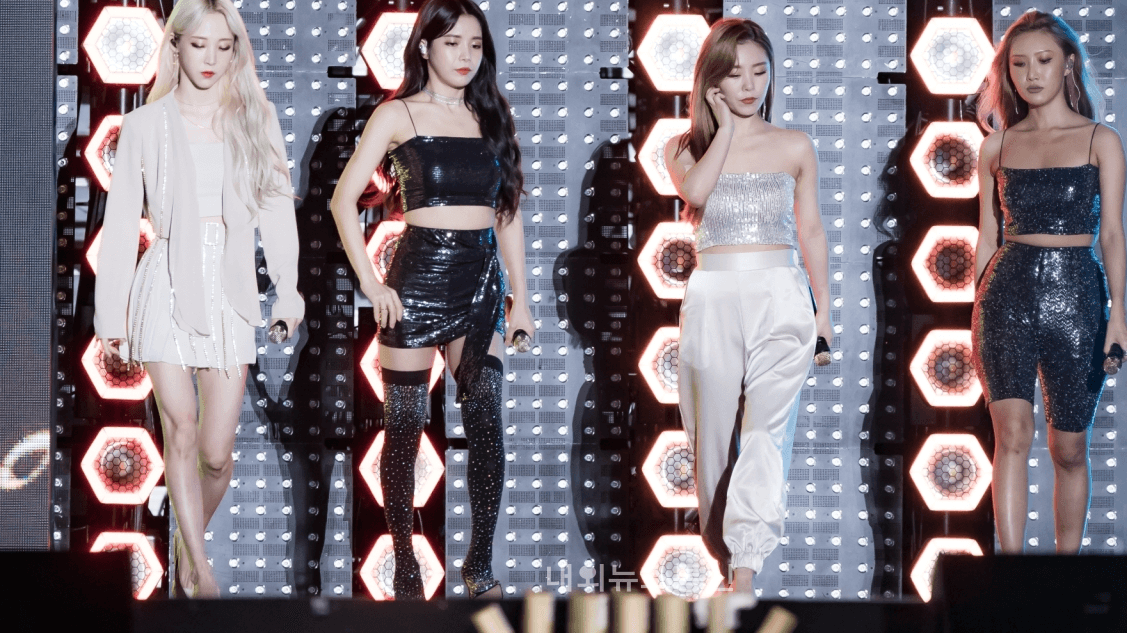
Ten years after debuting with a boldness that K-pop rarely permitted women, MAMAMOO marks their anniversary not with a comeback stage but with something far more radical. They have handed their songs to the fans. On January 21, 2025, the first volume of "Coloring" arrives: a fan remake compilation project that asked the global MAMAMOO fandom, known as MooMoo, to reinterpret a decade's worth of music.
What sounds like a tribute album is actually something the industry has not seen before at this scale. It is a structured competition — 207 fan musician teams applied in September 2024, and eight were selected. The result is a co-authored legacy document, written in the voices of the people who built the group's cultural staying power.
This is the angle that makes "Coloring" worth studying: it offers a new model for how a K-pop group navigates an extended hiatus without going silent — by empowering fans to become the creative stewards of their catalog.
A Decade of Defiance
MAMAMOO debuted on June 18, 2014, under RBW Entertainment with "Mr. Ambiguous," a jazz-inflected, theatrical number that arrived without the synchronized formation dancing and pastel aesthetics that defined girl group launches at the time. It was immediately clear that Solar, Moonbyul, Wheein, and Hwasa were operating by different rules. They harmonized with the technical precision of a vocal group and the stage confidence of veterans — despite being rookies. The debut did not chart in the stratosphere, but it identified something that would compound over time: an audience hungry for musicianship over image management.
The inflection point came with "Um Oh Ah Yeh" in 2015, a song that went genuinely viral inside South Korea for its playful subversion of male gaze tropes. The members dressed in male idol costumes and mimicked the hyper-masculine choreography conventions of boy groups — and the audience understood exactly what was being lampooned. It was satire with a chorus so infectious that the joke and the hit were inseparable. MAMAMOO was no longer just a vocal group. They were commentators.
By the time "Hip" landed in 2019, the group had accumulated something rare in K-pop: a discography with an identifiable worldview. "Hip" — blunt, self-assured, lyrically confrontational about beauty standards — reached audiences who had grown with the group across five years. It became one of their highest-charting domestic singles and signaled that the defiance that characterized their debut had not softened with commercial success. It had sharpened. That consistency across a decade, from debut single to anniversary project, is the foundation on which "Coloring" rests.
What the "Coloring" Model Actually Means
To understand why 207 teams applying to remake songs is significant, it helps to map what anniversary releases typically look like in K-pop. The default is a repackaged compilation, a fan-meeting concert film, or a special unit single. All of these keep the group at the center of the transaction. They are the producers; fans are the audience. "Coloring" inverts that relationship architecturally.
The competition structure matters. An open call that receives 207 applications is not a token gesture — it is evidence of an active, skilled creative community that exists around this music. That the applications required original reinterpretations rather than covers creates a meaningful bar: participants were asked to demonstrate compositional and production agency, not karaoke-level fidelity. The eight selected teams, whose work appears across two volumes, were chosen because their reimaginings stood on their own as artistic statements.
Volume 2, scheduled for release five days after this first installment, will include reinterpretations by artists with professional profiles of their own. Yehana, formerly of Pristin, will contribute a version of "Egotistic." Youngseo, a Korean traditional music vocalist, will bring her instrument to "Starry Night," one of MAMAMOO's most beloved ballads — a pairing that raises a genuine question about what the original song contains that a traditional Korean voice can unlock. These are not celebrity cameos. They are readings.
What "Coloring" resists is the nostalgia trap. A standard anniversary compilation says: here is what we were. The fan remake model says: here is what we made possible in other people. That is a fundamentally different claim about a group's cultural function — and it is the claim that makes "Coloring" a more interesting document than a greatest-hits package would have been.
The Solo Era and What It Proved
Between their last group release — the "MIC ON" EP in 2022, with its title track "ILLELLA" — and this anniversary project, all four members pursued solo careers with outcomes that would have been difficult to predict for members of a single group. Hwasa's "Twit" and subsequent "Maria" established her as one of K-pop's most provocative soloists, a performer whose persona operates at the outermost edge of what the industry typically permits female artists. Solar's own releases, including the COLOURS EP and "Spit It Out," demonstrated a willingness to experiment with electronic production beyond what group dynamics had required.
The most structurally interesting development during this period was Wheein's 2021 move to THE L1VE for solo activities, while maintaining her membership in MAMAMOO. K-pop group contracts rarely accommodate that kind of bifurcated loyalty, and the fact that it held — and that Wheein's continued participation in group contexts remained stable — suggests that the bond among the four members is not primarily contractual. It is vocational.
Solar and Moonbyul's unit MAMAMOO+, which completed an Asia tour in 2022, offered further evidence that the group's chemistry survives subdivision. Half a MAMAMOO still commands arena-level attention. That is not a given in K-pop, where group identity often depends on full-roster presence. The solo era did not fracture MAMAMOO. It demonstrated the group's structural resilience.
What Comes Next
From the vantage point of January 21, 2025, "Coloring" reads as a transition document rather than a closing statement. The project's architecture — a fan competition, a two-volume release, professional artists bringing Korean traditional instruments to MAMAMOO's catalog — suggests deliberate maintenance rather than archival work. Groups do not commission 207-team competitions for songs they intend to retire.
The broader K-pop landscape in early 2025 offers useful context. GFRIEND, who disbanded in 2021, reunited for their own tenth anniversary in January 2025. 2NE1 and Big Bang returned after extended hiatuses that once seemed permanent. The industry is rediscovering that veteran groups carry cultural weight new acts cannot manufacture from scratch. For a group with MAMAMOO's critical standing — five MAMA Awards, four Golden Disc Awards, and a reputation for live performance that remained uncontested throughout their hiatus — the question of what follows "Coloring" seems less like speculation and more like scheduling.
What "Coloring" establishes, regardless of what follows, is that a decade of MAMAMOO produced something rare: a body of music that other artists want to inhabit. That inheritance belongs to MooMoo now — and what would later prove to be far from a final chapter was already audible in every reinterpretation the project chose to release.
How do you feel about this article?
저작권자 © KEnterHub 무단전재 및 재배포 금지
Entertainment Journalist · KEnterHub
Entertainment journalist focused on Korean music, film, and the global K-Wave. Reports on industry trends, celebrity profiles, and the intersection of Korean pop culture and international audiences.
Comments
Please log in to comment