ONEWE STUDIO WE: Recording #4 and the Five-Year Demo Album Series
 By Park Chulwon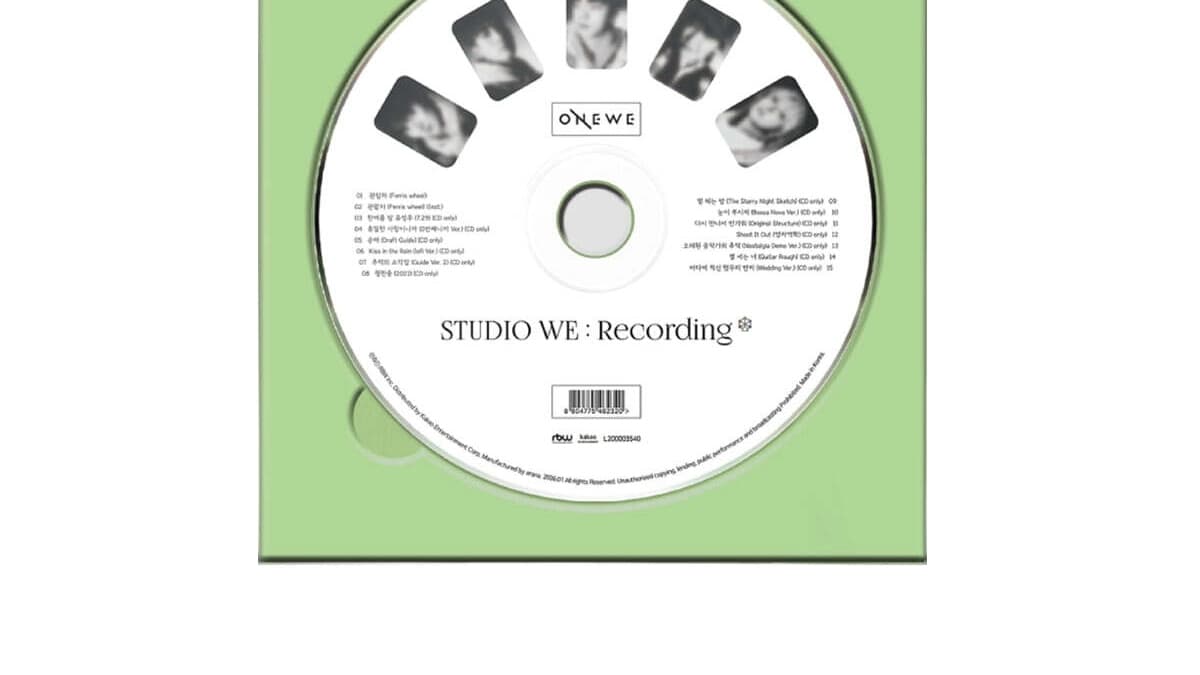
ONEWE released STUDIO WE: Recording #4 on January 30, 2026 — the fourth entry in their ongoing demo album series. The album was anchored by "Ferris wheel" (관람차), pre-released January 14, and extended a creative project now spanning five years. The series quietly became one of the more distinct artist-driven frameworks in K-pop: a band using formally incomplete recordings to argue that process transparency can be a product in itself.
The "Ferris wheel" single that headlined the album was written and composed by ONEWE member Kiwook. Thematically, the song maps the circular motion of a Ferris wheel onto the experience of revisiting a first love — the wheel returns to its origin point, just as memory circles back to a particular person. Musically, it combines band instrumentation with a melodic softness that critics noted leans closer to warm K-indie territory than ONEWE's occasional harder rock excursions. The Bias List review characterized the track as "coasting along classic K-pop melodies with string elements," drawing a comparison to fellow K-band Lucy.
The Studio We: Recording Series: A Four-Album Arc
To understand why STUDIO WE: Recording #4 matters, the series context is essential. ONEWE launched Studio We: Recording #1 in October 2020 — a nine-track demo album released under RBW Entertainment that included the pre-released single "Parting." The series concept was formally unconventional: these were presented as demo recordings rather than polished final cuts, exposing the working process of the band's songwriting and production in a way that standard K-pop releases rarely do.
Recording #2 followed in December 2021 with twelve tracks and "STAR" as the title cut. Recording #3 arrived in October 2022. The fourth entry in January 2026 extended the timeline to more than five years across the series, which is a sustained commitment unusual even among K-pop bands that operate with greater creative independence than idol groups. The gap between #3 and #4 was longer than between the earlier entries — over three years — which the band used to release conventional single and full-album projects, making #4's arrival a renewal of a creative thread rather than a continuous annual output.
Why Demo Albums Work Differently
The formal conceit of the "demo album" — presenting recordings as works-in-progress or intentionally unfinished — functions differently from standard K-pop album releases. In most cases, K-pop releases are fully polished and mixed to industry-standard production specifications. Demo framing removes the expectation of perfection and repositions the listening experience around process: the texture of live recording, the relative rawness of certain production choices, the sense of access to a creative working environment. For ONEWE, this has translated to a series that rewards listeners who are interested in the band as a creative entity rather than purely as a promotional vehicle.
The Bias List review of "Ferris wheel" noted that the track "doesn't deliver anything we haven't heard a million times elsewhere" — a critique that acknowledges the series' consistent emotional territory while underscoring that the appeal is as much in the context (demo transparency, band authorship) as in formal innovation. This is a distinguishing feature of bands that build deep fanbases through catalog consistency: the expectation isn't perpetual sonic reinvention but reliable emotional delivery within an established aesthetic.
ONEWE's Position in K-Band's Evolving Landscape
ONEWE occupies a specific position in the K-band ecosystem. They are neither a legacy rock act with decades of catalog nor a recently debuted indie band with algorithmic discovery momentum. Their roots stretch back to 2015 (when they performed as M.A.S 0094), but their current commercial infrastructure was built after their 2019 re-debut under RBW Entertainment. This places them in the generation of K-bands — alongside Day6, N.Flying, FT Island, CNBLUE, and peers — that built their audiences through consistent live performance and album releases before streaming became the primary discovery mechanism.
The five-year lifespan of the Studio We: Recording series is one marker of that consistency. Another is the band's simultaneous management of a conventional album discography alongside the demo series — releasing full and mini albums under their standard promotional cycle while reserving the Recording series for a different creative register. That dual-track approach keeps the band commercially legible while maintaining a creative outlet that distinguishes them from groups operating entirely within commercial K-pop production norms.
STUDIO WE: Recording #4 arrived in January 2026 without the headline figures that typically drive K-pop coverage cycles. There are no multi-million sales numbers or stadium sellout statistics attached to a ONEWE demo album release. What the series offers instead is a demonstrated commitment to creative longevity — a five-year thread of album releases that, when extended further, would stand as one of the more sustained artist-curated musical projects in the broader K-pop industry's recent history. The fan response to Recording #4 indicated that the audience for this format remained consistent: listeners drawn to ONEWE specifically for the combination of band instrumentation, member songwriting credits, and the intimacy that demo-format presentation provides found in "Ferris wheel" another entry in a reliable creative language.
How do you feel about this article?
저작권자 © KEnterHub 무단전재 및 재배포 금지
Entertainment Journalist · KEnterHub
Entertainment journalist focused on Korean music, film, and the global K-Wave. Reports on industry trends, celebrity profiles, and the intersection of Korean pop culture and international audiences.
Comments
Please log in to comment