PSY Summer Swag 2026 Opens As Korea’s Stadium Ritual
The Uijeongbu opener showed why PSY’s water-soaked concert brand still matters in Korea’s expanding live market.
 By Park Chulwon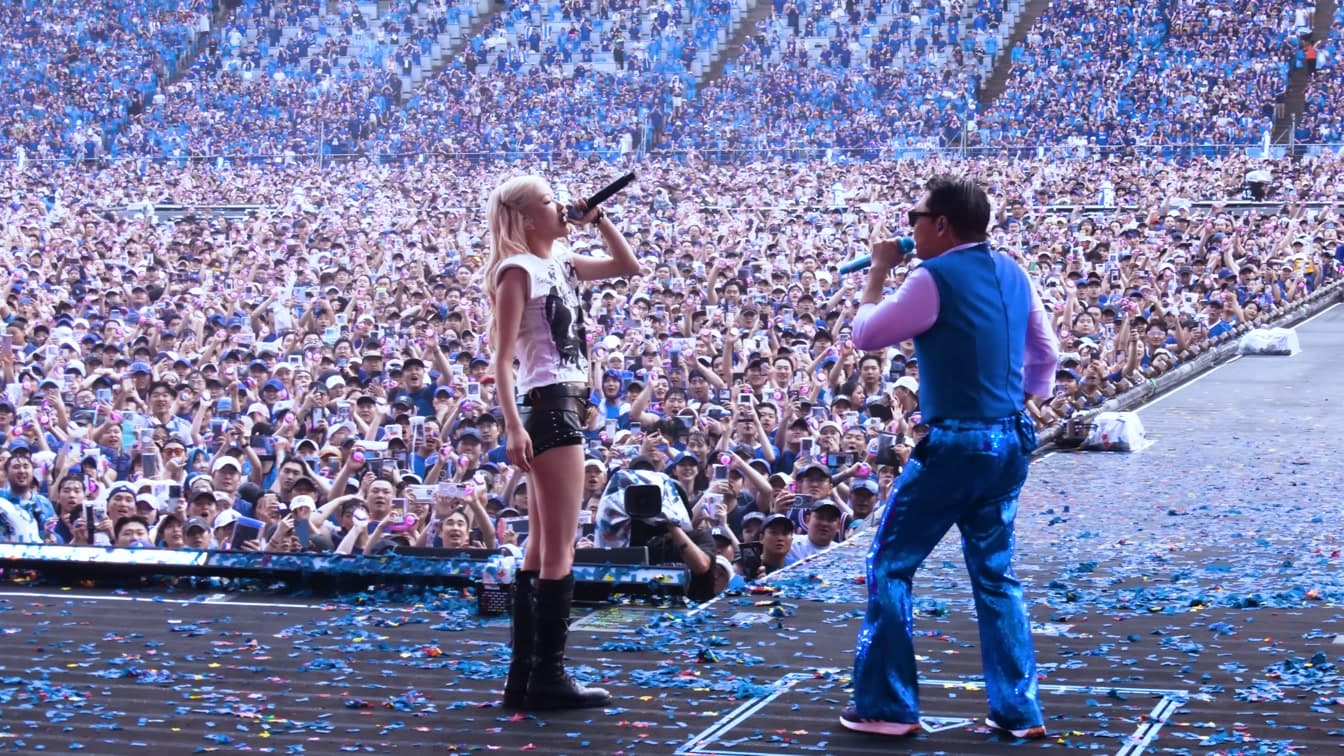
PSY opened Summer Swag 2026 in Uijeongbu with 33,000 people, four hours of music, and a crowd that behaved less like spectators than co-producers.
The June 27 concert at Uijeongbu Stadium was the first stop of a 9-city, 14-show national run, and Korean reports described it as both a water concert and a mass sing-along ritual. That distinction matters. PSY's annual brand is no longer only a seasonal concert; it is a repeatable live-entertainment format that shows how Korean pop can turn scale, nostalgia, and physical participation into a summer institution.
This review analyzes how PSY's 2026 opening performance uses audience immersion to strengthen the live market at a time when K-entertainment increasingly depends on experiences that cannot be reduced to streaming numbers.
The result was not subtle. It was loud, drenched, and engineered for collective release.
A Concert Built Like A Festival
The opening image told the story quickly. Fans arrived in blue and white, the Summer Swag dress code, hours before showtime. Inside the stadium, water cannons, lasers, fireworks, LED lights, and a runway-sized stage system turned the venue into something closer to a branded festival than a standard pop concert.
PSY began with familiar weapons: “Napalcaji,” “Celebrity,” “That That,” “Gentleman,” “New Face,” and “Gangnam Style.” The set list was not trying to surprise the audience into respect. It was designed to trigger recognition fast, then let the crowd supply volume. That is why the show works. PSY understands that his biggest hits are shared infrastructure. People do not attend only to hear them; they attend to perform them together.
The guest structure also kept the pacing elastic. Hwasa brought a sharper performance edge with songs including “Maria,” while Sung Si-kyung changed the temperature with ballads such as “Every Moment of You.” On paper, those choices sit far apart. In the stadium, they gave the audience a rhythm: sprint, breathe, sing, reset, and sprint again.
That control of energy is the show's main achievement. A four-hour concert can easily become indulgent. Here, the length felt like part of the value proposition.
The Numbers Explain The Brand Power
Korean reports put the Uijeongbu opening audience at about 33,000. The show ran for nearly four hours, and one review said roughly 1,500 staff members helped execute the production. The tour now moves through Daegu, Incheon, Seoul Grand Park, Wonju, Suwon, Gwangju, Busan, and Daejeon across 14 total performances.
Those figures place Summer Swag in the upper tier of domestic concert experiences. Disguise, a live-visual production company that worked on the 2025 tour, said last year's run sold out 16 performances across nine cities, with up to 30,000 fans attending each show. This year's Uijeongbu opening therefore did more than maintain the brand. It reportedly exceeded that per-show benchmark at the first stop.
The bigger context supports that growth. South Korea's performing arts ticket sales reached 1.7326 trillion won in 2025, according to the Ministry of Culture, Sports and Tourism, up 18.8 percent from the previous year. Concerts also sit at the center of music tourism, with market researchers estimating South Korea's music tourism market at $4.1 billion in 2024 and projecting strong growth through 2033.
So what does PSY add to that market? He offers a domestic mega-event that does not depend on idol fandom mechanics. Summer Swag is built on broad public memory, physical spectacle, and the promise that every attendee becomes part of the chorus. That makes it unusually resilient.
What Worked On Stage
The strongest part of the Uijeongbu show was its refusal to separate production from emotion. The water effects were not decorative. They gave the audience permission to stop looking polished, which is a surprisingly powerful concert device. Once everyone is drenched, self-consciousness drops, and participation rises.
PSY's performance style is suited to that environment. He does not need to look untouchable. He needs to look possessed by the same absurd energy he asks from the crowd. Reports from the venue described repeated call-and-response, mass singing, and encore sections that felt like another main set. That is exactly where his catalog has long-term value. Songs like “Champion,” “Celebrity,” and “It's Art” are not just hits; they are instructions.
The guest stages were also more than bonus content. Hwasa sharpened the show's contemporary relevance, while Sung Si-kyung gave the audience a planned recovery point without breaking the communal mood. That contrast kept the show from becoming a single-note endurance test.
The weakest risk is built into the concept itself. Summer Swag depends on excess: water, time, bodies, noise, and staff. That scale is its charm, but it also raises expectations every year. Once audiences treat abundance as the baseline, the artist has to keep finding emotional variation inside the machinery.
Impact And Audience Reaction
The audience response, at least from early Korean coverage, was exactly what the brand needs. Fans described losing themselves in the water and singing along from the first recognizable intro. Older attendees also appeared prominently in reports, which matters because Summer Swag is not marketed as a narrow youth event. It is a multi-generation release valve.
That breadth separates PSY from many younger touring acts. Idol concerts often rely on tightly organized fandom identity. Summer Swag relies on public familiarity and a festival promise: come prepared to be soaked, loud, and temporarily free from routine. That makes the brand easier for casual fans to enter.
It also explains why the opening stop can support a larger industry argument. Korea's live market is not only growing because artists are touring more. It is growing because events increasingly sell a condition that digital platforms cannot duplicate. You can replay “Gangnam Style” anywhere. You cannot recreate 33,000 people shouting it under water cannons on demand.
That scarcity is the show's real product.
Future Outlook
The next test is consistency. PSY now has to carry the same intensity through Daegu and the rest of a 65-day summer arc, with 64 days still ahead after the opener. A brand this physical can lose power if execution slips, but it can also compound momentum if each city feels like a local event rather than a copied stop.
For now, the Uijeongbu opening confirms why Summer Swag remains one of Korea's clearest examples of concert-as-format. It is not chasing streaming virality. It is selling collective memory at stadium scale, and on opening night, that memory sounded very much alive.
How do you feel about this article?
저작권자 © KEnterHub 무단전재 및 재배포 금지
Entertainment Journalist · KEnterHub
Entertainment journalist focused on Korean music, film, and the global K-Wave. Reports on industry trends, celebrity profiles, and the intersection of Korean pop culture and international audiences.
Comments
Please log in to comment