Review: Baby DONT Cry's 'I DON'T CARE' Is P NATION's Most Ambitious Single Yet
 By Jang Hojin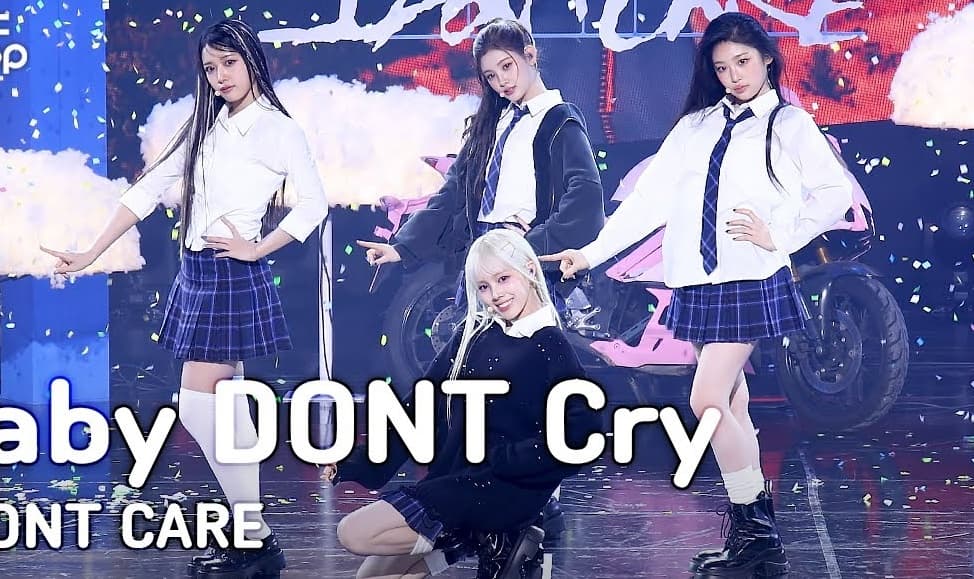
Baby DONT Cry's 'I DON'T CARE' crossed eight million YouTube views in one week and entered Melon's Hot 100. The November 19 release confirmed that P NATION's newest act has arrived in a way that their June debut only previewed.
The single is their first comeback since "F Girl," and the gap between the two releases — roughly five months — has produced a track that sounds considerably more confident and considered than a five-month runway might suggest. That confidence has a specific source, and understanding it requires understanding the label, the sound, and the production decisions that made this song what it is.
P NATION and the Group Behind the Single
Baby DONT Cry debuted in June 2025 under P NATION, the label PSY founded in 2019 after departing YG Entertainment. The label's artistic identity has always been defined by performers with strong individual personalities: PSY himself, HyunA, Crush, and Jessi have each carried that ethos in different directions. Baby DONT Cry represents something new for P NATION — a coordinated girl group in the idol tradition, but filtered through the label's characteristic resistance to generic presentation.
Their debut single "F Girl" established the group's visual energy and signaled a rock-leaning sonic direction without fully committing to it. It introduced four members — Yihyun, Kumi, Mia, and Beni — as a cohesive unit without yet revealing what that unit's most natural form sounds like. "I DON'T CARE" answers that question more directly.
The group's chemistry, visible in both the music video and their live performance appearances on Music Bank, M Countdown, and Inkigayo in the week following release, reflects the kind of coordinated energy that takes months of rehearsal to look effortless. What Baby DONT Cry has managed, in a debut half-year, is to develop a stage presence that functions less like a carefully sequenced idol performance and more like a band performance — coordinated but alive to the moment.
What 'I DON'T CARE' Actually Sounds Like
'I DON'T CARE' opens with a band-driven arrangement that is immediately, deliberately familiar. The drums are live-sounding, the electric guitar sits above the mix, and the chord progression carries the emotional weight of third-generation K-pop — the era of BLACKPINK, TWICE, and Red Velvet, when K-pop's global breakthrough was built on emotional directness and hooks designed to register in the first ten seconds.
This is not accidental. Third-gen K-pop has experienced a sustained nostalgic pull in 2024 and 2025, particularly among fans who came of age with that era and now consume new music through that emotional lens. 'I DON'T CARE' enters that conversation explicitly, using a sound vocabulary its target audience is already fluent in.
The lyrical frame reinforces this. 'Staying loyal to myself regardless of what they say' is a declaration that third-gen girl groups made into an identity cornerstone — the distinction between public persona and private self, dramatized in music. Baby DONT Cry's version of that declaration is not a throwback but a continuation: the same emotional logic, expressed by a group young enough to have grown up listening to the artists who established it.
What prevents the track from becoming mere pastiche is the production texture. Synths layer under the guitars with a precision and cleanliness that 2014 K-pop production did not have access to. The mix is dense without being muddied, and the chorus has an airiness — particularly in the vocal layering — that is recognizably contemporary. The result is a hybrid: a song with the emotional grammar of third-gen K-pop produced at 2025 technical standards.
The Production Credits: A Signal of Intent
'I DON'T CARE' was co-produced by VVN and IDO of The Black Label, alongside Tommy Brown. The credit is significant beyond what it says about the sound.
The Black Label, a production sub-label within the YG Entertainment group, has been responsible for some of the most precisely constructed K-pop productions of the past decade. IDO and VVN bring a structural discipline to their tracks — arrangements in which every element appears to serve a specific function, creating the sensation that nothing could be moved without the whole collapsing. Their involvement in a P NATION release represents a cross-label creative bridge that reflects how the K-pop production ecosystem has become increasingly collaborative at the top end.
Tommy Brown is an American producer whose credits include work associated with major Western pop releases and whose understanding of what travels between the Korean and international markets is evident in the track's construction. His presence in the producer list signals that 'I DON'T CARE' was not conceived primarily as a domestic Korean release but as a song designed to find listeners across multiple markets simultaneously.
The first-week performance supports that ambition. Eight million YouTube views in a week, for a group five months into its existence, reflects an audience that extends well beyond the dedicated domestic fan base that follows every new P NATION release. International viewership of the music video and performance clips has been a measurable part of that total.
Reception and What It Means for the Group
The Melon Hot 100 entry, while not a top-tier chart position for established acts, is a meaningful marker for a group in its first active half-year. Melon's chart algorithm factors streaming volume, unique listener count, and playlist adds — metrics that reflect distributed audience engagement rather than concentrated fan-base voting. Charting under these conditions means listeners beyond the core fan community are finding the song.
Baby DONT Cry performed 'I DON'T CARE' across all three of South Korea's primary music show broadcasts in the release week, building the kind of performance catalog that short-form video platforms then amplify over the following weeks. The clips from Music Bank, M Countdown, and Inkigayo have circulated beyond the platforms that hosted the original broadcasts, reaching listeners who may encounter the live version before the studio recording.
The most significant external validation is the one that came without a formal announcement: Baby DONT Cry was included in the 2025 SBS Gayo Daejeon lineup, joining thirty-five other acts at Incheon Inspire Arena on December 25. The Gayo Daejeon is not offered to every active group. The selection reflects a broader industry judgment about which acts have registered with the year's audience in a way that warrants inclusion in the year's largest music broadcast.
For a group five months old, a Gayo Daejeon slot is both recognition and a test. The show's scale — a live broadcast audience that spans multiple continents — is qualitatively different from a weekly music show performance. Baby DONT Cry arrives at that stage with 'I DON'T CARE' as the answer to every question about whether their debut was a single moment or the beginning of something larger. The answer, based on the evidence of this single, is the latter.
How do you feel about this article?
저작권자 © KEnterHub 무단전재 및 재배포 금지
Entertainment Journalist · KEnterHub
Entertainment journalist specializing in K-Pop, K-Drama, and Korean celebrity news. Covers artist comebacks, drama premieres, award shows, and fan culture with in-depth reporting and analysis.
Comments
Please log in to comment