Seoul's Data Reveals the True BTS Gwanghwamun Numbers
Official city data puts attendance at 75,927 — a far cry from media reports of 260,000
 By Jang Hojin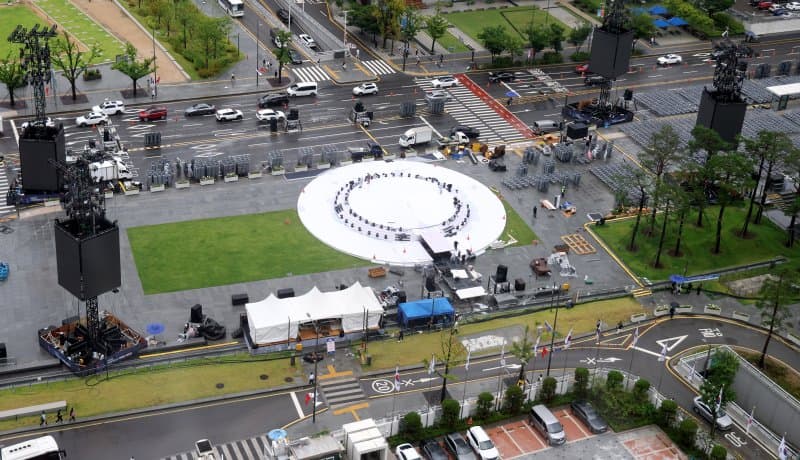
The debate over how many people attended BTS's historic Gwanghwamun comeback performance on March 21 has finally found an official answer. The Seoul city government released verified attendance data on March 26, placing the crowd at approximately 75,927 people between 8 and 9 PM during the peak of the event — settling a week-long dispute that had divided fans, media, and even BTS's own management.
The figure is striking not just for what it confirms, but for how dramatically it differs from numbers that circulated in the days following the performance. Some media outlets had reported attendance as high as 260,000 — a number that immediately drew widespread skepticism and turned the crowd count itself into a story within the story.
How Seoul Counted the Crowd
The Seoul city government's estimate is based on a methodology that combines mobile carrier signal data and public transportation usage statistics. Officials described the approach as the most reliable available measure for real-time crowd analysis in an open-air public space like Gwanghwamun Square.
Crucially, the 75,927 figure captures those present specifically in the Gwanghwamun and City Hall area during the event's peak hour. It reflects a narrower geographic scope than some previous estimates, which accounts for part of the gap between competing figures.
An earlier Seoul real-time city data estimate had placed attendance at approximately 48,000. Officials explained that this earlier reading had underestimated the crowd because it excluded short-term foreign visitors — a significant omission given the international composition of the BTS fanbase — and was affected by signal overlap issues in a densely populated area.
Three Different Numbers and Why They Diverged
The 260,000 figure appeared across multiple media outlets in the days after the March 21 event. Its scale — suggesting one of the largest single outdoor gatherings in recent Korean history — drew immediate pushback from those familiar with Gwanghwamun Square's physical dimensions.
HYBE, BTS's management label, offered its own estimate of approximately 104,000 attendees. The company noted that its count encompassed not only the immediate performance area but also surrounding commercial zones and general foot traffic across the broader Gwanghwamun district. That expanded geographic definition explains why HYBE's number sits meaningfully above Seoul's more focused measurement.
With three separate estimates now on record — 48,000 from early city data, 75,927 from the official city count, 104,000 from HYBE, and 260,000 from unverified media reports — the crowd count has become a case study in how major K-pop events are measured and reported in real time.
A Global Crowd at the Heart of Seoul
One of the most striking findings in Seoul's official data is the international composition of the audience. Approximately 25 percent of those counted — roughly 19,000 people — were foreign nationals. That figure alone reflects the global reach BTS holds even for a live outdoor event in central Seoul.
The breakdown by nationality showed Thailand leading, followed by Vietnam, India, and Japan. This distribution closely mirrors BTS's strongest fanbases in Southeast and South Asia, and aligns with the geographic spread of ARMY that has defined the group's international presence since its global breakthrough in the mid-2010s.
Notably, Seoul's data found that long-term foreign residents in Korea outnumbered short-term tourists among the international attendees. This suggests that a meaningful share of the foreign crowd consisted of people already based in Korea — international students, workers, and expatriates — rather than fans who traveled specifically for the event. The distinction matters: it implies BTS's pull extended even to those for whom attending was logistically easy, not just the most dedicated long-distance travelers.
The Comeback's Larger Context
The March 21 performance marked BTS's first full-group public appearance after all seven members completed their mandatory military service. RM, Jin, SUGA, J-Hope, Jimin, V, and Jungkook chose Gwanghwamun Square — one of Seoul's most historically significant public spaces — for their return to the stage. For fans, the venue carried immediate symbolic weight: steps from Gyeongbokgung Palace, framed by Seoul City Hall, and adjacent to the site where the group once filmed the music video for their 2017 song "Spring Day."
The event was broadcast live on Netflix in 190 countries, with the platform reporting 18.4 million simultaneous viewers — believed to be the first time a K-pop comeback stage has been simulcast globally on a major streaming service. The combination of a free domestic outdoor event and a worldwide broadcast made the occasion structurally unusual even by BTS standards, and helps explain why international interest — and international attendance — ran unusually high.
Why the Debate Matters Beyond BTS
At first glance, the crowd count at a free outdoor concert might seem like a minor footnote. But the dispute around BTS's Gwanghwamun attendance reflects something larger: the speed at which unverified numbers travel through social media during major K-pop events, and the gap between what fans and outlets report in real time versus what official data eventually confirms.
The 260,000 figure spread within hours of the event ending, amplified before any official methodology could be applied or verified. Seoul's release of confirmed city data — nearly a week later — provides a more reliable baseline, though it still represents a one-hour snapshot rather than a full-event count, and does not fully resolve the definitional question of where the event's boundaries ended.
For the broader K-pop industry, the episode raises questions about standardized crowd measurement practices at public events, particularly those that draw large international audiences to open urban spaces without ticketed entry.
For fans, the verified number carries its own weight. Roughly 76,000 people gathering in Gwanghwamun on a March evening — one in four of them from another country — speaks clearly to BTS's continued hold on its audience after years apart. With the group's full comeback now underway, the Gwanghwamun stage appears to have been the opening note of a chapter fans have waited nearly three years to read.
The Seoul city government's decision to release this data also reflects something about how public events are now being analyzed in real time. In the age of mobile carrier analytics and transit data, cities have the tools to provide crowd counts that are more precise than headcounts or aerial estimates. That the government chose to apply this methodology to a K-pop performance — and to share the results publicly — suggests that BTS's impact on Seoul's public space is now significant enough to warrant the same analytical attention as major civic gatherings. That is a statement in itself, independent of the exact number attached to it.
How do you feel about this article?
저작권자 © KEnterHub 무단전재 및 재배포 금지
Entertainment Journalist · KEnterHub
Entertainment journalist specializing in K-Pop, K-Drama, and Korean celebrity news. Covers artist comebacks, drama premieres, award shows, and fan culture with in-depth reporting and analysis.
Comments
Please log in to comment