Spotify House Seoul’s Four-Day Expansion Shows K-Pop’s Platform Shift
A four-day Seongsu event turns streaming data into a live map of Korean music discovery.
 By Park Chulwon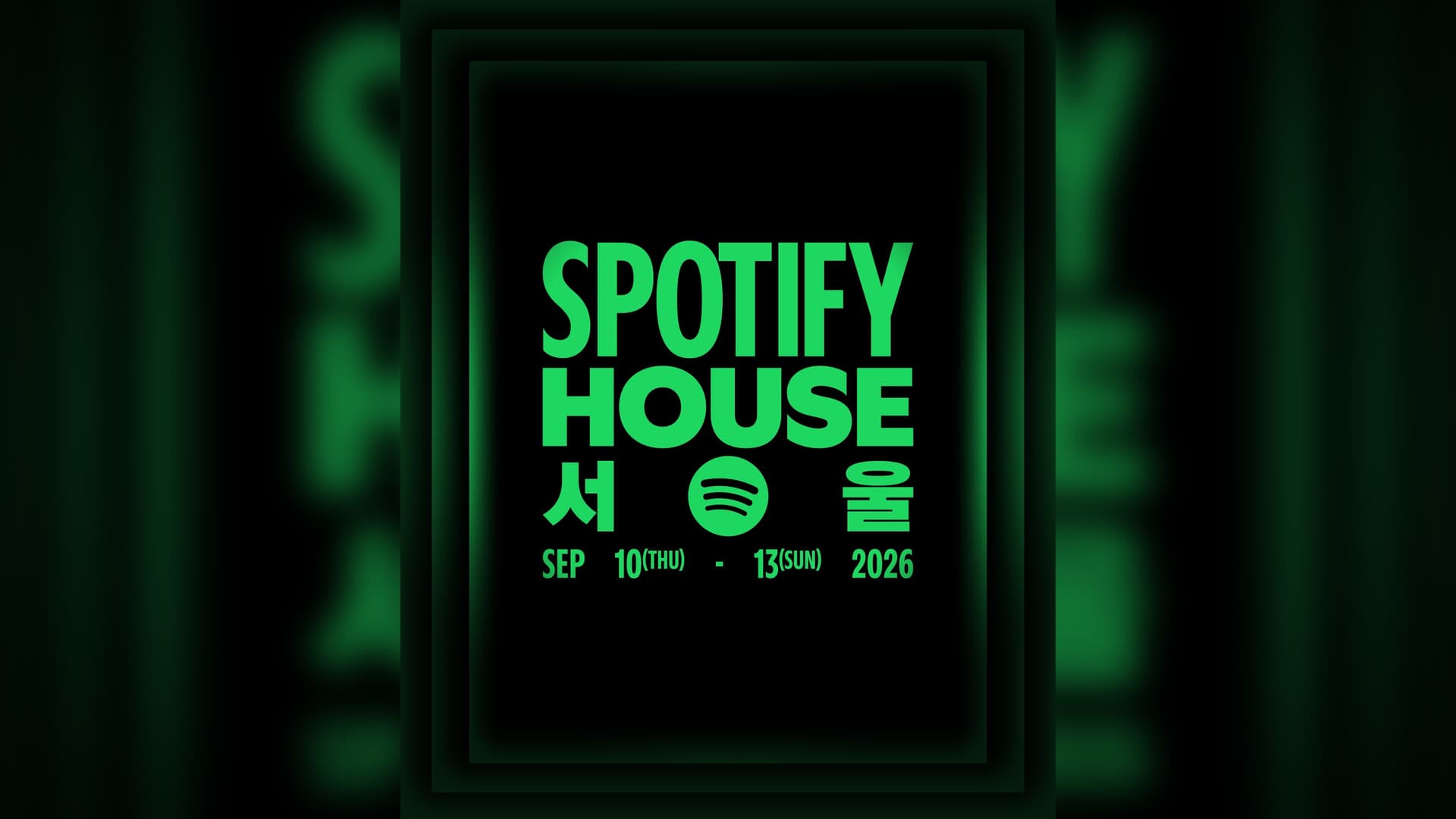
Spotify House Seoul is getting bigger because Korean music discovery is getting more physical. From Sept. 10 to 13, 2026, Spotify will stage a four-day edition at Anderson C in Seongsu, Seoul, using K-pop, indie rock and hip-hop nights to test how a streaming platform can turn passive listening data into a live cultural map.
The expansion matters because it arrives at a moment when K-pop’s global numbers are moving in two directions at once: streaming is widening the audience, while domestic album demand is still strong enough to support large-scale fan spending. Spotify’s own 2025 Loud & Clear data said K-pop royalties grew 31 percent among genres generating more than $50 million on the service, while Hanteo-linked first-half figures reported by Korean outlets put 2026 K-pop album sales at 49.53 million copies. The event is not just a brand pop-up. It is a platform trying to show what its recommendation engine looks like in a room full of fans.
This article analyzes how Spotify House Seoul’s move from a three-day 2025 pop-up to a four-day 2026 genre map gives K-pop, Korean indie and Korean hip-hop a shared offline stage, and what that says about the next phase of platform-led fandom.
From Pop-Up Venue To Genre Map
The most important change is scale. Spotify’s official newsroom described the 2025 Spotify House Seoul as a three-day event held from Nov. 13 to 15 at Anderson C. Korean reports on the 2026 edition now place the next run at four days, from Sept. 10 to 13, with three live performance days and a final culture-and-experience day.
That one extra day is easy to miss. It should not be. A move from three days in 2025 to four days in 2026 is a 33.3 percent increase in event duration, and it changes the format from a concentrated showcase into a broader programming grid. The lineup also makes the strategy clearer: Electronic and K-pop open the run with Diplo, RIIZE, RESCENE and Yves; indie rock follows with JANNABI, HYUKOH, Silica Gel, KARDI and can’t be blue; hip-hop then takes over with Dynamicduo, The Quiett, HAON, Kid Milli with OKASHII, CAMO and others reported across Korean coverage.
But the point is not merely that more artists are appearing. Spotify is placing different discovery cultures beside one another. K-pop fandom is highly organized, indie rock still depends heavily on credibility and live reputation, and hip-hop often moves through scene affiliation and viral clips. Putting them under one event brand allows Spotify to present itself as the connective tissue among scenes that are usually marketed separately.
The Numbers Behind The Expansion
The event’s growth looks more persuasive when it is placed against the market data. Hanteo-related first-half reporting said K-pop albums sold 49.53 million copies in the first six months of 2026, compared with 40.12 million in the same period of 2025. That is an increase of 9.41 million copies, or roughly 23.4 percent, and it pushed the first-half total beyond the previous Hanteo-era high of 46.17 million reported for the first half of 2023.
Spotify House Seoul expanded from three event days in November 2025 to four event days in September 2026, a 33.3 percent increase. Spotify House Seoul Event Duration 0 1 2 3 4 3 days 4 days 2025 Nov. 13-15 2026 Sept. 10-13 +33.3% Sources: Spotify Newsroom for 2025; Korean event reports for 2026
The time comparison is the cleanest signal: Spotify House Seoul went from three days in November 2025 to four days in September 2026, a 33.3 percent expansion in less than a year. In the same window, reported first-half K-pop album sales moved from 40.12 million copies in 2025 to 49.53 million in 2026, showing that offline fan spending has not weakened even as discovery keeps shifting toward streaming platforms. That is why the event’s physical footprint matters. It is not replacing the app; it is giving the app’s data a public stage.
Streaming data adds the second layer. Spotify’s Loud & Clear program said K-pop royalties rose 31 percent in 2025 among genres above the $50 million royalty threshold, and Korea JoongAng Daily reported that annual global streams of K-pop on Spotify had grown more than 570-fold from 2014 to 2025. Those figures point to a market where overseas listeners may discover Korean acts through playlists before they ever learn the fan rituals around albums, concerts or light sticks. Spotify House Seoul compresses that journey: the platform recommends, the event validates, and the fan community converts curiosity into memory.
Why The Lineup Mix Matters
There is a reason the 2026 bill does not read like a conventional K-pop festival. RIIZE and RESCENE give the opening night idol momentum, while Yves represents a solo narrative with strong international fandom interest. JANNABI, HYUKOH and Silica Gel pull the second night toward band culture, where live performance and long-tail catalog listening are often more important than first-week sales. Dynamicduo, The Quiett, HAON, Kid Milli and CAMO then make the hip-hop night a bridge between legacy credibility and younger digital-native audiences.
That mix gives Spotify a different kind of authority. Traditional Korean music events often sort acts by broadcaster, label relationship or award-season cycle. A streaming platform can sort by behavior: what listeners save, share, revisit and discover next. The result is a lineup that feels less like a ranking and more like an argument about adjacency. If a RIIZE listener leaves curious about Silica Gel, or a hip-hop fan encounters an idol soloist in the same branded environment, the platform has turned programming into recommendation.
It also reflects a broader shift in K-pop’s export logic. The old model pushed a finished idol product abroad through albums, videos and tours. The newer model sells an ecosystem: playlists, short-form clips, collaborations, merchandise, fan events and cultural spaces. Spotify House Seoul sits inside that ecosystem because it treats Korean music as something to enter, not just something to stream.
Impact On Fans And The Industry
For fans, the appeal is immediate. A four-day schedule creates more entry points than a single branded showcase, especially for listeners who do not identify with one fandom but still follow Korean music broadly. It also gives casual listeners a reason to treat genre boundaries as porous. That is valuable in Seoul, where young audiences often move between idol tracks, festival bands, club music and hip-hop without seeing those choices as contradictory.
For the industry, the more interesting impact is measurement. Live events generate social clips, queue photos, set-list chatter and artist-to-artist comparison in ways that pure streaming dashboards cannot. Spotify can read the data before the event, but the event itself produces new behavioral signals afterward. Which stages get shared? Which collaborations spark searches? Which artists benefit from being placed next to unfamiliar scenes? These are business questions disguised as fan moments.
There is a risk, too. When a platform becomes a curator in physical space, it can shape visibility as much as it reflects it. Smaller acts may gain reach, but they also become dependent on platform-mediated contexts. That tension is why Spotify House Seoul should be read as an industry signal, not simply an entertainment schedule.
What To Watch Next
The clearest test will come after Sept. 13. If the 2026 edition produces measurable bumps in artist searches, playlist adds, social sharing or catalog streams, Spotify will have a strong case for repeating the format in Seoul or exporting it to other K-pop hubs. If the impact stays mostly experiential, the event still works as brand positioning, but its strategic value will be harder to prove.
Either way, the expansion shows where Korean music promotion is heading. The next phase will not be fought only on charts or only in venues. It will be fought in the loop between data and presence, where a listener’s first click can become a night out, and a night out can send that listener back into the catalog with a clearer sense of belonging.
How do you feel about this article?
저작권자 © KEnterHub 무단전재 및 재배포 금지
Entertainment Journalist · KEnterHub
Entertainment journalist focused on Korean music, film, and the global K-Wave. Reports on industry trends, celebrity profiles, and the intersection of Korean pop culture and international audiences.
Comments
Please log in to comment