Takuya Kimura's First Korea Concert Is Finally Happening
 By Jang Hojin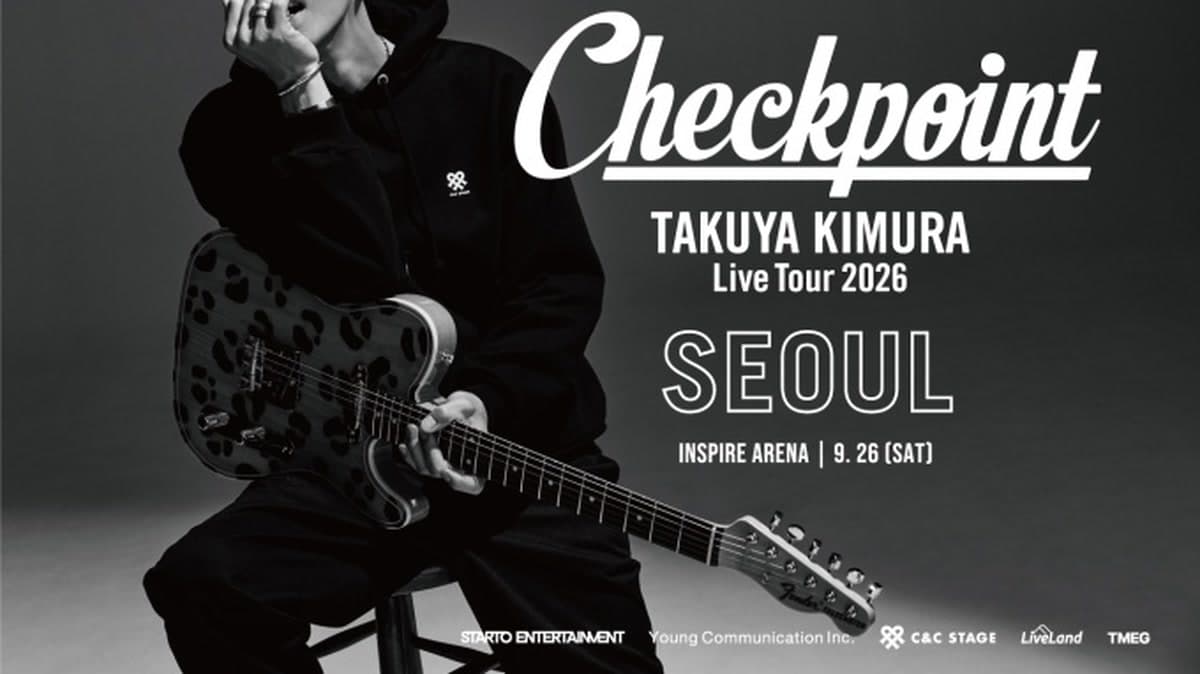
Takuya Kimura is turning a long-awaited fan wish into a date on the calendar: the Japanese entertainment icon will hold his first official solo concert in Korea this September. The Seoul stop matters not only because of Kimura's 38-year career, but because it arrives at a moment when Japanese pop and fan culture are moving onto bigger stages in Korea.
The concert, titled TAKUYA KIMURA Live Tour 2026 Checkpoint in Seoul, is scheduled for September 26 at Inspire Arena in Incheon. Ticket sales open at 7 p.m. KST on June 29 through NOL and NOL World, according to Korean reports citing the event's ticketing details.
For longtime fans, the number attached to this announcement is the headline: 38 years. Kimura began his entertainment career in 1988 as a member of SMAP, the group that became one of Japan's defining pop culture institutions, and later built a parallel reputation as an actor whose dramas helped shape the Asian television boom of the 1990s and 2000s.
A First Korea Concert After Decades Of Demand
Kimura has been familiar to Korean audiences for years, but a full official solo concert in Korea had never materialized until now. That gives the Incheon show an unusual sense of occasion: it is both a fan event and a marker of how far Japanese artists' Korean touring prospects have grown.
The Seoul concert is also being framed as a major step in Kimura's solo career. Korean coverage has described it as his first overseas performance since shifting into solo activities, and as a key stop in his first solo Asia tour. That context turns the show into more than a nostalgic visit by a famous name; it places Korea inside the current phase of Kimura's work as a performing artist.
The choice of Inspire Arena adds to that message. The Incheon venue has become a major destination for large-scale concerts, and the revealed stage plan has already drawn attention among fans. Reports noted a protruding runway-style stage extending deep into the first-floor audience area, a design meant to make the performer feel closer even in a large arena setting.
That detail is important for a performer like Kimura, whose appeal has always depended on closeness as much as scale. His career spans idol performance, television acting, film appearances, variety shows, and fashion influence, but fans often describe the draw in more immediate terms: the charisma of seeing him move, speak, and hold a room in real time.
When the tour was first announced earlier this month, Kimura expressed excitement about meeting fans outside Japan directly as a solo artist. Korean reports paraphrased his message as a hope that the concert would help both sides feel again how precious they are to each other, while also noting his anticipation over breathing the same air with overseas fans after beginning this solo chapter.
Why Korean Fans Know Him As More Than A J-pop Star
Kimura's Korean fan base is not built only on music. For many viewers, the gateway was television. His 1996 drama Long Vacation became one of the titles associated with the early wave of Japanese drama fandom in Korea, while later hits such as Love Generation and Beautiful Life helped cement his image as one of the faces of Japanese screen romance.
That legacy has continued to circulate through Korean pop culture. Yoo Jae-suk recently mentioned Long Vacation on the web variety show Pinggyego, saying he had watched all 11 episodes despite not usually being drawn to romance dramas. The comment revived attention around the drama and showed how Kimura's older work still travels through contemporary Korean entertainment conversations.
Kimura is also remembered in Korea through a warmly localized nickname: "Kim Tak-gu." During a 2007 Korean fan meeting, he reportedly reacted playfully to the nickname, saying it felt natural in Korea because he had noticed so many staff members with the surname Kim. That anecdote has remained part of how Korean fans talk about him, making him feel less like a distant foreign celebrity and more like a familiar figure with his own local fan language.
His broader resume explains why the Seoul concert feels unusually cross-generational. Kimura was a member of SMAP, a group whose influence stretched across music, variety television, and advertising. As an actor, he became a ratings magnet in Japan. He also appeared in Wong Kar-wai's film 2046, extending his profile beyond domestic television and into auteur cinema.
In the 1990s and early 2000s, his hairstyle, clothes, and public image shaped youth trends across parts of Asia. That matters for the Korean concert because the audience is likely to include fans who discovered him in different eras: viewers who watched Japanese dramas through imported broadcasts and online communities, younger fans who know his name through clips and recommendations, and music listeners now more open to Japanese pop acts touring Korea.
The Bigger J-pop Shift Behind The Seoul Stop
Kimura's first official Korea concert comes as J-pop is gaining measurable momentum in the Korean market. One Korean report cited Genie Music data showing J-pop streaming in the first half of this year up 29.5 percent from the same period a year earlier, and up 57.5 percent compared with 2024. In a market where overall annual music consumption has faced pressure, that genre-level growth stands out.
The same trend is visible on stage. Japanese acts that once might have played smaller halls are increasingly appearing at Korean venues with capacities above 10,000 seats. Recent examples cited in Korean coverage include Fujii Kaze at Gocheok Sky Dome, Official Hige Dandism and King Gnu at KSPO Dome, and Vaundy at Inspire Arena.
Kimura's Incheon concert sits directly inside that shift. He is not a new artist testing Korean demand for the first time, but a veteran star whose arrival confirms that the market now has room for Japanese legacy acts, current hitmakers, and fan-driven cross-border projects at the same time.
The Korea-Japan entertainment exchange is also becoming more structured. Japanese artists are increasingly using Korean fan platforms, music shows, short-form content habits, and concert infrastructure to reach wider audiences. Weverse, originally identified strongly with K-pop, now hosts a growing range of Japanese and global artists, reflecting how fan communities have become less bound by national industry lines.
For Kimura, that environment gives the Seoul show a different meaning than it might have had a decade ago. The concert is not simply a one-off visit by a Japanese star; it is arriving in a market where fans already move easily between K-pop, J-pop, Japanese dramas, Korean variety shows, and international fan platforms.
What Fans Can Expect Next
The most immediate focus is ticketing. Sales begin at 7 p.m. KST on June 29 through NOL and NOL World, and the show's first-concert status is likely to be a major selling point for Korean fans who have waited years to see Kimura perform in a full-scale local concert setting.
The stage layout may also shape expectations. A long runway stage suggests the production is designed around proximity, visibility, and audience interaction rather than treating the arena purely as a distant spectacle. For fans who know Kimura through the intimacy of dramas and variety clips, that design could help translate a screen-based attachment into a live performance experience.
There is also a symbolic layer. Kimura's career began before today's streaming-driven fan culture, yet his Seoul concert is being discussed in the language of modern touring: global access, platform ticketing, arena production, and cross-border fandom. That combination gives the event a rare generational span.
If the Incheon show sells strongly, it will reinforce a wider lesson for the regional concert business: Korean audiences are not only interested in the newest viral Japanese acts, but also in artists whose work has shaped decades of Asian pop culture. In Kimura's case, the appeal is not limited to one hit song or one famous drama. It is the accumulated memory of a career that many fans have followed from afar, finally meeting them on a Korean stage.
For now, the simplest fact is also the most powerful one. After 38 years in entertainment, Takuya Kimura's first official Korea concert is no longer a rumor, a wish, or a fan-café question. It has a venue, a date, a ticketing window, and a stage plan built for the kind of close-up moment his Korean fans have been waiting to see.
How do you feel about this article?
저작권자 © KEnterHub 무단전재 및 재배포 금지
Entertainment Journalist · KEnterHub
Entertainment journalist specializing in K-Pop, K-Drama, and Korean celebrity news. Covers artist comebacks, drama premieres, award shows, and fan culture with in-depth reporting and analysis.
Comments
Please log in to comment