The 80s Idol Who's Now 'Just the Cafe Lady' to Gen Z
Lee Sang-ah shares her life running a dog cafe, a bizarre surgeon visit, and why only parents recognize her anymore
 By Jang Hojin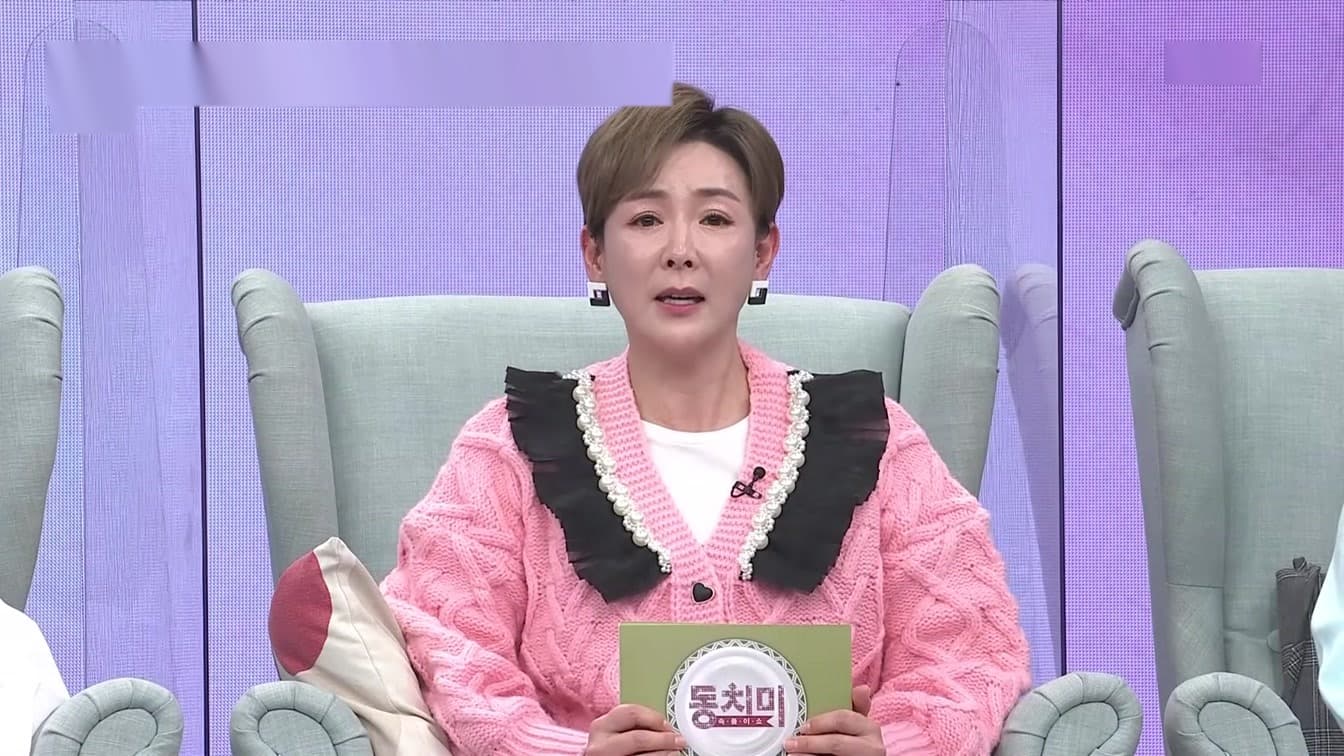
Lee Sang-ah walked onto the MBN variety program Donchimi last week and did what she has always done best — she made everyone in the studio laugh, made them gasp, and then made them reach for their phones. The veteran actress, who spent the 1980s plastered across every commercial break and every teenage bedroom wall in South Korea, has a quiet revelation: these days, she spends most of her time surrounded by dogs. She runs a dog cafe.
The episode, which aired May 2 on MBN, covered the theme of "where does money-making end?" — a question that turned out to be more personally resonant for Lee than anyone anticipated. What followed was a tour through four decades of a career that began when she was thirteen, wound through 500 commercial shoots and a landmark Korean film, and arrived, unexpectedly, at a dog kindergarten somewhere in Gyeonggi Province.
From the Bookmark to the Leash
To understand what Lee Sang-ahs Donchimi appearance meant, you need to understand what she once was. Host Kim Yong-man set the tone immediately: "If this is the era of Jang Wonyoung and Karina, then forty years ago was her era." Co-host Lee Hyun-yi called her "timeless" — or, as Koreans put it, a bang-bu-je mimo, a beauty preserved as if in formaldehyde. Panel member Choi Hong-rim was more specific: "In middle school, the Lee Sang-ah bookmark was the ultimate. She was the biggest fan-magnet of our generation."
In an era before social media or streaming platforms, the laminated plastic bookmark was South Koreas version of the celebrity trading card. Students tucked them between textbook pages. They were traded, argued over, and collected. And for much of the 1980s, Lee Sang-ahs face was on them.
She debuted in 1984 at thirteen — a middle schooler entering the entertainment industry — and a year later appeared in Im Kwon-taeks celebrated 1985 film Gilsodeum, her first major screen role. What followed was a commercial career that she describes as having produced approximately 500 individual shoots: television spots, print campaigns, billboards. "From the time I was eleven or twelve, I was working. I never managed my own money — my mother handled everything. Even now, I have no concept of it," she admitted on the show.
Today, that same woman lives with five dogs in her home and runs a dog cafe and kindergarten outside of it. "At home Im with my five dogs. Outside, Im the aunt to many more," she told the panel. Running a dog kindergarten, she said, is more energy-draining than it sounds. "Being around all those dogs pulls so much out of you," she said. "But the healing they give back is just as enormous."
The Surgeon Who Refused to Fix Her Fortune
Perhaps the most-shared moment from the episode was Lees account of a very unusual appointment at a plastic surgery clinic — one she attended not for vanity, but for financial protection.
Lee has long been a believer in gwansang, the Korean folk practice of reading a persons fate and character through their facial features. After catching a television segment that claimed visible nostrils were a sign of "money leaking out," she looked in the mirror, panicked, and began experimenting with solutions. First, she acquired a nose-shaping clip — a small device marketed for cosmetic purposes — and wore it around the house. "I couldnt breathe," she told the panel flatly. The clip went in the bin.
So she went to the surgeon. Her request, by her own account, was unusual: "I told him I wasnt there to look prettier. I wanted gwansang surgery. My money is leaking out — please block it." The surgeon, roughly the same age as Lee and apparently familiar with her career, refused outright. His reasoning was both practical and, in its way, rather touching. "He told me: if your face changes, the bookmark beauty of our entire generation disappears. He said he absolutely would not do it, and that I should never go looking for another clinic that would." His parting advice, delivered with apparent seriousness: tilt your head down slightly when walking. The nostrils, from that angle, become less visible.
The audience howled. The story spread quickly online after the episode aired, with many viewers pointing out that it captured something quintessentially Lee Sang-ah — self-deprecating, warmly absurd, and somehow both funny and oddly endearing.
The Fee Her Mother Never Mentioned
Behind the laughter, Lee shared something that landed with a quieter kind of weight: the story of her first film paycheck, and the secret her mother kept for years.
Her debut film appearance was in Im Kwon-taeks 1985 drama Gilsodeum, a work that has since become part of the canon of Korean cinema. She was in her second year of middle school. Her appearance fee was one million won — equivalent, Kim Yong-man estimated, to roughly ten million won in todays terms.
Her mother traveled to collect the payment in person, as was common at the time. On the walk home, on a dark and rainy night, it happened: a stranger approached from behind and pressed something sharp against her side, while a second person on a motorcycle swooped in and snatched her bag. The fee was gone.
"She never told me," Lee said. "She was afraid that if I found out at the very start of my career, I would lose all motivation. She hid it completely. I only found out years later." The studio quieted briefly. Panelist Shim Jin-hwa pressed her: could it have been someone who knew about the payment and targeted the family? Lee shook her head. "At the time, I was nobody. I wasnt famous. Nobody would even have known I was an actor."
The story added unexpected texture to an appearance that had otherwise been mostly comedic — a reminder that Lees career, which now reads as one long glamorous highlight reel, was built on something more complicated from the beginning.
When the Parents Recognize You, Not the Customers
Back in the present tense: Lees dog cafe, she acknowledged, presents a specific kind of identity challenge. Her typical customer is in their mid-twenties. That age group, as it turns out, has limited awareness of who she is. They see the woman behind the counter — friendly, clearly put-together, aging in a way that prompts the occasional "you look familiar" comment — and they generally conclude she is the staff.
"The auntie," she said, with a laugh that suggested she has made her peace with it.
The pattern that does produce recognition is generational: a young customer arrives at the cafe with their parents. The customer has no idea who Lee is. The parent does a double-take. "Oh — is that Lee Sang-ah?" The child looks confused. This chain of recognition — mediated through a parents memory — has become a recurring feature of her daily working life.
Panel member Yoon Young-mi speculated that Lees old male fans would surely bring their dogs to visit. Lee considered this. "They cant find me," she said. "They think Im just the staff."
Whether or not the Donchimi episode sends a new wave of curious visitors to her door — with or without dogs in tow — Lee Sang-ah appeared entirely at ease with the life she has built. She manages the kennels, she tilts her head down on the doctors advice, and she lets the former fans discover her through their children. For the woman who once had her face on every bookmark in the country, being briefly unrecognizable seems less like a loss than a particular kind of freedom.
How do you feel about this article?
저작권자 © KEnterHub 무단전재 및 재배포 금지
Entertainment Journalist · KEnterHub
Entertainment journalist specializing in K-Pop, K-Drama, and Korean celebrity news. Covers artist comebacks, drama premieres, award shows, and fan culture with in-depth reporting and analysis.
Comments
Please log in to comment