The Eerie Beauty Behind Salmokji: Production Design and Cinematography
How a reservoir, ghost hunter tools, and a handheld camera created one of Korea's most unsettling horror films
 By Jang Hojin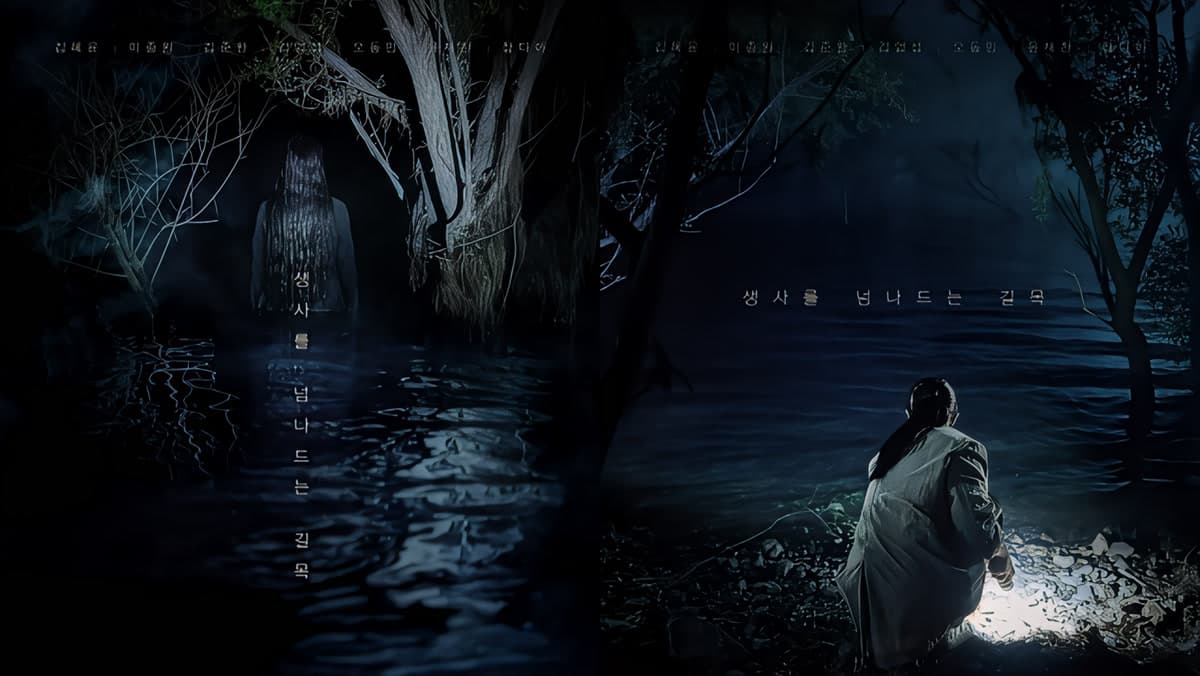
When a horror film uses a 왕버들 — a towering king willow forest whose gnarled branches twist into shapes resembling human heads — as its central setting, it signals that something distinct is at work. Salmokji, the Korean horror film directed by Lee Sang-min and opening April 8, 2026, may be one of the most deliberately unsettling productions to come out of Korea in recent years. The film follows a documentary crew that heads to a rural reservoir to reshoot footage after a mysterious entity appears in their road-view camera recordings. What they find there, lurking in the deep dark water, forms the terrifying heart of the story.
Behind the film's dread lies a careful, painstaking collaboration between art director Ko Seung-hyo and cinematographer Kim Seong-an — two craftsmen who approached the production as a study in spatial psychology rather than conventional horror staging. The result is a film that asks a deceptively simple question: what is scarier — a monster you can see, or the vast, silent space that hides it?
Designing Isolation: Ko Seung-hyo's Philosophy of the Paradoxical Space
Ko Seung-hyo, whose previous work includes the acclaimed Korean film Noise, was tasked with creating a physical environment that could sustain psychological dread across the film's entire runtime. His answer was rooted in a single concept: the paradox of feeling trapped in an open space.
"The paradoxical sense of being isolated in a vast space is the core of Salmokji's horror," Ko said in production notes. He designed the king willow forest around the reservoir not as a claustrophobic enclosure but as an environment that tricks the eye and the mind — wide enough to suggest freedom, yet visually dense enough to feel inescapable. The trees themselves do much of the work. Their enormous, knobbed trunks branch upward in formations that, from the right angle or in the right light, appear disturbingly human — a landscape that seems to watch back.
The reservoir itself is central to the film's visual grammar. Ko made deliberate use of what lies beneath the surface: underwater weeds allowed to grow in flowing, hair-like formations. In the film's underwater sequences, these plants drift and undulate in a way that blurs the line between aquatic life and something humanoid — a subtly skin-crawling visual that builds dread long before anything explicit appears on screen.
Ko also made an unusual decision when it came to props. Rather than fabricating fictional ghost-hunting devices, the production used real equipment employed by actual paranormal investigators: ghost boxes and motion detectors that would be familiar to anyone who has watched ghost hunting television. The decision was deliberate. Authentic equipment grounds the film's found-footage-adjacent premise in a recognizable real-world context, making the crew's vulnerability feel genuine rather than constructed. When a motion detector goes off in Salmokji, the audience intuitively understands what that means — because the device is the same one they've seen on late-night paranormal programming.
The art direction also leans heavily into the stark contrast between day and night at the location. During daylight hours, the king willow forest has an almost peaceful, painterly quality. The light through the canopy dapples across the water. But when darkness falls, the same trees become oppressive architecture — their human-shaped crowns pressing down, their reflections in the black water doubling the sense of encirclement. Ko built the film's horror not by transforming the location but by revealing what was always already there in the dark.
Framing Fear: Kim Seong-an's Camera as a Character
Cinematographer Kim Seong-an brings a distinguished resumé to Salmokji. His prior work includes Pilot, Escape, and the hit ensemble drama Perfect Strangers — films with very different tonal registers. For Salmokji, he adopted a visual strategy that is both technically specific and emotionally purposeful.
The most immediately noticeable element of Kim's approach is his use of the bird's-eye overhead angle at key moments throughout the film. From directly above, human beings look very small against the landscape — and that smallness is exactly the point. Salmokji is, at its core, a film about people encountering something far larger and more ancient than themselves. The overhead shot does not simply illustrate this idea; it embeds it into the viewer's nervous system. When the camera floats above the crew picking their way through the forest or across the reservoir's edge, the audience feels the vast indifference of the space around them.
"I wanted to show small humans overwhelmed by the vast space," Kim explained. The overhead angles work in concert with Ko's production design: from above, the king willow trees form dense, alien patterns across the ground, and the reservoir becomes an eye staring up at the sky. The geometry of the location reveals a different kind of menace when viewed from altitude.
Perhaps more technically demanding is Kim's decision to shoot the entire film handheld — and to maintain a very specific rule throughout. Even in scenes where characters are completely still, the camera continues to move. It is a barely perceptible motion: a slow drift, a gentle sway. But it means that the frame is never truly at rest. The audience is never given the relief of a locked-off, stable image.
"Maintaining the rhythm and tension so the audience follows the story while showing the fear of the confined space together with the characters" was Kim's stated goal. The continuously moving handheld camera creates a subconscious identification between the viewer and the characters — we share their physical instability, their inability to get a firm foothold. It is a technique borrowed from documentary filmmaking and from earlier Korean horror, but deployed here with unusual consistency and purpose.
Location as Co-Star: The King Willow Forest
One of the most striking aspects of Salmokji's production is the degree to which the actual filming location — a king willow forest adjacent to a real reservoir — functions as a narrative element rather than merely a backdrop. Ko Seung-hyo and the location scouts spent considerable time searching for a site that would not require significant artificial augmentation. What they found was a location that arrived pre-loaded with visual menace.
The king willow, known in Korean as 왕버들, is a tree species indigenous to East Asia that grows in wetland environments. Mature specimens develop massive, irregular trunks with deeply furrowed bark, and their upper branches can spread into silhouettes that, especially at night or in fog, bear an unsettling resemblance to a standing human form with arms outstretched. For a film about an entity encountered at a reservoir, the casting of this particular tree species is inspired — the environment itself whispers that something human-shaped might be among the trees.
The production team worked to emphasize the day-night contrast of the location rather than smooth it over. During daylight hours, insert shots and wide establishing images were captured in natural light to document the forest's deceptively benign appearance. Night shooting utilized carefully positioned practical lighting — sources that replicated the crew's flashlights and equipment — to cast the trees in the specific quality of illumination that makes their shapes most humanoid and disturbing.
The reservoir itself required underwater photography for several key sequences. The hair-like weeds Ko Seung-hyo specified were allowed to grow naturally rather than being artificially planted, meaning their movement in the water reflects genuine biological rhythms rather than stage-managed choreography. Kim Seong-an's underwater camera work makes the most of this — holding on the drifting plants long enough for the viewer's pattern-recognition instinct to start seeing things that may or may not be there.
Why Salmokji Matters for Korean Horror
Korean horror has had a significant international moment in recent years, driven partly by the global success of streaming platforms and partly by the distinctive visual and thematic vocabulary that Korean filmmakers bring to the genre. Salmokji arrives at a moment when audiences worldwide are actively seeking out Korean genre films.
What distinguishes Salmokji within this context is its willingness to prioritize atmosphere and spatial dread over jump scares and gore. The creative choices made by Ko Seung-hyo and Kim Seong-an — the paradoxical isolation of the open space, the human-shaped trees, the real ghost equipment, the never-still camera — add up to a film that works on the viewer's subconscious rather than their adrenal system.
Director Lee Sang-min has assembled a creative team that clearly shares a unified vision: horror emerges not from what is shown but from what the space implies. The reservoir has always had something in it. The trees have always looked like that. The camera has always been slightly uncertain. By the time the entity in the deep dark water makes itself known, the audience has already been living in its world for ninety minutes.
Salmokji opens in Korean theaters on April 8, 2026. For audiences drawn to the more cerebral, atmospheric strain of Korean horror — think the slow-burn spatial dread of The Wailing or the location-as-character approach of The Witch — it represents a compelling new entry in the genre.
How do you feel about this article?
저작권자 © KEnterHub 무단전재 및 재배포 금지
Entertainment Journalist · KEnterHub
Entertainment journalist specializing in K-Pop, K-Drama, and Korean celebrity news. Covers artist comebacks, drama premieres, award shows, and fan culture with in-depth reporting and analysis.
Comments
Please log in to comment