The Real Reason Korea's Top Domestic OTT Stopped Making Dramas
Wavve produced just one original drama in all of 2026. Behind the silence is a crisis of skyrocketing actor fees, a stalled merger, and a platform running out of options.
 By Jang Hojin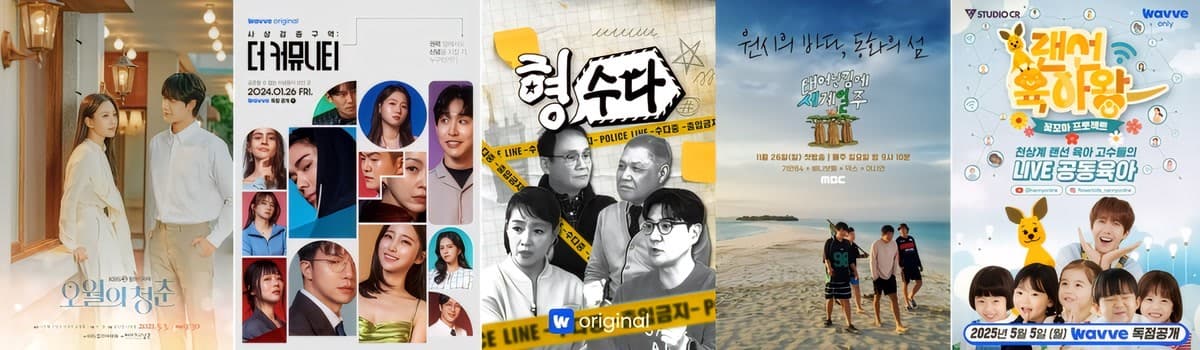
Earlier this year, Wavve (웨이브) — once the dominant force in South Korea's domestic streaming landscape — released a mystery thriller called "Reverse" (리버스): an eight-episode series that premiered in February 2026. It was a competent show. It was also, almost certainly, the last original drama Wavve will produce this year.
In a country where the drama industry has become one of the nation's most powerful cultural exports, producing exactly one original drama across an entire calendar year is the kind of statistic that prompts a single word from industry insiders: "Unprecedented." The shorthand circulating in Korean entertainment circles is more blunt: "역대급" — a level of failure so extreme it's difficult to describe in ordinary terms.
Understanding how Wavve got here requires looking at forces that have been reshaping Korean entertainment for years — and accelerating, at a pace no one fully anticipated, since 2023.
How Korean Actor Fees Became Untouchable
The cost of a top Korean actor's time was already climbing sharply when Netflix first began producing original Korean content at scale. The streaming giant's willingness to pay premium fees — by 2024, top-tier leads on Netflix projects were reportedly commanding as much as 4 billion to 5 billion Korean won (approximately $3 million USD) per episode — fundamentally reset market expectations for what A-list talent was worth.
The math cascaded quickly. If Netflix was paying 400 million to 500 million won per episode for a marquee actor, why would that actor settle for significantly less on a domestic platform? And if the domestic platform couldn't match those rates, how could it attract the same caliber of talent that drives viewership?
By the time this logic had fully worked its way through the Korean industry, drama production budgets had ballooned past recognition. Industry figures cited in multiple Korean media reports suggest that the minimum production cost for a full Korean drama series now sits between 20 billion and 30 billion won — with top-end productions running significantly higher. One industry analyst quoted by Herald Economy noted that some lead actors are now commanding fees comparable to A-list talent in American prestige television.
The ripple effects extended beyond actor fees. Directors, writers, and production designers found themselves renegotiating their own rates against this new benchmark. Equipment and post-production costs climbed to match the ambition of larger budgets. And the overall pressure to produce content that could compete visually and narratively with Netflix's global productions created a quality arms race that smaller platforms had no real way to win.
For international comparison: Netflix continues to release 10 or more original Korean dramas annually. Disney+ maintains a comparable production pace. These companies can absorb high per-episode costs across enormous subscriber bases that span dozens of countries. For a domestic platform whose viewers are almost entirely in one country, the economics simply do not scale the same way.
Why Wavve Is the Hardest Hit Platform
To understand why Wavve has been hit harder than its domestic competitors, it helps to understand the company's unusual structural position.
Wavve is owned by a consortium: SK Telecom, the largest mobile carrier in South Korea, holds a major stake, while the three major Korean terrestrial broadcasters — KBS, MBC, and SBS — together hold the remainder. The arrangement made sense when the platform launched: Wavve would serve as a home for the broadcasters' existing content libraries, supplemented by original productions that could compete with international entrants.
The problem is that this same arrangement has complicated Wavve's ability to move decisively. The terrestrial broadcasters' primary business model remains advertising-supported linear television. Content produced for Wavve could, in some configurations, compete directly with their own broadcast schedules. The incentive structure is misaligned in ways that make aggressive original production politically difficult, even setting aside the financial burden.
Meanwhile, competitors like Coupang Play have the backing of an e-commerce giant with deep pockets and a subscriber base primed for bundled services. TVING, backed by CJ ENM and primarily distributing content from cable television's largest operator, benefits from a more coherent ownership structure and a clearer content pipeline. Both platforms have moved past Wavve in Korean domestic market share — a reversal that would have seemed nearly impossible just a few years ago, when Wavve was the consensus choice for domestic streaming leadership.
The subscriber numbers tell the story clearly. Wavve's monthly active user base, which once reached 6 million, has declined to approximately 3.8 million — a drop of more than 35%. The platform's own losses have accumulated past 200 billion won, a figure that represents years of betting on a market position it has since been unable to maintain.
Compounding all of this: Wavve's content pivot toward variety shows. Without the budget to produce dramas, the platform has shifted its original content investment toward variety programming — significantly cheaper to produce, and capable of generating engagement without the same upfront commitment. The lineup for 2026 is heavy with variety content. Viewers looking for the kind of original drama storytelling that once made Wavve a must-subscribe platform have been coming up empty.
The Stalled Merger That Could Have Saved Everything
The proposed merger between Wavve and TVING has been discussed for nearly two years. On paper, the logic is obvious: combining two domestic streaming platforms would create a competitor with enough scale to negotiate better talent fees, absorb production costs across a larger subscriber base, and present a unified front against international entrants. Industry analysts have consistently called it a strategic imperative.
The deal has not happened.
The central obstacle is KT Corp. — South Korea's second-largest telecommunications company and the second-largest shareholder in TVING. KT has opposed the merger, and its reasons are a matter of ongoing speculation in Korean entertainment media. Some analysts have pointed to concerns about competitive dynamics in the telecom sector. Others have suggested that KT sees more value in maintaining TVING as a separate negotiating asset. The result, regardless of the underlying logic, is a two-year deadlock that has allowed Wavve's position to deteriorate while the conversation continues without resolution.
Industry observers have grown increasingly urgent in their assessments. Every month that passes without a merger is a month in which Wavve loses subscribers, misses content cycles, and falls further behind its competitors. The efficiency gains from combining two platforms' operations — shared marketing budgets, unified licensing deals, consolidated content pipelines — diminish in value with each delay. By the time a merger is eventually consummated, if it ever is, it may be addressing a much weaker asset than the one that first entered the conversation.
One unnamed industry figure quoted in Korean media summarized the situation with characteristic directness: "The longer this takes, the less there is worth merging."
What This Means for Korean Drama Viewers
For the audiences who have built their streaming habits around Korean content, the decline of Wavve has practical implications that go beyond corporate strategy.
Wavve's original drama slate, at its peak, gave viewers content that couldn't be found on Netflix or TVING — projects that prioritized different tones, genres, and storytelling approaches. Shows like "ONE: High School Heroes" and "S-Line" represented a distinct creative voice, filling gaps in a market where Netflix's Korean output, however impressive, has its own aesthetic tendencies and commercial pressures.
When a platform stops making original dramas, the content ecosystem narrows. Fewer production companies get greenlit. Fewer writers and directors find development pathways for their projects. The talent that might have gone into a Wavve drama — actors, crews, composers — either migrates toward the remaining active platforms or, in some cases, waits for the market to stabilize. These effects compound over time and are not easily reversed once the production infrastructure has scattered.
For international fans of Korean drama — a community that has grown dramatically over the past five years, particularly in Southeast Asia, Latin America, and English-speaking markets — the calculus is slightly different. Most international viewers access Korean content through Netflix or YouTube, where Wavve's absence is less directly felt. But the health of the domestic production ecosystem ultimately determines the volume and variety of Korean content that reaches global platforms. A contracted domestic industry means a contracted pipeline for everyone.
A Comparative Look: Lessons From the Competition
The contrast between Wavve's trajectory and that of its domestic rivals illuminates what the platform might have done differently — and how narrow the window for correction has become.
TVING, Wavve's closest domestic competitor, made a defining bet several years ago: deepen its integration with the cable television ecosystem rather than treat it as a liability. CJ ENM, TVING's primary backer, owns tvN — the cable network responsible for many of the most critically acclaimed Korean dramas of the past decade, from Crash Landing on You to Twenty-Five Twenty-One. Rather than competing with those properties, TVING co-produces and cross-distributes them, ensuring that its platform carries premium content while sharing the production risk with a partner that has its own commercial incentive to see that content succeed. The result: TVING's original drama production has continued, albeit at reduced volume, even as budgets across the industry have climbed.
Coupang Play took a different path: acquisition and sporting rights. By securing exclusive broadcasting rights to major football leagues and high-profile live events, the platform built a distinct subscriber value proposition that drama and variety content alone cannot replicate. Subscribers who came for live sports encountered Coupang Play's growing original content library. The conversion rates have reportedly exceeded the platform's internal projections. As of early 2026, Coupang Play has surpassed Wavve in the number of paying subscribers — a symbolic milestone that underscores how much ground Wavve has conceded.
What both rivals demonstrated, in different ways, is that survival in the current Korean streaming market requires either a structural content advantage that reduces per-production costs or a complementary product offering that reduces dependence on drama as a subscriber driver. Wavve, boxed in by its ownership structure and unable to execute on the merger that would have given it scale, has had access to neither. Its drama production slowdown is as much a symptom of strategic paralysis as it is a response to cost pressure — the two problems are, at this point, impossible to fully separate.
Industry analysts have begun framing Wavve's situation not as a company in crisis, but as a company in transition — one whose current difficulties are the predictable result of structural mismatches that were apparent long before 2025. The question, as several Korean entertainment commentators have framed it, is not whether Wavve needs to change its model, but whether it still has the runway to do so before the market completes its consolidation around two or three dominant players.
The Road Ahead for Korean Streaming
The structural problems that have weakened Wavve are not unique to Wavve. The entire Korean domestic streaming sector is navigating a set of challenges — inflated production costs, intensified international competition, fragmented ownership structures — that have no easy solutions.
Some version of consolidation seems inevitable. Whether Wavve and TVING eventually merge, or whether one platform is eventually absorbed into a larger entity, or whether one of the major telecom companies decides to rationalize its streaming holdings is a question that Korean entertainment industry insiders continue to debate. What seems clear is that the current structure — multiple underfunded domestic platforms competing with each other while simultaneously trying to compete with Netflix — is not sustainable at scale.
There is also a growing conversation within the Korean entertainment industry about actor fee norms. Several production companies have quietly begun exploring ways to structure deals differently — revenue sharing arrangements, deferred compensation models, equity stakes in content — in an attempt to attract top talent without committing to per-episode fees that make budgets structurally unworkable. These experiments are early-stage and unproven, but they reflect a genuine search for alternatives.
For now, Wavve's situation serves as the clearest possible illustration of what happens when those alternatives aren't found in time. One drama in 2026. Three-point-eight million monthly users. Two hundred billion won in losses. And a merger that, two years in, remains unresolved.
The platform that once led Korean streaming still has a path forward. But the distance between where it is and where it needs to be has never been wider.
How do you feel about this article?
저작권자 © KEnterHub 무단전재 및 재배포 금지
Entertainment Journalist · KEnterHub
Entertainment journalist specializing in K-Pop, K-Drama, and Korean celebrity news. Covers artist comebacks, drama premieres, award shows, and fan culture with in-depth reporting and analysis.
Comments
Please log in to comment