Why MAMAMOO’s 4WARD Comeback Is a Bigger K-Pop Test
The group’s June 4 single and sold-out Seoul run show how mature K-pop acts can turn reunion demand into a forward strategy.
 By Park Chulwon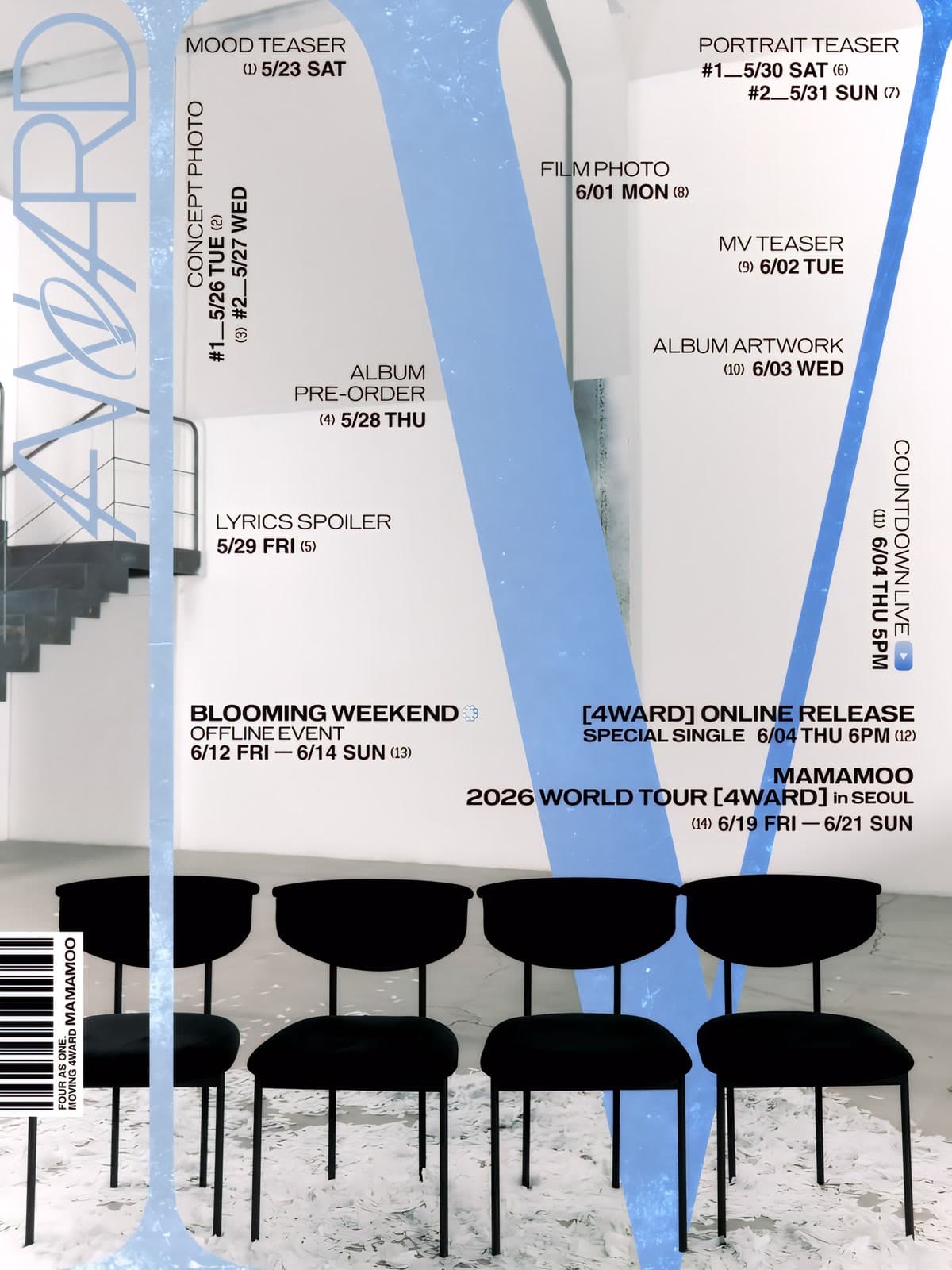
MAMAMOO's 4WARD is more than a reunion notice. The group is using a June 4 special single, a tightly staged teaser calendar, and a sold-out Seoul concert run to test how a mature K-pop act can restart as a full team without pretending the last four years did not happen.
The core fact is simple: Solar, Moonbyul, Wheein, and Hwasa are returning as MAMAMOO with the special single 4WARD, led by the title track 4 Flowers, after their last full-group release, MIC ON, in October 2022. Korean reports and international coverage place the new release at 6 p.m. KST on June 4, with the first leg of MAMAMOO 2026 WORLD TOUR [4WARD] opening in Seoul from June 19 to 21.
But the more important story is strategic. This article analyzes how MAMAMOO's 4WARD turns a long-awaited reunion into a test of K-pop's mature-group economy, from comeback pacing to tour demand. In an industry built around relentless novelty, the group is betting that continuity, vocal identity, and solo-grown fandoms can still behave like growth assets.
The Comeback Is Built Around Absence, Not Nostalgia
The obvious temptation is to frame 4WARD as a sentimental return. That would be too small. MAMAMOO debuted in 2014 under RBW, became one of third-generation K-pop's most recognizable vocal groups, and built its reputation around live performance, bright personality, and a less standardized idol-group texture. Those traits matter now because the comeback is arriving in a market where older groups often return as anniversary products rather than active competitors.
The timeline gives the comeback its pressure. MIC ON arrived in October 2022, which means 4WARD lands after roughly 44 months without a full-group release. During that gap, the four members did not disappear. They moved through solo music, unit work, television, festivals, and individual brand activity, keeping separate fan channels warm while leaving the full-team identity scarce.
That scarcity is the point. Instead of asking fans to remember MAMAMOO exactly as they were, 4WARD asks whether the group can reconvene with more individual capital than it had before the pause. The name helps carry that argument: the number four signals the members, while "forward" makes the reunion sound like movement rather than restoration. So what looks like a comeback slogan is also a positioning statement.
That context explains why the teaser rollout has attracted attention beyond the usual pre-release cycle.
A Slow Rollout With Fast Market Signals
RBW's campaign has been unusually legible. The scheduler points to a mood teaser on May 23, concept photos from May 26 to 27, album pre-orders on May 28, a lyric spoiler on May 29, portrait teasers on May 30 and 31, a film photo on June 1, an MV teaser on June 2, album artwork on June 3, and the online release on June 4. It is a compact twelve-day runway, not a sprawling month-long campaign.
That compression matters. For younger groups, long teaser cycles often function as world-building. For MAMAMOO, the asset is not mystery. It is confirmation. Fans already know the voices, the chemistry, and the group's performance grammar, so the campaign can spend fewer days explaining who they are and more days proving that the four-member signal is active again.
The tour data gives the campaign its sharper edge. Multiple Korean reports say the Seoul opening run, scheduled for June 19 through 21 at Olympic Hall, sold out all three performances during fan-club presales. A three-show sellout before the single is released does not prove the song will dominate charts. It proves something else: the group's live-demand base is still organized enough to convert anticipation into tickets before the full music narrative has arrived.
The chart shows why the strategy is efficient: the campaign moves from first mood signal to release in 12 days, then to the first Seoul concert in 27 days. That is not just scheduling. It creates a short feedback loop where digital attention, pre-order interest, and live demand reinforce one another before the conversation has time to cool.
Yet the strongest part of the plan may be what it does not overclaim.
Why 4WARD Fits the Mature-Group Moment
K-pop reunions used to be treated as exceptions. In 2026, they look more like a recurring business model. The market has learned that a group can pause, let members build separate artistic identities, and then return with a higher-value full-team moment if the original brand remains emotionally clear. MAMAMOO is well suited to that model because its appeal was never limited to a single concept cycle.
The group's differentiator is still vocal trust. MAMAMOO's public image has long rested on the idea that the members can sing live, improvise with confidence, and turn variety-show ease into stage charisma. That gives 4 Flowers a different burden from a rookie-group title track. It does not need to introduce a universe. It needs to make the reunion feel musically necessary.
The title 4 Flowers points in that direction. It suggests individuality inside a shared frame, which is exactly the problem a mature group must solve. If the song leans too heavily on nostalgia, it risks sounding like a souvenir. If it ignores the intervening solo years, it wastes the growth that makes this comeback commercially interesting. The sweet spot is a track that lets each member's current identity be heard while still landing as a MAMAMOO record.
That is why the Seoul sellout matters more than the headline suggests. Three presale-sold-out shows are not merely proof of loyalty; they are proof that fans still understand MAMAMOO as a live unit. In a streaming-first environment, that live-unit identity is valuable because concerts convert affection into high-intent behavior. It is harder to fake than a trending tag.
There is also a global layer. Reports describe the Seoul concerts as the start of a tour through major cities in Asia and the Americas. That routing reflects a broader K-pop reality: older acts with established catalogs can use touring to monetize depth, while newer acts often rely on explosive discovery. MAMAMOO's catalog gives 4WARD a base; the new single gives the tour a current reason to exist.
Fan Reaction Is Really a Demand Test
Fan responses quoted in Korean coverage have centered on relief, anticipation, and the emotional weight of seeing the four members together again. That reaction is predictable, but it should not be dismissed as mere sentiment. For a group returning after a long full-team gap, emotional clarity is a commercial signal.
The reason is simple. A reunion campaign has to answer two questions at once: do fans still care, and can that care move quickly? The available evidence says yes on the second question, at least in Seoul. Presale momentum arrived before the single's release, which means fans were buying the full-team promise as much as the new-song promise.
That creates pressure, too. A sold-out opening run raises expectations for the June 4 single. If 4 Flowers sounds too cautious, the campaign may feel like a tour announcement with a soundtrack attached. If it sharpens the members' strengths into a clear adult-pop identity, 4WARD could become a template for how third-generation groups re-enter the center lane without chasing fourth- or fifth-generation aesthetics.
The next measure will be whether the music can match the architecture around it.
What Comes After June 4
The immediate outlook is straightforward: 4WARD arrives on June 4, the Seoul concerts begin on June 19, and the tour is expected to continue through Asia and the Americas. Those dates give MAMAMOO a narrow but powerful window to turn comeback curiosity into sustained performance demand.
The larger question is whether 4WARD becomes a single-era celebration or the start of a durable second phase. If the song translates the members' solo maturity into a coherent group sound, MAMAMOO will have done more than satisfy longtime fans. They will have shown that the mature K-pop group is not a nostalgia category. It can still be a forward business.
How do you feel about this article?
저작권자 © KEnterHub 무단전재 및 재배포 금지
Entertainment Journalist · KEnterHub
Entertainment journalist focused on Korean music, film, and the global K-Wave. Reports on industry trends, celebrity profiles, and the intersection of Korean pop culture and international audiences.
Comments
Please log in to comment